
In-Ear vs Half-In-Ear vs Open-Ear Earbuds: Which Is Best for You?
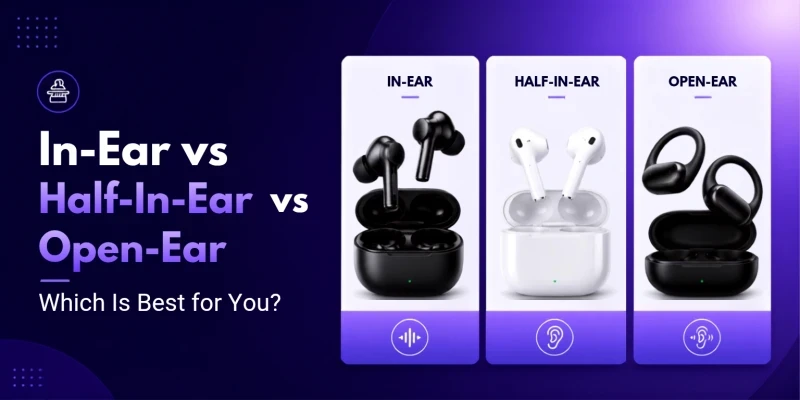
Earbuds may look similar in product photos, but their fit changes how they sound, how much outside noise you hear, and how comfortable they feel. The three common designs are sealed in-ear, half-in-ear or semi-in-ear, and open-ear. None is automatically best. The right choice depends on where you listen, how much isolation you need, and whether you prefer stronger bass or better awareness of your surroundings.
For a wider checklist covering budget, sound, battery, microphones and features, read our complete earbuds buying guide in Bangladesh.
In-Ear, Half-In-Ear and Open-Ear: What Do the Labels Mean?
In-ear (sealed)
These earbuds use silicone or foam tips that sit at the entrance of the ear canal and create a seal. That seal provides passive noise isolation, helps active noise cancellation work more effectively, and usually produces fuller bass. Examples include Nothing Ear (a), realme Buds Air 6 Pro, and OnePlus Buds 4. The trade-off is that some listeners feel pressure or notice the occlusion effect—the plugged sensation that can make your own voice and footsteps sound louder.
Half-in-ear (semi-in-ear)
These earbuds rest in the outer ear without a silicone tip sealing the canal. Examples include Apple AirPods 4 and SOUNDPEATS Air5. They usually feel lighter and allow more outside sound to enter, but bass and isolation vary more with ear shape. Some modern half-in-ear models do offer ANC, although it is generally less effective and less consistent than ANC from a well-sealed in-ear model.
Open-ear (clip, hook or air-conduction)
These earbuds keep the ear canal open. A speaker sits near the ear opening and directs sound toward it. Examples include QCY Crossky C30 and EarFun Clip. They are designed for comfort and situational awareness rather than isolation. Bass is usually lighter than on sealed in-ear earbuds, and sound leakage can increase at higher volumes.

Quick Comparison
|
Feature |
In-Ear (Sealed) |
Half-In-Ear (Semi-Open) |
Open-Ear (Clip-On) |
|
Noise isolation |
High |
Low to moderate |
Minimal |
|
Bass |
Strongest |
Moderate |
Weakest |
|
Awareness of surroundings |
Low |
Moderate |
High |
|
Long-wear comfort |
Depends on tip fit |
Good for most ears |
Very good |
|
Best for |
Commute, ANC, calls |
Casual daily use |
Running, cycling, office |
|
Workout stability |
Good with wing tips |
Can loosen |
Usually secure |
|
BD price range |
৳2,500 to ৳18,000 |
৳2,000 to ৳16,000 |
৳2,000 to ৳6,500 |
Sound Quality and Bass
Fit and acoustic design strongly affect sound. A sealed in-ear earbud reduces low-frequency leakage, so bass usually feels deeper and more consistent. Half-in-ear and open-ear models lose more low-frequency energy to the surrounding air, although larger drivers, digital signal processing, and EQ can improve their bass response. Even so, a sealed model will usually deliver stronger sub-bass than an open model at a similar price.
Noise Isolation and Active Noise Cancellation
A secure seal gives ANC a major advantage because it passively blocks sound and creates a more predictable acoustic space. However, a seal is not an absolute requirement: AirPods 4 with Active Noise Cancellation and SOUNDPEATS Air5 show that half-in-ear designs can use ANC. The important distinction is performance. Open-fit ANC usually reduces less noise—especially higher-frequency voices and sudden sounds—than a good sealed in-ear model. ENC, by contrast, mainly processes microphone audio for clearer calls and does not cancel noise for the listener.
For buses, flights, offices, or other noisy places, sealed in-ear earbuds with effective ANC remain the safest recommendation for isolation. For outdoor exercise, an open-ear design can make it easier to notice traffic and people, but it does not guarantee safety. Keep the volume low, stay alert, and follow local road and cycling rules.
Comfort and Fit
Comfort is personal. In-ear earbuds depend on choosing the correct tip size: a tip that is too large can create pressure, while one that is too small may feel loose and weaken bass and ANC. Half-in-ear earbuds avoid silicone-tip pressure but may not fit every outer ear securely. Open-ear clips and hooks keep the canal free, which many people prefer for long sessions, although some clips can pinch and some hooks may interfere with glasses.
Battery Life and Durability
Battery life depends more on the model, codec, volume, call use, and ANC setting than on the earbud category. ANC and high-resolution codecs such as LDAC or LHDC usually reduce playback time. For example, Nothing rates Ear (a) at up to 42.5 hours with the case under its test conditions, while QCY officially rates the Crossky C30 at up to 25 hours total. For workouts or light rain, check the exact IP rating of the earbuds—not the case—and remember that water resistance can weaken with age and wear.

Where Each Type Works Best
Commuting and travel: Sealed in-ear earbuds are usually the best option because passive isolation and ANC work together. ANC is particularly useful against steady low-frequency sounds such as engines, fans, and road rumble, although sharp horns and nearby voices may still come through.
Exercise: For an indoor gym, sealed earbuds can provide stronger bass and a secure fit if the shape suits your ears. For running or walking outdoors, open-ear or half-in-ear models improve awareness, but you should still keep playback at a moderate level and check traffic visually. You can also compare the best earbuds for gym and running based on fit, stability and water resistance.
Office calls: Half-in-ear and open-ear earbuds can feel more natural when you need to hear colleagues, doorbells, or announcements. Sealed earbuds may provide clearer listening in a noisy office, especially when they include transparency mode and a capable microphone system. You can also compare the best earbuds for office and online classes
Cycling or walking near traffic: Prioritise awareness, use the lowest practical volume, and avoid assuming that any earbud design makes road use automatically safe.
Approximate Prices in Bangladesh (Checked July 2026)
Which Type Should You Buy?
Choose sealed in-ear earbuds when your priorities are stronger bass, effective ANC, commuting, gaming, or listening in noisy places. Choose half-in-ear earbuds when you dislike silicone tips and want a balance of comfort, sound quality, and awareness. Choose open-ear earbuds for long wear, outdoor awareness, light office listening, and workouts where keeping the ear canal open matters more than deep bass or isolation.
There is no universal winner. Fit varies from person to person, and two earbuds with the same design can perform very differently. Whenever possible, check the return policy or try the fit before buying. Also compare the actual battery figure with ANC on, codec support, IP rating, microphone quality, warranty, and app features—not only the advertised maximum numbers.
For better long-term performance, learn how to clean earbuds safely and follow proper charging and storage practices. After deciding which design suits your routine, compare current stock and warranty terms by browsing all earbuds in Bangladesh. Prices can change quickly, so confirm the final price and official or seller warranty before ordering.
Frequently Asked Questions
Not necessarily bad, but they usually deliver less sub-bass than sealed in-ear earbuds. Some models use larger drivers and bass-enhancement algorithms, but the open design still allows more low-frequency energy to escape.
AirPods 4 with Active Noise Cancellation and SOUNDPEATS Air5 are examples. However, ANC performance in an open-fit or half-in-ear design is usually less consistent than in a properly sealed in-ear model.
A well-fitted clip or ear hook can be very secure, but fit depends on ear size, glasses, hair, and the specific design. Try the fit or buy from a seller with a clear return policy whenever possible.
Open-ear earbuds generally preserve more environmental awareness, but no earbud makes running near traffic risk-free. Keep the volume low, look carefully before crossing, and follow local safety rules.
No. Price depends on brand, drivers, ANC, microphones, codecs, app support, battery life, and warranty. Budget in-ear earbuds can cost less than premium open-ear models.
There is no reliable category winner. Compare each model using the same conditions—ANC on or off, codec, volume, and earbuds-only versus total battery with the charging case.
Many are sweat-resistant, but ratings vary. IPX4 or IP54 can cover typical sweat and light splashes, while the charging case is often not water-resistant. Check the exact specification before use.
In-ear earbuds are usually the better choice for immersive sound, stronger bass, and reduced distraction. For competitive gaming, latency and device compatibility matter more than ANC, so check the tested or advertised low-latency mode and codec support.