
Does Driver Size Matter? 10mm vs 13mm Drivers in Earbuds
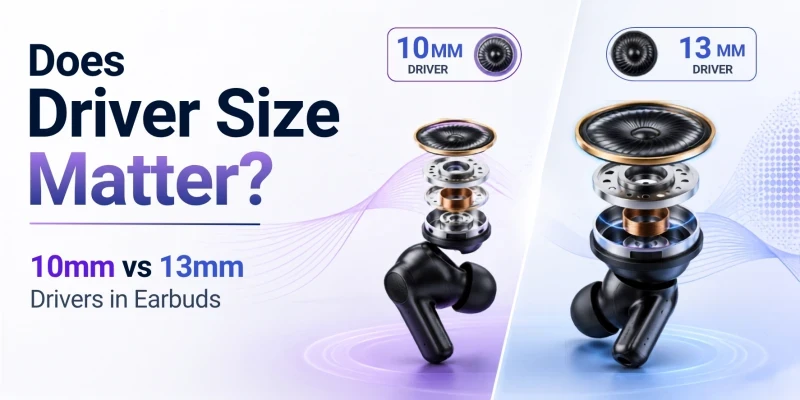
Driver size is one of the most misunderstood specs in the earbud market. Walk into any online shop, and you'll find brands advertising 13mm, 14.2mm, even 16mm drivers as proof of better audio performance. The reality is more complicated and interesting than what the market suggests.
This guide explains what earbud drivers actually do, how size affects different aspects of sound, and when driver size matters versus when it's just a number on the box. If you are also comparing connectivity specs, our Bluetooth 5.0 vs 5.3 guide explains which Bluetooth changes actually affect latency, stability, and battery life.
What is an Earbud Driver?
A driver is the component inside an earbud that converts electrical signals into sound. Think of it like a tiny little speaker. When audio data arrives at your earbud, the driver vibrates to produce the sound waves you hear.
The driver size you see on the spec sheet refers to the diameter of that component in millimeters. A 10mm driver has a 10mm diameter, and a 13mm driver has a 13mm diameter. That's the full extent of what the number tells you.
How Earbud Drivers Work
Most wireless earbuds use dynamic drivers, also called moving-coil drivers. The design has three main parts: a permanent magnet, a voice coil, and a diaphragm attached to the coil.
When electric current flows through the voice coil, it interacts with the magnetic field, pushing the diaphragm back and forth. That movement changes pressure in the air, which we hear as sound. Quick movement produces high-frequency sound (treble); slow, large movement produces low-frequency sound (bass).
The diaphragm sits at the center of this. Its size, mass, stiffness, and material all affect how it responds to the voice coil and, therefore, what the audio sounds like.
10mm vs 13mm Drivers: Key Differences
The difference between a 10mm and a 13mm driver lies in the diaphragm area. Using some geometry:
10mm driver: area = π × (5mm)² ≈ 78.5 mm²
13mm driver: area = π × (6.5mm)² ≈ 132.7 mm²
That's almost a 70% increase in diaphragm area. More surface area means the driver can push more air. Bass output is directly dependent on air movement. Low-frequency sound waves are large and require significant air movement to feel physically impactful.
So far, the 13mm driver has the physical advantage. Where things get complicated is everything else: what the diaphragm is made of, how stiff it is, how strong the magnet is, and , critically, how the entire acoustic housing is designed around it.
Here's how they compare across key dimensions:
Does Bigger Mean Better?
Not by default. This is where the marketing misleads customers.
A 13mm driver with a thin, poorly damped diaphragm and a weak magnet can sound noticeably worse than a precision-engineered 10mm driver with quality materials and careful acoustic tuning. Driver size isn't everything. The QCY HT10 AilyBuds Pro and Hoco EQ34 Plus TWS use different driver sizes, but a larger driver doesn't automatically mean better sound. Audio tuning, codec support, and overall acoustic design have a much greater impact on sound quality than driver size alone.
Budget brands know that most buyers just look for bigger numbers. A 13mm driver is an easy way to show "more", but it doesn’t actually deliver better sound. Premium brands invest in materials and engineering instead, which is why you rarely see them advertising driver size.
Driver size is only one part of sound performance. You should also understand how Bluetooth audio codecs such as SBC, AAC, aptX, and LDAC affect wireless sound quality.

How Driver Size Affects Bass, Vocals, and Clarity
Bass: A larger diaphragm is advantageous for low-frequency sounds. Bass waves are long, slow oscillations that require significant air displacement to feel impactful in the ear canal. A 13mm driver has more area to do that. At the same build quality and price point, a 13mm driver typically produces deeper, fuller bass than a 10mm driver. This is simply physics, but it only holds when everything else is equal. A well-tuned 10mm driver in a properly designed housing can match or beat a poorly tuned 13mm one.
Midrange and vocals: Driver size does not directly influence midrange reproduction. Vocal clarity depends more on diaphragm damping, material quality, and tuning. A light, responsive diaphragm interprets the complex waveforms of human voices more accurately than a heavy, underdamped one. Many budget earbuds with large diaphragms struggle with vocals because the bass seeps into the mids.
Treble: This is where larger drivers face a physical disadvantage. Higher-frequency sounds require the diaphragm to move faster. A larger, heavier diaphragm has greater inertia and is slower to respond to rapid changes in signal. Small balanced drivers are used specifically for treble in high-end multi-driver earphones precisely because of this. A 13mm dynamic driver covering the full frequency range may roll off at higher frequencies more than a smaller, lighter driver would.
Clarity and detail: Detailed reproduction depends on driver quality (materials, magnets, tolerances) rather than on size. Premium earbuds from Sony, Jabra, and Apple consistently outperform many 13mm budget options on clarity, despite using smaller drivers. Better engineering wins over raw dimensions. If an earbud suddenly sounds muffled or loses detail, a blocked speaker mesh can imitate a driver problem, so check our guide on how to clean earbuds safely before assuming the hardware is faulty.
Soundstage: In-ear earbuds have a naturally narrow soundstage regardless of driver size, because the ear canal is a confined space with limited acoustic room. Driver size has little effect on perceived soundstage in such earbuds. Open-back over-ear headphones have a structural advantage here that no earbud driver size can replicate.

Why Premium Earbuds Use Smaller Drivers
People are often surprised to learn that high-end earbuds tend to have smaller drivers. A few reasons explain this:
Fit and housing design: A larger driver requires a larger housing. Larger housings fit fewer ear shapes comfortably and can be harder to seal properly. Poor seal is the single biggest hindrance to bass response, even worse than driver size. Premium brands prioritize ergonomics because fit matters more than spec sheet numbers. Users who struggle with bulky earbud housings should learn how to choose earbuds for small ears
Material investment: At higher budgets, manufacturers use better diaphragm materials: beryllium-coated polymer, liquid crystal polymer, and carbon fiber composites. These materials improve the rigidity-to-weight ratio, which directly improves sound across the frequency range in ways that increasing driver size cannot.
Multi-driver configurations: Some premium IEMs (in-ear monitors) use multiple small specialized drivers instead of one large driver. A balanced armature driver handles highs, another handles mids, and a small dynamic driver handles bass. Each driver does one job and does it precisely. This approach produces better performance than any single large driver.
Acoustic engineering: At premium price points, the housing design (port placement, size, damping material)contributes as much to sound quality as the driver itself. An 8mm driver in an expertly designed housing can produce better bass than a 13mm driver in a cheap plastic shell.

Best Driver Size for Different Users
Music Lovers
If you listen to a wide range of genres like pop, rock, jazz, classical, sound quality and tuning accuracy matter more than driver size. Look for earbuds with a balanced or neutral frequency response rather than chasing a large driver number. For bass-heavy genres like hip-hop and EDM, a 13mm driver from a reputable brand at a mid-range price point delivers more physical impact. Just make sure the bass doesn't get into the mids.
Driver size alone cannot tell you whether an earbud will sound balanced or bass-heavy. Compare the best earbuds for music based on tuning, codec support, clarity, and overall sound signature.
Gamers
Driver size has minimal effect on gaming audio. Latency and directional accuracy matter far more. A 10mm driver in earbuds with aptX Low Latency support is more useful for gaming than a 13mm driver with 200ms Bluetooth lag. For competitive gaming, the ability to hear footsteps and directional cues accurately depends on tuning and signal processing, not on diaphragm area.
Before buying, learn how to check earbud latency and spatial audio, especially if you play competitive mobile games.
Movie Watchers
Dialogue clarity and a clean bass for action sequences are the priorities. Large 13mm drivers tuned for bass emphasis can make explosions satisfying but smear dialogue. A 10mm driver tuned for a balanced response handles both dialogue and cinematic bass better for movie watching. Latency also matters as a delayed audio track ruins the experience, regardless of how good the driver sounds.
Workout Users
For workouts, the top priority is keeping the earbuds in place. Compact housings for smaller drivers tend to have a lower profile and cause fewer movement issues. Sweat resistance rating (IPX4 or higher) matters more than driver size here. Sound quality is secondary to fit stability when you're running or lifting.
Check our guide to earbud IPX ratings to understand the difference between IPX4, IPX5, IPX6, and IPX7 protection.

Common Myths About Driver Size
Myth 1: Bigger drivers always produce more bass.
It is often true for earbuds of the same price tier, but not at different price tiers and build qualities. A well-tuned 10mm driver with proper housing design can produce deeper, tighter bass than a cheaply built 13mm driver. Tuning and housing matter as much as diaphragm area.
Myth 2: 13mm automatically sounds better than 10mm.
The Sony WF-1000XM5 (8.4mm driver) is widely regarded as one of the best-sounding wireless earbuds on the market. It sounds better than nearly every 13mm earbud available. Size is not a proxy for quality.
Myth 3: Driver size determines how loud the earbuds can get.
Volume is a function of the driver sensitivity (measured in dB/mW) and the amplifier's power output. A smaller, highly efficient driver can output more volume than a larger, inefficient one. Sensitivity is the relevant spec for loudness, not size. Whatever the driver size, listening volume matters more for hearing health; see our guide on safe earbud use and hearing protection.
Myth 4: Large driver size signals a premium product.
Some budget brands use 13mm or even 14mm drivers specifically as a marketing hook. Premium brands like Sony, Apple, and Jabra do not lead with driver size because their sound quality is far better. If a product's main selling point is a large driver number, that's worth noticing.
Should You Buy Earbuds Based Only on Driver Size?
No. Driver size is a single data point, and usually not the most informative one on the spec sheet.
Things that matter more when buying earbuds:
- Frequency response: Look for reviews that include measurements or describe the sound signature. Balanced or neutral tuning vs bass-heavy tuning tells you more about how the earbuds will actually sound than any driver size number.
- Codec support: For wireless earbuds, the audio codec (LDAC, aptX, AAC) affects how much audio quality reaches the earbuds over the Bluetooth connection. This can affect perceived sound quality more than driver size in many real-world use cases. Read our complete guide to SBC, AAC, aptX, and LDAC to understand which codec is compatible with your phone.
- Fit and seal: A loose-fitting earbud loses bass and clarity regardless of driver size. Good fit is the most impactful variable you can't read off a spec sheet. This is why ear tip selection matters, and why some earbuds include multiple tip sizes. Earbud design also affects comfort, passive isolation, and bass response. Compare in-ear, half-in-ear, and open-ear earbuds before choosing a model.
- ANC quality: If noise cancellation matters to you, ANC performance depends on microphone placement and signal processing, not driver size. Driver size does not determine noise-cancellation performance. Read our ANC vs ENC comparison to understand how each technology works.
- Driver material and build: Beryllium, liquid crystal polymer, and composite diaphragms outperform cheap polymers at the same size. Material quality matters more than size.
- Connection reliability: If one side cuts out or sounds different, the issue may be pairing or charging rather than the driver. Try these TWS pairing fixes before replacing the earbuds.
- Battery condition: Battery age and charging habits can affect everyday performance and usable lifespan. Our earbud battery-care guide explains practical charging and storage habits.
Driver size can be a useful tiebreaker when comparing two otherwise similar earbuds at the same price. As a standalone buying criterion, it doesn't hold up.

Best Earbuds by Driver Size in Bangladesh
Here's a practical breakdown of well-regarded earbuds available in Bangladesh, grouped by driver size category. Prices are approximate.
Compact Drivers (Under 10mm) — Premium Performance
Galaxy Buds Core (6.5mm driver) — Around ৳6.700 to ৳7,200. Samsung’s driver size doesn't determine quality. Best-in-class ANC, natural-sounding audio
Apple AirPods Pro 2 (custom Apple driver) — Around ৳27,000 to ৳32,000. Optimised for iPhone and AAC. Exceptional ANC, transparent listening mode, compact fit.
Standard Drivers (10mm to 12mm) — Versatile Range
Soundcore liberty 4 pro (10.5mm) — Around ৳9,999 to ৳12,000. LDAC, AAC, and SBC support, solid ANC, built for all-day wear. One of the most balanced options in the mid-premium range.
QCY T13 ANC 2 (10mm) — Around ৳1,600 to ৳2,300. Good sound quality, compact housing that fits most ears.
Nothing Ear (a) (11mm Dynamic driver) — Around ৳5,000 to ৳6,000. Larger driver at a mid-range price. Well-tuned for the size, distinctive design, good LDAC and ANC for the price.
QCY HT08 Melobuds Pro (12mm) — Around ৳4,500 to ৳6,000. Reliable budget-to-mid option with ANC and good bass tuning at the price.
Larger Drivers (13mm+) — Budget Tier
Many budget earbuds in the ৳1,000 to ৳3,000 range from brands like Haylou, QCY, and Ugreen come with 13mm drivers. These are generally bass-forward tuned products that sacrifice midrange accuracy for impact. Good value for casual bass-forward listening, less suitable for vocal clarity or critical listening.
What to watch for: At this price point, check for an IPX4 rating if you use earbuds during workouts, and test the call microphone quality before committing. It varies widely.
Driver size alone does not determine sound quality; our complete guide to choosing earbuds also explains codecs, tuning, fit, ANC, battery life, and price. To compare more models by driver size, sound quality, codec support, ANC, and price, browse the complete collection of earbuds in Bangladesh.
Frequently Asked Questions
It matters, but not as much as marketed. Driver size is one of the many variables that make an earbud. Diaphragm material, magnet strength, housing acoustics, and tuning all affect sound quality more than driver size. At the same price tier, a larger driver may produce more bass. Across price tiers, smaller well-engineered drivers routinely outperform larger budget ones.
Not automatically. The Sony WF-1000XM5 uses an 8.4mm driver and sounds better than most 13mm earbuds available in the market. At the same price point, a 13mm driver may produce more bass output due to greater diaphragm area. Beyond that single dimension, the comparison doesn't hold.
No. Bigger drivers have more natural air displacement for bass, but they can struggle with high-frequency accuracy due to greater diaphragm mass. Premium earbuds tend to prioritize engineering quality over driver size, which is why flagship models from Sony, Apple, and Jabra use 8mm to 10mm drivers.
A larger diaphragm can move more air per cycle, giving it a physical advantage in low-frequency reproduction. At the same price point, a 13mm driver typically produces more bass than a 10mm driver. That advantage disappears when the 10mm driver is better built and better tuned.
It does not have a significant effect. Gamers need better Bluetooth latency, directional accuracy, and microphones. A 10mm driver with low-latency aptX is more useful for gaming than a 13mm driver with 200ms Bluetooth lag.
Because of a few important reasons. Smaller housings fit more ear shapes well. Higher budgets allow better diaphragm materials (beryllium, liquid crystal polymer) . Multi-driver designs use small specialized drivers for different frequency ranges. And acoustic tuning through housing design can extract more performance from a smaller driver in a well-engineered enclosure.
For daily use — commuting, calls, music, and occasional video — driver quality matters more than driver size. A well-tuned 10mm driver from a reputable brand will serve most daily listening situations better than a cheaply built 13mm driver. Look at sound reviews and frequency response measurements, not the spec sheet.