
How to Check Power Bank Quality Before Buying: Terms and Specs Explained
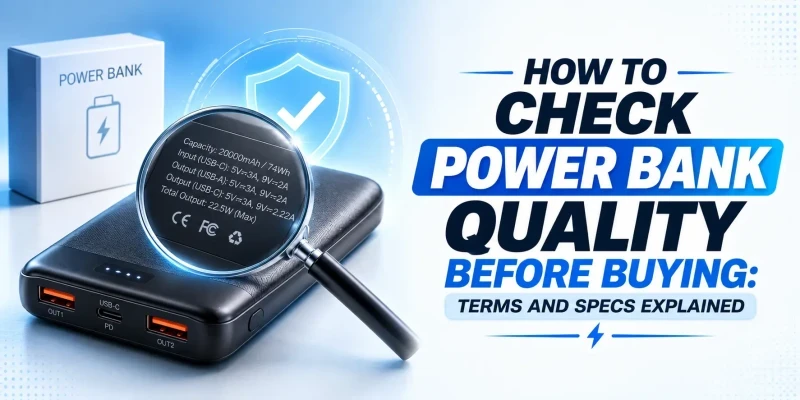
When buying a power bank: check the rated capacity (not just the advertised one), match the output wattage to your phone's fast charging support, confirm it lists basic protections like overcurrent and overheat safeguards, and look for a brand with a real warranty rather than an unmarked import. High mAh with a rock-bottom price and no brand name on it is the single biggest red flag; genuine cells at that capacity simply cost more to make than that price allows.
Buying a power bank seems straightforward enough, until you find out just how much variation there is in the technology as well as the specs. If you are a nitpicker and want to find the maximum value for your money, you have to do some serious research. Well, fret no more, as this article is here to help you with exactly that. We go through each term and spec related to a power bank so that you make an informed purchase decision.
Power Bank Specs Explained for Beginners
mAh Capacity
Milliamp-hours (mAh) measure how much charge the battery cell can store. It's usually the biggest number printed on every power bank box, and the one most buyers compare first. However, it doesn't tell you how much of that charge reaches your phone. We break down how much charge actually goes into your device in our article on why real capacity is lower than advertised.
Watt-Hour (Wh) Rating
Watt-hours is a unit of energy. It combines capacity and voltage into a single energy figure (Wh = mAh ÷ 1000 × voltage), and it's the number airlines regulate instead of mAh. A 20,000mAh power bank at 3.7V nominal cell voltage works out to about 74Wh, which is why most 20,000mAh units fall comfortably under the common 100Wh airline carry-on limit.
Input and Output Power
Input power is how fast the power bank itself recharges from an outlet, while output is how fast it charges your phone. The input and output circuits as well as the ports are different in most power banks. So check both of them separately.
Voltage and Amperage
Watts is the unit of power, and it's equal to volts multiplied by amps. So a spec sheet listing "5V/3A" is describing 15W. Once you know this, you can compare power banks that list their output in different formats without getting confused by which one sounds bigger.
Rated Capacity vs Advertised Capacity
The mAh number printed on the box is the cell's raw capacity. The actual rated capacity may also be printed in smaller font nearby, which accounts for conversion losses and is what reaches your device. An authentic power bank usually delivers somewhere around 60 to 80 percent of its advertised mAh. Anything far below that range is suspicious. Our guide to spotting fake power banks goes through how to test this yourself with a USB power meter.
How to Choose the Right Power Bank Capacity
Bigger isn't automatically better. A high-capacity power bank you leave at home because it's too heavy to carry is worth less than a smaller one that's actually in your bag.
Capacity | Good For | Roughly How Many Phone Charges |
5,000mAh | Slim daily carry, backup for short trips | About 1 full charge |
10,000mAh | Most people's everyday use | 1.5 to 2 full charges |
20,000mAh | Travel, heavy daily use, multiple devices | 3 to 4 full charges |
30,000mAh+ | Extended trips, laptops, camping | 4+ full charges |
For a deeper comparison between the two most popular tiers, see 10,000mAh vs. 20,000mAh: which one should you buy and our full capacity guide.

How to Check Charging Speed Before Buying
Output Wattage
This determines how fast the power bank charges your phone. Most current phones fast charge somewhere between 18W and 45W, so a power bank rated well below that will still work, just slower than your phone is capable of.
Input Wattage
This determines how fast the power bank itself recharges. A high output spec paired with a low input spec means a phone that charges fast, but a power bank that takes a long time to refill afterward.
USB-C PD, Quick Charge, and PPS
USB Power Delivery (PD) and Qualcomm Quick Charge (QC) are the two most common fast charging standards we have access to. PPS, on the other hand, is a newer PD extension that fine-tunes voltage for slightly more efficient charging, mainly on recent Samsung phones. A power bank and phone need to support the same standard to actually reach their advertised speeds. Mismatched standards fall back to a slower default rate. Our fast charging power bank guide explains how this negotiation works in more depth.
Ports and Cable Types to Check
- USB-A: the older rectangular port, still common on budget models and as a secondary port on higher-end ones.
- USB-C: now standard for both input and output on most current power banks, and required for higher wattages.
- Built-in cable: convenient since there's nothing separate to carry, though usually not repairable if it fails. Our slim power bank guide covers this trade-off if that format interests you.
- Multiple output ports: useful if you regularly charge more than one device, though total output is shared across whatever's plugged in rather than delivered at full speed to each.
Battery Type and Charging Cycles
Power banks use either lithium-ion or lithium-polymer cells, and despite how the two are often marketed as competing technologies, they're the same underlying chemistry in a different casing. Lithium-polymer uses a gel electrolyte in a flexible pouch, which allows for thinner designs. And Lithium-ion uses a liquid electrolyte in a rigid metal can. Neither is strictly "better" than the other. The choice mostly affects the shape and slimness of the finished product rather than raw performance.
Charging cycles measure how many full charge-discharge cycles a cell can handle before its capacity noticeably drops, generally somewhere in the 300 to 500 cycle range for the lithium cells used in consumer power banks. A power bank charged and drained daily will show its age faster than one used occasionally.

Safety Features Every Good Power Bank Should Have
- Overcharge protection, to stop current once the battery reads full
- Overheat protection, to pause charging if the internal temperature climbs too high
- Short-circuit protection, to cut power instantly if something goes wrong internally
- Overcurrent protection, to prevent unsafe current draw from damaging the cell
These should be listed on the box or spec sheet of any power bank worth buying. Our power bank safety guide and why power banks overheat cover what happens when these protections are missing or fail.
Certification Marks Worth Recognizing
Mark | What It Means |
CE | Meets European Union safety, health, and environmental requirements. Common on power banks sold internationally. |
FCC | Meets US Federal Communications Commission limits on electromagnetic interference. |
RoHS | Restricts hazardous substances like lead and mercury in the product's construction. |
UL | A US safety testing certification, less common on budget power banks but a strong signal of quality when present. |
None of these marks alone guarantees a good power bank, and counterfeit marks do exist. Treat them as one signal among several, not proof on their own.

How to Spot Fake or Low-Quality Power Banks
- A capacity claim like 50,000mAh or higher in a body too small to physically hold that many cells
- A price well below every other listing for the same advertised capacity
- No visible brand name, model number, or manufacturer info anywhere on the unit
- Packaging with obvious spelling mistakes or blurry printing
- No warranty offered, or a seller who can't tell you where to claim one
Our full guide to spotting fake power banks walks through testing a suspicious unit's real capacity with a USB power meter, step by step.
Build Quality and Design Checks
- Weight should roughly match capacity; a 20,000mAh unit that feels suspiciously light may be hollow inside or padded with a smaller cell.
- Ports should feel snug, not loose or wobbly, when a cable is plugged in.
- Any included cable should feel solid, not paper-thin or overly flexible at the connector.
- A digital display, if included, should be legible and accurate against a USB power meter.
- The casing should feel evenly warm at most during charging, never hot in one specific spot.
Best Specs for Different Users
User | Capacity | Output | Notes |
Students | 10,000mAh | 18-22.5W | Light enough for a bag, enough for a full day |
Travelers | 20,000mAh | 22.5-45W | Check airline Wh limits before flying |
Office users | 10,000mAh | 20W+ | Slim, built-in cable models are convenient for desks |
Mobile gamers | 20,000mAh | 30W+ | Higher output keeps up with a phone under heavier load |
Laptop users | 20,000-30,000mAh | 45-65W | Needs USB-C PD rated for laptop charging, not just phones |
If you're flying with one, check our power bank airline rules guide before you pack it.

Common Mistakes to Avoid Before Buying
- Buying based on mAh alone without checking output wattage or your phone's actual charging needs.
- Ignoring input wattage, then being surprised the power bank takes all day to recharge.
- Choosing an unbranded model with an implausibly high capacity purely because it's cheap.
- Not checking whether the power bank's fast charging standard actually matches your phone's.
- Skipping the warranty check, which matters most exactly when something eventually goes wrong.
Shop Power Banks With Verified Specs
All power banks listed at SMS Gadget come with genuine spec sheets, real warranty coverage, and nationwide delivery. Visit the showrooms all across Bangladesh to check a unit in person, or browse the full lineup online before you decide.
Frequently Asked Questions
You should check rated capacity, output wattage, input wattage, port types, and listed safety protections before buying any power bank. Don’t just go for a large mAh number; that's just one single factor.
Match it to your phone's supported charging speed, generally 18W to 45W for most current phones. Going higher than your phone supports doesn't charge it any faster.
Test its real output against the advertised mAh with a USB power meter, and be suspicious of unrealistically high capacity claims paired with a very low price and no visible brand.
Generally yes. You're paying for tested cells, real safety protections, and a warranty that actually gets honored, all of which matter more the longer you keep the unit.
You can’t single out one particular spec. Rated capacity, output wattage, and safety protections all matter together. Optimizing for just one single spec is how people end up being disappointed.