
What mAh Power Bank Do I Need? Complete Capacity Guide
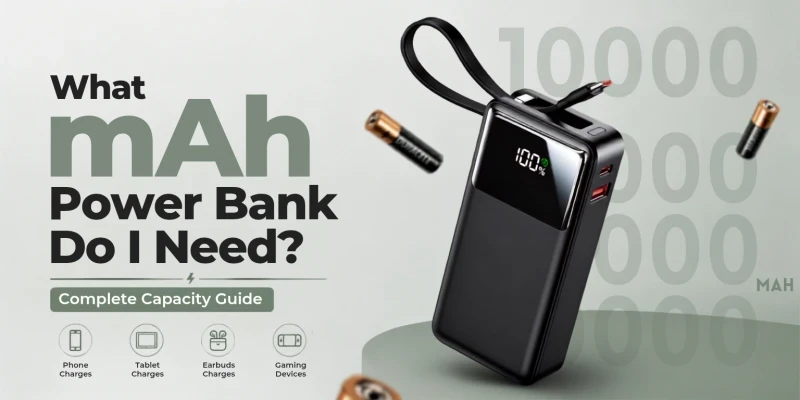
In this busy modern era, people are constantly moving from one place to another. It’s quite rare to find power outlets outside while you’re on the move to recharge your devices. Thus, power banks have become a rather important utility. It’s become so popular that the consumer market has been flooded with all sorts of power banks. The most important spec of a power bank is the capacity. This guide aims to help you understand what the “mAh” means for power banks and what capacity you need for your use case.
What Does mAh Mean in a Power Bank?
mAh stands for milliampere-hour. It is a unit that measures how much electrical charge a battery can store and deliver over time. A 10000mAh power bank can push out 10000 milliamps of current for one hour, or a smaller current for a longer time. In practice, it is easier to think of mAh as a rough measure of “how big is the tank,” similar to litres in a fuel tank. A bigger number means more stored energy, but how much of that energy actually reaches your phone is a separate question, which the next section covers.
Why Power Bank Capacity Is Not 100% Usable
This is the part most product listings leave out. A power bank's battery runs at 3.6-3.7 volts, but phones and USB ports expect 5 volts (or higher for fast charging). Converting that voltage costs energy, and more is lost as heat during the transfer. On top of that, the power used by the display, indicator lights, and protection circuit also adds up to the energy lost. So the number on the box no longer matches what you really get.
Because of this, a power bank rated at 10000mAh will deliver somewhere around 7000-8500 mAh usable charge to your phone. Manufacturers are not lying when they print 10000mAh; that is the true capacity of the cells inside. It is just that your phone will never be able to use 100% of that power. When you compare capacities, keep this conversion loss in mind rather than doing the math against the printed figure.

Quick Answer: Which Power Bank Capacity Should You Choose?
These numbers assume an average phone battery around 4000 to 5000mAh and a realistic 60 to 70 per cent usable output. A phone with a smaller battery will get more charges out of the same power bank, and a phone with a large 6000mAh+ battery will get fewer.
5,000mAh Power Bank: Who Should Buy It?
On the market today, it's hard to find something smaller than a 5,000mAh power bank and usefully gameable. It fits those who want a safety net, not an entire day of backup power.
Best for:
Emergency backup for unexpected low battery
Light phone users that charge about once a day or every two days
Quick trips where a pack must remain light
Students who require only one top-up from class to class
10,000mAh Power Bank: Best for Daily Use
This is the most popular selling capacity in Bangladesh. It occupies the Goldilocks zone between size and backup power for a regular workday.
Best for:
Most everyday phone users
Office workers who need a top-up before heading home
Students carrying it in a backpack all day.
Daily commuters who use maps and stream on the way
20,000mAh Power Bank: Best for Travel
If you are charging more than one device, 20,000 mAh becomes the better choice. It is heavier than a 10,000 mAh unit but still fits comfortably in most travel bags.
Best for:
Travellers who are away from a wall socket for long stretches
Heavy phone users who are on-screen most of the day
People charging a phone and earbuds or a smartwatch together.
Long domestic and international flights
30,000mAh Power Bank: Best for Long Backup
The 30,000mAh capacity power bank is for heavy users or multiple devices. It carries real weight, but it can keep multiple people's phones running for days without access to mains power.
Best for:
Camping trips with no charging point nearby
Outdoor fieldwork
Load-shedding or power outage backup at home
Charging two or three phones from one unit over a trip

What mAh Power Bank Do I Need for My Phone?
The following formula is a simple way to get you close enough for your planning:
Phone battery capacity × number of charges needed ÷ 0.65
For example, if your phone has a 5,000 mAh battery and you want two full charges in your trip, the math looks like this: 5,000 × 2 ÷ 0.75, which comes out to roughly 13,400mAh. Since power banks are sold in fixed capacities, you would round up to a 20,000mAh unit.
Power Bank Capacity by User Type
What mAh Power Bank Do I Need for an iPhone?
Recent iPhones carry batteries in the 3,200-4,500 mAh range depending on the model. So they charge fully before larger power banks run out.
10,000 mAh is enough for daily use on most iPhone models.
20,000 mAh is a better fit for travel or heavy screen-on time.
5,000 mAh works only as an emergency top-up, not a full charge.
One thing worth knowing: charging an iPhone at full speed needs a USB-C Power Delivery power bank, since Apple's fast-charging protocol runs on USB-C PD rather than the older Quick Charge standard used on many Android phones. A 20W or higher PD output gets noticeably faster charging than a basic 10W port.
What mAh Power Bank Do I Need for Android?
Android flagships and mid-range phones now commonly ship with 4,500 to 5,500mAh batteries, and some gaming phones go well past that.
10,000mAh works for light daily use on Android.
20,000mAh covers a full day of heavy use.
30,000mAh is perfect for travellers, mobile gamers, and outdoor campers.
Android charging protocols vary by brand (Quick Charge, VOOC, SuperVOOC, and others). So a power bank that supports both PD and QC gives the broadest compatibility across different phones in the same household.
What mAh Power Bank Do I Need for a Laptop?
Laptops need a different way of thinking about capacity. mAh alone does not tell you whether a power bank can charge a laptop at all; what matters is whether it supports USB-C Power Delivery and how many watts it can push out.
Before buying a power bank for laptop charging, check:
Support for USB-C PD (as opposed to just USB-A output)
Output wattage, since most laptops need 45W to 100W to charge properly
Total Wh capacity, since laptops draw power faster than phones
Your specific laptop's charging requirement, listed on its original charger
Most laptop users should look at a 20,000mAh or higher power bank with 45W, 65W, or 100W USB-C PD output. A power bank without PD support may show a compatible connector but will not actually charge a laptop, since the laptop needs more voltage than a standard USB port supplies
Power Bank Capacity vs Weight
Power Bank Capacity and Flight Rules
In general, airlines ask that power banks travel in carry-on luggage, not in checked bags. That is due to the dangers of lithium batteries catching fire. Regardless, a quick look at the rules of the airline and country in question before every flight is always worth it. Yet the general format for international air travel regulations remains as follows:
Power banks up to 100Wh (roughly 27,000mAh at typical cell voltage) are usually allowed without special approval.
Power banks between 100Wh and 160Wh often need airline approval and are limited to a couple of spare units per passenger.
Power banks above 160Wh are not permitted on passenger flights at all.
For most travellers, a 20,000mAh power bank stays comfortably under the 100Wh threshold and avoids any extra paperwork or gate questions. Many 30,000mAh units exceed the 100 Wh limit, so they might not be approved by the airline. Be sure to check that before packing for your flight.

Common Mistakes When Choosing Power Bank Capacity
Selecting simply via mAh and overlooking genuine available output
So when we forget to look the output wattage, Slow charging will not happen.
Buying fake or inflated high-capacity power banks from unverified sellers
Choosing a capacity too heavy actually to carry day to day
Skipping USB-C PD or Quick Charge support
Not checking airline Wh limits before a flight.
Buying an unknown brand with no warranty or safety certification
Popular Power Bank Picks in Bangladesh
If you have figured out your target capacity from the sections above, here are a few well-reviewed options currently sold in the Bangladeshi market, spanning the daily-use and travel categories most readers land on.
Prices shift with promotions and stock, so treat these as a general range rather than a fixed quote, and confirm the current price before ordering.
Ready to upgrade your charging setup? Explore the latest power banks in Bangladesh at SMS Gadget and choose the right capacity for your daily routine, travel, gaming, or laptop charging needs. From compact options such as the Awei C03 and Baseus Adaman for everyday carry to higher-capacity models like the QCY PB20A with 45W fast charging, there are options for different users and budgets.
Buying from SMS Gadget also gives you more confidence than picking an unknown listing based only on a low price. You can choose genuine power banks with warranty and after-sales support while comparing practical features such as battery capacity, USB-C PD, charging speed, built-in cables, and digital displays. So, whether you need a lightweight 10,000mAh model for work or a powerful 20,000mAh–30,000mAh power bank for travel and extended backup, check the full power bank collection and find the option that suits you best.
Final Takeaway
It all comes down to the use case; this is the best power bank for you. 10,000mAh for daily commuting and office use is good enough to cover most of the usage without putting weight on your bag. 1–Chinese characters in the middle of an image for less than one hour. For frequent travellers or heavy users who charge several devices, 20,000mAh is the safer purchase yet within typical flight limits. If you only need multi-day backup, like camping or long fieldwork—then aim for 30,000mAh. When purchasing a power bank to charge laptops, look for one that specifies USB-C PD and the appropriate wattage (not just the mAh figure).
Frequently Asked Questions
It can cover short trips, but most travellers are better served by 20,000mAh, since travel days tend to involve heavier phone use than a normal day at home or the office.
Only partially in most cases. After accounting for real-world conversion losses, a 10,000mAh power bank usually delivers closer to one and a half charges for an average phone battery.
Voltage conversion from the battery cells to the 5V USB output, along with heat loss and the power used by the display and circuitry, brings the real usable output down to roughly 60 to 70 per cent of the printed figure.
10,000mAh is good for day-to-day use, and 20,000mAh is the best pick for travel or lots of screen time every day.
It depends on how you use it. While a compact 5,000 to 10,000mAh unit slips into a pocket with ease, higher-capacity 20,000mAh or even 30,000mAh models sacrifice portability for time between charges.
Beyond 30,000mAh, it gets difficult to justify carrying on a day-to-day basis for most people because the extra weight and bulk have diminishing returns in terms of added backup for everyday smartphone usage.