
10000mAh vs 20000mAh Power Bank: Which One Should You Buy?
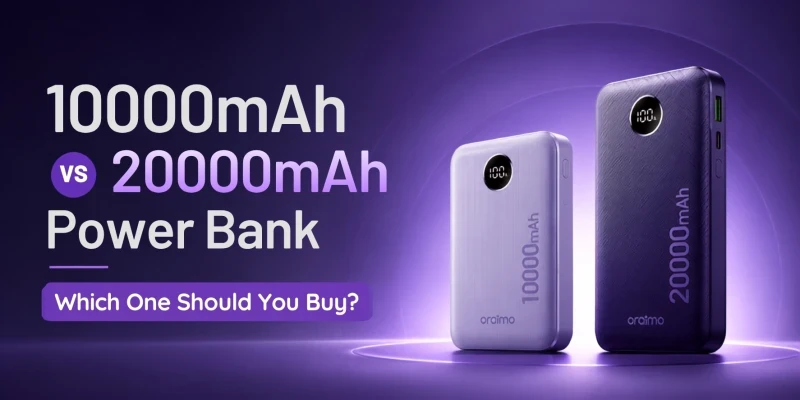
This is one of the most common questions in any power bank shop in Dhaka: buy the lighter 10,000mAh, or spend a bit more and carry the bulkier 20,000mAh? Both are good products. The right one just depends on how you actually use your phone day to day, not on which number looks bigger on the box.
10000mAh vs 20000mAh Power Bank: Quick Comparison
|
Factor |
10,000mAh |
20,000mAh |
|
Real usable capacity |
≈ 6,000–6,500mAh |
≈ 12,000–13,000mAh |
|
Phone charges (5,000mAh battery) |
1–1.5 charges |
2.5–3 charges |
|
Typical weight |
180–220g |
350–420g |
|
Typical price in Bangladesh |
≈ 1,000–3,000৳ |
≈ 2,000–4,000৳ |
|
Best for |
Daily carry, students, office |
Travel, heavy users, multiple devices |
|
Flight rules |
No restrictions, carry-on only |
Carry-on only, under 100Wh |
What Does mAh Mean in a Power Bank?
A 10,000mAh power bank is rated at the internal cell voltage, usually around 3.7V. That equals roughly 37Wh. Expressed at a 5V USB output, the same energy corresponds to about 7,400mAh even before efficiency losses. Voltage-conversion and circuit losses reduce the usable output further, which is why many 10,000mAh power banks provide roughly 6,000–7,000mAh when expressed at 5V.
How Many Times Can a 10,000mAh Power Bank Charge a Phone?
With real usable output around 6,000 to 6,500mAh, a 10,000mAh power bank charges an average phone with a 4,000 to 5,000mAh battery about one and a half times, sometimes just short of two if the phone's battery is smaller. For a single day where you charge your phone once, this is normally enough with some buffer left over.
How Many Times Can a 20,000mAh Power Bank Charge a Phone?
A 20,000mAh power bank realistically outputs around 12,000 to 13,000mAh, which covers about two and a half to three full phone charges for the same average battery size. That's double the capacity of the 10,000mAh unit, and it does roughly double the real-world charges too, just not the four full charges the raw mAh number might suggest.
Why Power Banks Do Not Give Full mAh?
Voltage conversion from 3.7V cells to 5V USB output, heat loss in the circuit, and resistance in the charging cable all quietly eat into the advertised capacity. This applies equally to both sizes, so it doesn't change which one is the better buy, but it does explain why neither one performs as well as the number on the box implies.

When Should You Buy a 10,000mAh Power Bank?
- You charge one phone, once or twice a day, mostly at home or the office.
- You want something slim enough to carry in a pocket or small bag every day.
- You're a student or commuter who just needs a safety top-up, not a full backup.
- You'd rather pay less and don't need to charge more than one device.
When Should You Buy a 20,000mAh Power Bank?
- You travel often or spend long stretches away from a wall socket.
- You're a heavy phone user relying on GPS, camera, or mobile data all day.
- You regularly charge more than one device, like a phone and earbuds or a smartwatch.
- You don't mind the extra weight in exchange for real backup.
10,000mAh vs 20,000mAh for Travel
Both 10,000mAh and most 20,000mAh power banks are normally below 100Wh, so they are generally permitted in carry-on baggage. Power banks must not be packed in checked luggage. However, airline rules can be stricter and may limit how many power banks you can carry or whether you can use or recharge them during the flight. For example, some airlines now prohibit using a power bank onboard even when it is allowed in the cabin. Always check your airline's latest power-bank policy before travelling.
10,000mAh vs 20,000mAh for Students
Most students are better served by a 10,000mAh power bank. It's light enough to carry in a backpack every day without adding noticeable weight, and it comfortably covers the gap between classes or a commute. A 20,000mAh unit only makes sense for students who are away from campus and a charger for very long stretches.
10,000mAh vs 20,000mAh for iPhone
Current iPhone battery capacities vary substantially by model, from just over 3,000mAh to around 5,000mAh in the iPhone 17 family. So a 10,000mAh power bank easily covers one full charge with some left over for daily use. On the other hand, 20,000mAh is worth it mainly for travel or heavy screen time. Either way, a power bank with USB-C Power Delivery output charges an iPhone faster than one without it.
10,000mAh vs 20,000mAh for Android
Many Android phones use batteries around 4,500–5,000mAh, while some newer high-capacity models reach 6,000mAh or more, which eats into the number of charges a bit more than on an iPhone. 10,000mAh still works fine for light daily use, but heavier Android users and anyone with a big-battery phone will get more practical value out of 20,000mAh.

Charging Speed: Does 20,000mAh Charge Faster?
No. Capacity and charging speed are two separate things. How fast a power bank charges your phone depends on its output wattage and fast-charging protocol (like PD or QC), not on whether it holds 10,000mAh or 20,000mAh. A 10,000mAh power bank with 45W output can charge a phone faster than a 20,000mAh power bank limited to 18W.
Recharging Time: Which One Takes Longer?
This one does depend on capacity. Refilling a 20,000mAh power bank takes roughly twice as long as refilling a 10,000mAh one, assuming both are charged at the same input wattage. If you need your power bank ready again quickly overnight, the smaller capacity has a practical edge here.
Portability: Which One Is Easier to Carry?
A 10,000mAh power bank usually weighs around 180-220 grams and fits easily in a pocket or a bag. The 20,000mAh units usually weigh 350-420 grams, which is heavier and bulkier. For daily carry, the 10,000mAh option is easier to live with; for occasional travel use, the extra weight of a 20,000mAh unit is a fair trade for the backup it provides.

Price: Which One Gives Better Value?
In the Bangladeshi market, decent 10,000mAh power banks typically run from about 1,000-3,000৳, while good 20,000mAh options land around 2,000-4,000৳. Per mAh, the 20,000mAh models usually work out cheaper, but that only translates into better value if you actually need the extra capacity. Buying a bigger power bank than you'll use just adds weight without adding real benefit.
10,000mAh vs 20,000mAh: Pros and Cons
|
|
10,000mAh |
20,000mAh |
|
Pros |
Light, cheap, fast to recharge, fits any bag |
More real backup, covers multiple devices, better for
travel |
|
Cons |
Not enough for multi-day trips or heavy use |
Heavier, costs more, takes longer to recharge fully |
Final Verdict: Which One Should You Buy?
If your daily requirement is one full charge for your phone, 10,000mAh is the smarter buy since it's lighter and cheaper. Buying a bigger one means carrying weight you won't use. But if you are a traveller/camper, you might need to charge more than one device or use your phone heavily enough that a single top-up won't be enough. In such a case, 20,000mAh is definitely better for you. There's no universal best option here, only the one that matches your specific charging requirements.
Where to Buy in Bangladesh
SMS Gadget lists power banks from brands including Foneng, AWEI, QCY and Baseus, with warranty terms shown on applicable product pages. For daily carry, the Foneng PX137 (10,000mAh, 35W) and Awei P23K (10,000mAh, 22.5W) are light, fast-charging, and easy to carry. For travel and heavier use, the Baseus Adaman, Awei C03, and QCY PB20A cover the 20,000mAh bracket at 22.5W to 45W output, with the QCY PB20A adding a digital display to track remaining charge. Visit smsgadget.com and find what suits you best.
Frequently Asked Questions
Around one and a half times for an average phone with a 4,000 to 5,000mAh battery, once real-world conversion losses are accounted for.
Around two and a half to three times for the same average phone battery, roughly double the 10,000mAh figure.
Because the mAh figure describes the battery cells at 3.7V, while your phone charges at 5V. Converting between the two, plus normal heat and circuit losses, brings real usable output down to about 60 to 65 percent of the printed number.
Yes, if you only charge one device, it would be a waste of money to buy a bigger one. It has more capacity and weight than most people need. It becomes worthwhile once travel, heavy use, or multiple devices enter the picture.
Yes, for most users who charge their phone once a day and aren't relying heavily on GPS, camera, or streaming the whole time.
Generally yes, for a single phone with moderate use, though heavy use or charging more than one device will use it up faster.