
Why Power Bank Real Capacity Is Lower Than Advertised?
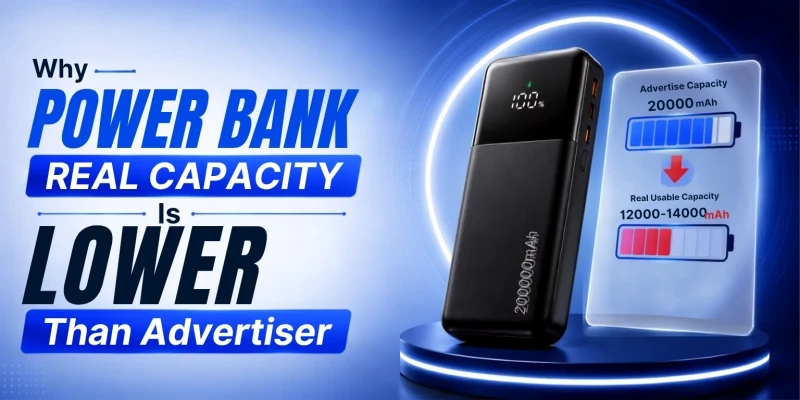
Almost everyone who has owned a power bank has had the same moment of doubt: the box says 10000mAh, but the phone barely gets one and a half charges out of it. The instinct is to assume the product is fake or defective. Most of the time, it isn't. The gap between advertised capacity and usable capacity is built into how power banks work, and understanding it makes shopping for one a lot less confusing.
What Does Advertised Power Bank Capacity Mean?
The mAh number printed on a power bank refers to the rated capacity of the lithium-ion or lithium-polymer cells inside it, measured at the cell's own operating voltage. A “10000mAh” power bank contains cells that can theoretically supply 10000 milliamps for one hour at roughly 3.7V. This number is generally accurate to the cells themselves. The confusion starts because customers assume that number describes what reaches their phone, and it does not, since the phone is charged at a completely different voltage.
What Is Usable Power Bank Capacity?
Usable capacity is the charge that actually gets to your phone's battery after factoring in voltage conversion, heat loss and circuit overhead. That is always less than the rated cell capacity. With 99% of the well-made power banks, usable output falls between 60 to 70 per cent of the printed mAh amount. A cheap or badly designed unit might be much lower than that, whilst a properly engineered (and efficiently built) boost converter will be towards the high end.

Why Power Banks Do Not Give Full mAh?
Voltage Conversion Loss
Battery energy is stored at 3.6-3.7V for power bank cells, and USB output requires 5V (9V,12V,20V for fast charging). Boost Converter — A boost converter step up the voltage. However, no converter is 100 per cent efficient. A standard boost converter is about 85-90 per cent efficient, and even that loss creates a wide gap between rated and actual capacity.
Heat Loss During Charging
Some energy is always lost as heat during charging. It is a direct result of the 2nd law of thermodynamics. This happens inside the conversion circuit and inside the cells themselves, which is why a power bank feels warm during heavy use. The warmer it runs, the more energy is escaping as heat instead of reaching your phone.
Cable Resistance
Every cable has electrical resistance. Thin and low-quality cables waste more energy as heat compared to thick and well-made ones. Also, the longer the cable, the greater the heat loss. A bargain cable bundled with a cheap power bank can significantly reduce how much charge your phone receives.
Charging Circuit Loss
Apart from the boost converter, a power bank's protection circuitry (overcharge protection, short-circuit protection, temperature monitoring) draws a small amount of power to operate. Digital displays and LED indicators add to this overhead too. So a power bank with a screen usually loses a little more capacity to its own electronics than a basic model without one.
Phone Battery Management
Phones do not charge at a constant rate all the way to 100 per cent. Most slow down sharply above 80 per cent to protect long-term battery health. A behaviour sometimes called trickle charging. This isn't a power bank capacity loss at all, but it can make charging look incomplete or slower than expected when the phone is simply throttling the last stretch.
Fast Charging Efficiency Loss
High-voltage fast charging (PD, QC, SCP) divides wattage into low current. It can achieve this by lowering cable and connector resistance losses compared to old 5V charging. However, the conversion circuitry that creates those higher voltages incurs its own losses. Faster charging does not always mean more efficient. It's simply the loss of one to gain on the other side.
The Main Reason: 3.7V Battery Cells vs 5V USB Output
If there is one single factor behind the mAh gap, it's this voltage mismatch. Energy, measured in watt-hours (Wh), stays the same regardless of voltage, but mAh does not, because mAh is current over time at a specific voltage. A 10000mAh cell rated at 3.7V holds about 37Wh of energy. If you tried to express that same 37Wh at 5V instead, it would only be about 7400mAh, even before any conversion losses are subtracted. This is why the printed mAh number, which describes the cells at 3.7V, was never going to match what comes out at 5V in the first place.

How to Calculate Real Power Bank Capacity
Simple Real Capacity Formula
A simple mathematical estimate for usable capacity can look something like:
Real capacity ≈ Rated capacity × (3.7V ÷ 5V) × circuit efficiency
Circuit efficiency for a decent power bank is around 85-90 per cent. Multiplying the voltage ratio (0.74) by that efficiency range gives an output factor of approximately 0.65-0.70. It matches what most independent teardown tests and USB power-meter measurements find in practice.
Example: 10000mAh Power Bank Real Capacity
10000mAh * 0.74 * 0.85 estava em ≈6,290mAh. In non-technical terms, most good-quality 10000mAh power banks give about 6,000 to 6,500mAh of real usable juice for a phone charge.
Example: 20000mAh Power Bank Real Capacity
If you multiply: 20000mAh × 0.74 × (0.85 just as a rough estimate — it can definitely vary here) ≈ 12,580mAh. Since the underlying physics scales linearly with rated capacity, this is always about half of what you get for 10000mAh - a 20000mAh power bank will typically net around 12-13000mAh of usable output.
Power Bank Advertised Capacity vs Real Capacity
|
Advertised Capacity |
Typical Real/Usable Capacity |
Approx. Efficiency |
|
5,000mAh |
3,000–3,300mAh |
60–66% |
|
10,000mAh |
6,000–6,500mAh |
60–65% |
|
20,000mAh |
12,000–13,000mAh |
60–65% |
|
30,000mAh |
18,000–19,500mAh |
60–65% |
Why a 10,000mAh Power Bank May Not Charge a 5,000mAh Phone Twice
10,000 mAh should charge a 5,000 mAh phone battery approximately 2 times. But in reality, the power bank only has about 6,000 to 6,500mAh of usable output after conversion losses. The phone itself only accepts about 80-90 per cent of its own rated capacity as effective charge, since a small buffer is reserved at both ends of the battery to protect its lifespan. Put those two effects together, and a 10,000mAh power bank charging a 5,000mAh phone manages one full charge plus a partial top-up instead of two clean charges.
Why a 20,000mAh Power Bank May Not Give 4 Full Charges
The same math applies at the larger size. A 20,000mAh power bank realistically outputs around 12,000-13,000mAh. Most modern phone batteries in the 4,500 to 5,000mAh range effectively need slightly more than their rated capacity to go from empty to full, given charging losses on the phone's side too. That usually works out to two and a half to three full charges rather than four, unless the phone has a notably smaller battery.

Normal Capacity Loss vs Fake Power Bank Capacity
When Lower Capacity Is Normal
If a power bank delivers somewhere close to 60-70 per cent of its printed mAh rating, that is considered an expected engineering loss. It shouldn’t be taken as a defect. This applies across genuine products from established brands.
When Lower Capacity Means Poor Quality
If output consistently falls well below 50 per cent of the rated figure, it might be a poor-quality power bank. The unit most likely uses low-grade cells or a poorly designed boost converter, or degraded components. Even if the brand printed an honest capacity to begin with, the quality of the components might not produce the desired output.
When Lower Capacity Means the Power Bank May Be Fake
If a power bank barely manages 20 to 30 per cent of its advertised capacity, or the physical size and weight are clearly too small to hold the cells needed for the printed mAh number, the capacity label itself is likely inflated or fabricated. This is common with unbranded power banks sold far below the normal market price for their claimed capacity.
Other Reasons Your Power Bank Capacity Feels Lower
Using Your Phone While Charging
Charging a phone while actively using the screen, camera, or a data connection means some of the incoming power is consumed immediately rather than stored in the battery, which makes the power bank appear to drain faster than it actually is.
Old Battery Cells
Lithium-ion and lithium-polymer cells lose capacity gradually as time goes on. Repeated charge cycles also reduce the capacity due to internal degradation. A power bank that is a year or two old and used often will hold noticeably less charge than it did new, separate from any manufacturing issue.
Low-Quality Cable
As mentioned earlier, a thin or damaged cable increases resistance and wastes energy as heat. It can make a perfectly good power bank feel underpowered.
High Temperature
Lithium cells are less efficient and less safe when charging or discharging at high ambient temperatures. A power bank left in direct sunlight or a hot car will generally deliver less usable capacity and may throttle its own output to protect the cells.
Poor-Quality Power Bank Circuit
An inexpensive, poor-quality protection and conversion circuit does not perform as well (runs hotter) with respect to the given nominal current than a more carefully engineered module using the same kinds of cells. It is also a reason that two power banks with the same advertised mAh can often perform quite differently in real-life usage.

How to Check the Real Capacity of a Power Bank
Use a USB Power Meter
An inline USB power meter (a small device that sits between the power bank and the charging cable) measures the current and voltage delivered over time, letting you calculate Wh or mAh output directly rather than relying on the printed label.
Check the Wh Rating
For this reason, you will find most reputable manufacturers print a Wh rating next to the mAh number for its portable chargers — that's because they want you to take their power banks on aeroplanes. Wh is derived from the actual voltage and capacity of each cell. Thus, checking whether the Wh number fits what you would expect given the mAh and voltage gives you some measure of assurance that at least it is self-consistent.
Test with Your Phone Battery
A very simple test that you can perform: fully charge the power bank, drain your phone to near-empty, then note how many full charge cycles the power bank provides before it runs out. Comparing that to the expected usable capacity from the formula above will give you a rough idea of the actual capacity.
Compare with Brand Specifications
Popular brands publish rated capacity with Wh and sometimes even efficiency figures on their official spec sheets. Comparing the number on a marketplace listing with the brand's own official page is one of the fastest ways to figure out if there is a mismatched or inflated capacity claim.
mAh vs Wh: Which One Is More Accurate?
Wh (watt-hours) is the more accurate and voltage-independent way to describe stored energy, since it already accounts for the cell's operating voltage. mAh only tells the full story when you also know the voltage it was measured at, which is exactly why two power banks can both say “10000mAh” and still store meaningfully different amounts of real energy if their internal voltage or cell configuration differs. This is also why airlines regulate power banks by Wh rather than mAh: it's the only version of the number that means the same thing across every device.
How Much Capacity Loss Is Normal?
As a rule of thumb, losing 30 to 40 per cent of the advertised mAh figure to real-world conversion and circuit losses is normal for a genuine power bank. Losing closer to 50 per cent suggests a lower-quality but still honest product. Losing 70 per cent or more, especially paired with a suspiciously low price for the claimed capacity, is a strong signal of an inflated or fake mAh rating rather than ordinary engineering loss.
How to Avoid Buying a Fake Capacity Power Bank
Avoid Unrealistic mAh Labels
Be sceptical of very high capacities (50,000mAh or more) packed into a small, light, inexpensive shell. Real high-capacity cells add real weight, and there is no way around that physically.
Check Brand Authenticity
You should buy from brands with official presence and warranty support in Bangladesh. Don’t risk buying from an unbranded listing which can’t provide warranty.
Look for Safety Certifications
Genuine power banks typically carry recognisable safety markings and certification info on the packaging, along with a printed Wh rating, not just a bare mAh number.
Avoid Very Cheap High-Capacity Models
If a 20,000mAh or 30,000mAh power bank is priced far below every other listing for the same capacity, that price gap is usually funded by cutting corners on the cells inside, not genuine efficiency.
Buy from Trusted Sellers
A seller who offers a real warranty and after-sales support has a direct incentive to sell power banks that actually match their labels, since inflated claims come back to them as returns and complaints.
A trusted retailer like SMS Gadget will guarantee you genuine power banks that match the capacity claims. SMS Gadget is at the forefront of retailers in the Bangladeshi gadget market. They stock power banks like the Foneng PX137 (10,000mAh, 35W) and Awei P23K (10,000mAh, 22.5W) for daily carry, alongside larger options such as the Baseus Adaman, Awei C03, QCY PB20A, and Foneng PX138, all rated at 20,000mAh with 22.5W to 45W output for travel and heavier use. Every single one of these is a brand-sourced original unit with proper warranty backing. This means the mAh printed on the box reflects the actual cells inside. Given how common capacity inflation is at the cheaper end of the market, buying from a source that stands behind its warranty is one of the simplest ways to make sure the power bank you charge tonight actually holds what it claims. Visit msgadget.com to check their vast inventory at the best price and offers available in Bangladesh.
Final Verdict: Is Lower Power Bank Capacity Normal?
Yes, in almost every case. A gap between the advertised mAh and the usable charge your phone receives is built into how power banks convert stored battery energy into USB output. A 30-40 per cent loss is standard even for well-made products. The line between normal loss and a problem worth worrying about sits around the 50 per cent mark. Below that, the issue is more likely a poor-quality build or an inflated capacity claim than a matter of ordinary physics.
Frequently Asked Questions
It is because the 10,000mAh figure describes the battery cells at roughly 3.7V, while your phone charges at 5V. Converting between the two, plus normal heat and circuit losses, brings usable output down to about 60-70 per cent of the printed number.
A 20,000mAh power bank realistically delivers around 12,000 to 13,000mAh of usable charge, and phone batteries also have their own charging losses, so two and a half to three full charges is the more realistic expectation.
Roughly 6,000 to 6,500mAh in a well-made unit, based on typical voltage conversion and circuit efficiency figures.
Typically around 18,000 to 19,500mAh of usable charge, following the same 60 to 65 per cent efficiency range seen at smaller capacities.
Because that is the nominal voltage of the lithium-ion or lithium-polymer cells actually used inside the power bank, which is a natural and standard way to rate the cells themselves.
Because 5V is the standard USB charging voltage most phones and devices expect, which is why the power bank's internal circuit has to step up the voltage from the cells before it reaches your phone.
Compare its weight and size to genuine units of the same claimed capacity, check whether a Wh rating is printed alongside the mAh figure, and be cautious of any unit priced far below the market for its stated capacity.