
Can You Take a Power Bank on a Plane? Airline Rules Explained
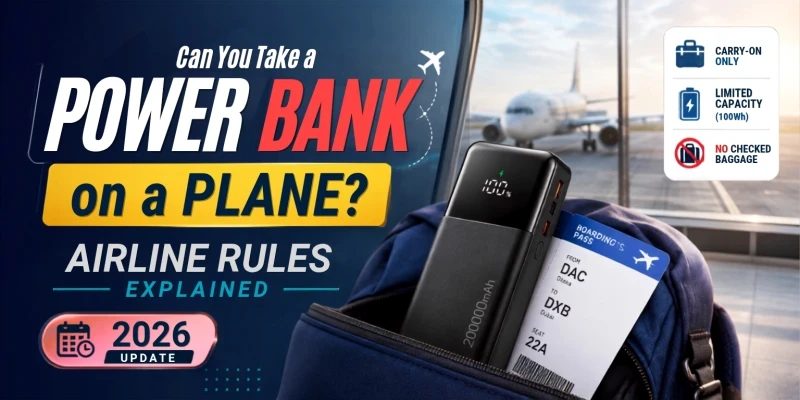
One of the main concerns when buying a power bank in Bangladesh is whether you can take it with you on domestic and international flights. A large number of people take flights on a regular basis, both international and local. For them, it is very important to know if they can take their power bank with them to recharge their devices on the go. We answer that question in detail in this guide.
Quick Answer: Are Power Banks Allowed on Planes?
Yes. Airlines and aviation authorities worldwide treat power banks as spare lithium-ion batteries, and spare batteries are welcome in the cabin. The catch is where and how you carry them, not whether you can carry them at all.
Yes, but only in carry-on luggage
You must keep the power bank in your hand luggage or on your person during travel. This is not an airline preference. It is a rule set by aviation regulators including the FAA, EASA, the UK CAA, and Bangladesh's own carriers operating under IATA's Dangerous Goods Regulations.
Why power banks are restricted on flights
Lithium-ion cells can enter thermal runaway, a chain reaction where a damaged or short-circuited cell heats up, releases gas, and can catch fire. In the cabin, crew members can see and respond to that within seconds using onboard extinguishers and fire containment bags. In the cargo hold, nobody would know until the smoke detector goes off, which is why the hold is off-limits for these batteries.
The most important rules travellers should know
The three most important rules you need to remember are: carry-on only, two units per passenger and keep the Wh rating under 100. Everything else in this guide builds on these rules.

TSA, FAA, IATA and Biman Bangladesh Rules
TSA rules for power banks in the United States
The Transportation Security Administration screens power banks through the X-ray machine along with the rest of your carry-on. You do not need to remove them unless an officer specifically asks, which sometimes happens with larger or bulkier units that are harder to read on the scanner image.
FAA lithium battery limits explained
The Federal Aviation Administration sets the underlying safety limits enforced by the TSA and the US airlines. Power banks rated at 100Wh or less need no approval, up to two units per passenger. From 100 to 160Wh, the power bank needs airline approval in the US. 160Wh+ is prohibited from passenger aircraft entirely, in both the cabin and the hold.
IATA rules for international flights
The International Air Transport Association is an industry trade body, not a government regulator, but its Dangerous Goods Regulations are widely adopted by airlines outside the US, including Biman Bangladesh Airlines, and by national aviation authorities as the basis for their own rules. IATA's structure is similar to the FAA's: under 100Wh does not need permission, capped at two units per passenger. Anything past 100Wh is not allowed at all. Since this framework is shared globally, a power bank that is legal to fly from Dhaka is generally legal to fly from anywhere else too, though individual airlines can still add their own conditions.
Biman Bangladesh Airlines rules
Biman Bangladesh Airlines has adopted the IATA Dangerous Goods Regulations as the basis for its own power bank policy, classifying them as spare lithium batteries. Power banks are allowed in carry-on baggage and restricted from checked baggage. Following safety concerns raised by lithium battery fires on other airlines, Biman announced that passengers may no longer charge a power bank through the onboard USB ports, nor use a power bank to charge any other device, at any point during the flight. The power bank itself still needs to travel in your cabin bag or personal item throughout the journey.
Why airline policies may differ slightly
Two particular incidents caused the industry to move toward stricter in-flight handling. A fire on an Air Busan aircraft in South Korea in January 2025, where investigators pointed to a spare power bank as the likely cause. Fortunately, there were no fatalities, only minor injuries. The other incident was a fire on an Air China flight in October 2025. The likely cause was found to be a power bank kept in the overhead bin. The fire forced a diversion, and no injuries were reported. Because of these incidents, airlines across Asia, the Middle East, and North America moved beyond the baseline FAA and IATA rules. Some now ban overhead bin storage of power banks. They require you to keep the power bank under the seat, in the seat pocket, or on your person so cabin crew can see it. Always check your specific carrier's website before your travel date. These carrier-level rules change faster than the FAA and IATA framework.

Can You Pack a Power Bank in Checked Luggage?
Why power banks are not allowed in checked bags
A fire in the cargo hold cannot be seen, reached, or extinguished quickly by the crew during flight. Keeping lithium batteries in the cabin means a problem gets caught in its earliest, most manageable stage rather than growing unnoticed for hours.
What happens if you accidentally pack one
If a power bank turns up in checked baggage during screening, ground staff will typically pull the bag, locate the item, and either have you retrieve it before boarding or remove it from the bag. In some cases, the bag is delayed while this happens, and in rarer cases the battery is confiscated on the spot. Neither outcome is worth risking for a habit that is easy to fix: pack power banks in your cabin bag every time, without exception.
What to do if your carry-on is gate-checked
Overhead bins fill up on busy flights, and gate agents sometimes tag carry-on bags to go into the hold. Before you hand that bag over, take out every power bank and spare battery and carry them into the cabin in your pocket or personal item. This step is non-negotiable under FAA, EASA, and IATA rules, and gate staff at Hazrat Shahjalal International Airport and elsewhere will usually remind you of it anyway.

Power Bank Capacity Limits: mAh and Wh Explained
What is the 100Wh limit?
Watt-hours (Wh) measure the energy stored in a battery, which is what matters in case of a fire risk. A power bank at or under 100Wh needs no approval from any airline and is capped at two per passenger under the baseline rules.
How to convert mAh to Wh
Usually, manufacturers print capacity in milliamp-hours (mAh). But airline regulations are in watt-hours (Wh). Here is the mathematical formula to convert mAh to Wh: Wh = (mAh ÷ 1000) × V.
The figure that matters is the voltage of the internal lithium-ion cells, which is 3.6V to 3.7V for almost all consumer power banks, not the 5V or higher output voltage printed next to the USB port. Using 3.7V as the standard reference:
● 10,000mAh × 3.7V ÷ 1000 ≈ 37Wh
● 20,000mAh × 3.7V ÷ 1000 ≈ 74Wh
● 27,000mAh × 3.7V ÷ 1000 ≈ 99.9Wh, the maximum capacity you can carry without approval
● 30,000mAh × 3.7V ÷ 1000 ≈ 111Wh, forbidden
So at the standard 3.7V cell voltage, roughly 27,000mAh works out to approximately the 100Wh ceiling for flying, though actual cell chemistry varies slightly by brand, so this figure is a guide rather than an exact cutoff. Some manufacturers list the Wh figure directly on the casing or in the spec sheet, which removes the need to calculate anything. Most 10,000mAh power banks and 20,000mAh models fall comfortably below 100Wh when based on typical lithium-cell voltages.
SMS Gadget Tip
• Every 10,000mAh and 20,000mAh power bank in SMS Gadget's inventory sits at around 37Wh to 74Wh, comfortably under the 100Wh no-approval limit for both domestic and international flights.
• If your travel plans include layovers on Gulf or Southeast Asian carriers, a compact 10,000mAh model is the easiest choice, since it clears every airline's limit without a second thought.
Common Power Bank Sizes and Flight Rules
The table below applies the 3.7V nominal cell voltage used across the industry. Actual Wh can vary slightly by brand depending on the exact cell chemistry, so always check the printed rating when one is available.
|
Capacity (mAh) |
Approx. Energy (Wh) |
Flight status |
|
5,000mAh |
~18.5Wh |
Allowed, no approval needed |
|
10,000mAh |
~37Wh |
Allowed, no approval needed |
|
20,000mAh |
~74Wh |
Allowed, no approval needed |
|
26,800mAh |
~99.2Wh |
Allowed, right at the
practical edge |
|
30,000mAh |
~111Wh |
Forbidden outside US,
requires airline approval within the US |
|
40,000mAh |
~148Wh |
Forbidden outside US,
requires airline approval within the US |
|
50,000mAh |
~185Wh |
Forbidden everywhere |
What if your power bank has no Wh rating?
Look for the mAh figure and the voltage, usually printed together as something like "10000mAh 3.7V", and run the calculation above. If neither number appears anywhere on the device, having the product listing or manual on hand as backup can help, since an unlabeled battery may be treated with extra caution or, in rare cases, refused at the checkpoint.

How Many Power Banks Can You Bring on a Plane?
Personal-use limits under 100Wh
The International Civil Aviation Organisation (ICAO) has issued globally on the 27th of March 2026: power banks under 100Wh are capped at two units per passenger. Some airlines apply the same or a similar limit on top of this baseline.
Limits for the 100Wh+ tier
You can not carry any power bank above the 100Wh capacity limit. But if you are travelling from US, you can take at maximum two power banks within 100-160Wh capacity after getting the airlines approval.
When carrying multiple power banks becomes a problem?
Security officers may flag a bag carrying several large power banks even if each one is individually compliant since a cluster of batteries reads differently on an X-ray screen than a single unit. It’s best to pack them separately rather than stacking them together. You should be ready to explain that they are for personal travel use.
Can You Use a Power Bank During a Flight?
Charging your phone or tablet onboard
This depends entirely on the airline, and the answer has shifted quickly through 2025 and 2026. Some carriers still allow you to plug your phone into your own power bank mid-flight. Others, including Biman Bangladesh, Singapore Airlines and Scoot, Thai Airways, and several South Korean carriers, have banned it outright.
Airline rules about using power banks in flight
Since early 2025, airlines have moved firmly toward restriction rather than permission. Airlines that still allow you to use power banks generally still forbid recharging the power bank itself from the seatback or overhead USB port, and require the power bank to remain visible.
When cabin crew may ask you to stop using it
If a power bank feels unusually warm, is visibly swollen, or is generating an odd smell, stop using it immediately and tell a flight attendant. Cabin crew carry fire-containment equipment specifically for lithium battery incidents, and reporting it early is what keeps a warm battery from becoming a real problem.
How to Pack a Power Bank Safely for Air Travel
1. Keep it in your carry-on bag or personal item at all times, never in the suitcase that gets checked.
2. Protect the ports and terminals from short circuits by using the original pouch or a padded pocket, away from loose coins, keys, or metal objects.
3. Skip power banks that are damaged, swollen, cracked, or show any sign of overheating, and dispose of them properly rather than traveling with them.
4. Keep the power bank somewhere easy to reach during security screening, in case an officer wants to inspect it separately.

Airline-Specific Power Bank Rules
Bangladesh and South Asia
Biman Bangladesh Airlines follows the IATA 100Wh limit, bans checked-baggage carriage, and no longer permits onboard charging or use of power banks. Regional carriers serving Dhaka, such as IndiGo and Air India, apply broadly the same structure, though it is worth confirming current in-flight use policy directly with the airline before departure since rules have changed more than once in the past year.
Middle East carriers
Emirates, Qatar Airways, and Etihad, the three carriers most used by Bangladeshi workers and families traveling to the Gulf, all follow the standard 100Wh limit for carriage. Given how quickly Gulf carriers have tightened in-flight electronics rules recently, checking the airline's current policy on charging power banks in the cabin is worth the two minutes it takes.
Asian carriers
Singapore Airlines and its budget arm Scoot, Malaysia Airlines, and Thai Airways have all introduced restrictions on power bank use and overhead-bin storage. Malaysia Airlines, for instance, now requires power banks to stay with the passenger under the seat or in the seat pocket rather than in the overhead bin, and forbids charging devices with them during the flight. These routes matter for Bangladeshi travelers connecting through Kuala Lumpur, Singapore, or Bangkok.
Why should you check your airline before flying?
The FAA and IATA laid the groundwork. Individual airlines are free to add tighter rules on top, and several have done exactly that since 2025. It’s good practice to quickly check your airline's baggage or dangerous goods page to avoid an unpleasant surprise at the gate.
Power Bank Rules for International Flights
Do rules change by country?
The core Wh limits remain similar worldwide because most countries adopted the same IATA Dangerous Goods Regulations. What changes are usually additional rules and regulations like quantity caps, in-flight use policy, and visible-carry rules.
Domestic versus international flights
Domestic and international flights from Bangladesh mostly follow the same core rules, such as carry-on only, a 100Wh limit and only 2 units per passenger. However, if your itinerary goes through another country’s airport, their own security screening will apply during the layover. So a device that cleared Dhaka could still be flagged in another airport.
Airport security differences around the world
Screening technology and staff practice vary around the world. Some airports take out every power bank for a visual check regardless of size, while others rely entirely on the X-ray images. Neither approach changes the underlying legal limit, only how much friction you experience getting through the checkpoint.

What Happens If Your Power Bank Isn't Allowed?
Can airport security confiscate your power bank?
Yes. If a power bank exceeds 100Wh, has no readable rating or appears damaged, security staff can refuse to let it board and confiscate it on the spot.
Can you get airline approval at the airport?
It is possible in some cases, but it is far less reliable compared to arranging it in advance. Airlines generally require written approval before you arrive, so treat day-of approval as a last resort rather than a plan.
How to avoid problems before your trip
Check the Wh rating before you pack and keep it in your carry-on. For most travellers carrying a standard 10,000mAh or 20,000mAh unit, there should be no issues.
How to avoid problems before your trip
Check the Wh rating before you pack and keep it in your carry-on. For most travelers carrying a standard 10,000mAh or 20,000mAh unit, there should be no issues.
Fly Confidently with SMS Gadget
SMS Gadget features travel-ready power banks from Awei, QCY, Baseus, and Foneng, all in the 10,000mAh to 20,000mAh range that clears airline limits without any approval paperwork. Built-in cable models like the Awei C03 and Foneng PX138 mean one less item to pack for your trip. Every unit ships with manufacturer warranty support and is available for home delivery across Bangladesh throughSMS Gadget. Visit our website and browse for whichever power bank you need.
Best Travel-Friendly Power Banks Available in Bangladesh
|
Model |
Capacity / Output |
Approx. Wh |
Approx. price (BDT) |
|
10,000mAh, 22.5W, digital
display |
~37Wh |
1,600–2,000 |
|
|
10,000mAh, 35W, built-in
cable |
~37Wh |
2,400–2,800 |
|
|
QCY PB10A (PBW10A) |
10,000mAh, 22.5W magnetic
wireless |
~37Wh |
2,000-2,500 |
|
20,000mAh, 22.5W, metal body |
~74Wh |
1,800–2,500 |
|
|
20,000mAh, 45W, built-in
cables |
~74Wh |
2,900–3,300 |
|
|
20,000mAh, 45W PD, built-in
cable |
~74Wh |
3,000–3,500 |
|
|
20,000mAh, 45W |
~74Wh |
3,000–3,500 |
For a short trip, a 10,000mAh unit is usually easier to carry, while a 20,000mAh model provides considerably more backup capacity. See our 10,000mAh vs 20,000mAh power bank comparison if you are unsure which capacity is right for you.
Before your next trip, compare the latest power bank prices in Bangladesh and choose a model with a clearly printed battery capacity and Wh rating.
Final Checklist Before Flying With a Power Bank
● Check the Wh rating, printed or calculated from the mAh and voltage values.
● Must keep it in your carry-on or personal item, never in checked luggage.
● Leave damaged, swollen, or recalled batteries at home.
● Check your specific airline's in-flight use policy before you fly, since this has changed on many carriers within the past year.
Airline Rules References
Frequently Asked Questions
Yes. At the standard 3.7V cell voltage, a 20,000mAh power bank works out to roughly 74Wh, well under the 100Wh threshold that needs no airline approval.
Not anymore. A 30,000mAh unit is close to 111Wh, which currently falls in the 100Wh+ limit. So you can’t carry such a power bank with you on your flights.
No. Power banks and all spare lithium batteries must travel in carry-on baggage on every major airline, including Biman Bangladesh, under IATA and FAA rules.
You can carry only two power banks per passenger, each with a capacity of 100 Wh or less. This is the standard set globally by ICAO as of 27 March 2026.
It depends on the airline. Biman Bangladesh, Singapore Airlines, Scoot, and Thai Airways are among the carriers that now prohibit charging devices with a power bank during flight, while some airlines still permit it. Check your specific carrier before departure.
Yes. The same core Wh tiers apply internationally because most countries' aviation authorities follow IATA's Dangerous Goods Regulations, though individual airlines may add stricter conditions on top.