
Wired vs Wireless Power Bank: Which One Should You Buy?
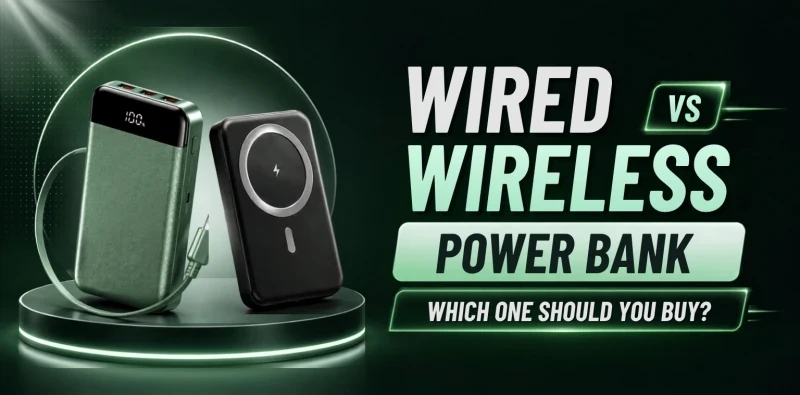
You're standing in a shop in Bashundhara City, and two power banks sit side by side. One has a plain USB-C port. The other has a smooth back with a magnet ring and no visible port. They are both within the same price range and have similar capacity. Which one do you go for? The honest answer depends on what you do with your phone during the day, not which one looks more premium.
Quick Comparison Table: Wired vs Wireless
What Is a Wired Power Bank?
A wired power bank charges your phone through a physical USB cable, plugged into either a USB-C or USB-A port on the power bank. Power flows directly through the copper wire, so very little energy gets lost along the way. This is still the dominant format in Bangladesh, and for good reason: it's cheaper to manufacture, charges faster, and works with essentially every phone made in the last decade as long as you carry the right cable.
What Is a Wireless Power Bank?
A wireless power bank charges through electromagnetic induction instead of a cable. You set your phone flat against the power bank, or snap it into place on magnetic models, and power flows across a small air gap between two coils. Most wireless power banks sold today follow either the Qi standard (the older, universal one) or Qi2, Apple's MagSafe-based successor that both iPhone and a growing number of Android phones now support. Some Bangladeshi retailers sell magnetic wireless power banks that pair induction with a ring of magnets, mainly to keep the phone from sliding off mid-charge.
If you've read our guide on fast-charging fundamentals, you already know that wattage doesn't tell the whole story. That gap between advertised and real-world speed is even wider with wireless.

Wired vs Wireless Power Bank: Key Differences
Charging Speed
A wired power bank clearly wins when it comes to charging speed. A USB-C PD power bank delivers 20W to 45W into a phone. Most wireless power banks get capped out around 15W under Qi2, and a lot of budget models sold in Bangladesh are around 5W–10W. Fifteen watts wireless sounds close to twenty watts wired, but conversion losses mean the phone doesn’t actually receive the full number either way.
Charging Efficiency
Wired power banks usually convert about 85% to 95% of the stored energy into charging your phone. Wireless charging is less efficient compared to wired. According to Wireless Power Consortium data and independent efficiency studies, wireless charging has an efficiency of around 60% to 80%. That missing 20% to 40% is released as heat, which is very noticeable in a wireless charger.
Convenience
Wireless is definitely more convenient since you don’t have to go through the hassle of searching for and connecting a wire. No cable to dig for, no worn-out port to fumble with in the dark, and magnetic models line up almost by feel. If you've ever snapped a charging cable at the connector because it got yanked at an awkward angle, you’re not alone.
Heat and Safety
Because wireless charging wastes more energy as heat, a wireless power bank and the phone sitting on it both run warmer during a charge cycle than they would over a cable. Occasional heat isn't dangerous by itself, but sustained heat is one of the fastest ways to shorten a lithium battery's lifespan, a topic we've covered in more depth in our piece on why power banks overheat.
Device Compatibility
Wired charging works with almost anything through the right cable and connector. Wireless charging only works with phones that have a Qi or Qi2 receiver built in, which rules out a fair number of budget Android phones still sold new in Bangladesh. Always check your phone's own spec sheet before assuming wireless charging will work at all.
Price and Value
A decent 20,000mAh wired power bank with 22.5W–45W fast charging costs about Tk 1,900 to Tk 3,300 in Bangladesh right now. In the case of a wireless power bank, the coil, magnets, and thermal management hardware necessary for the charging process add layers of extra manufacturing cost. So a similar wireless power bank is usually more expensive per mAh capacity. A 10,000 mAh wireless charger will cost you around Tk 2,300-4,000 in the current market.

Pros and Cons of Wired Power Banks
Faster Charging
Higher wattage threshold allows a near-empty phone to realistically reach a comfortable charge in under an hour with a good PD-compatible power bank and cable.
Better Efficiency
Less energy wasted as heat means more of the power bank's own capacity actually ends up in your phone, so you get more real-world charges out of the same mAh rating.
More Device Compatibility
Works with any phone that has a USB port, an accessory (earbuds, watch, portable fan), or a laptop that accepts USB-C PD input.
Requires a Cable
The one real downside. Forget the cable and the power bank is dead weight in your bag, which is why models with a built-in cable, like the Foneng PX138 or the Anker Zolo A1680H12, have gotten popular in Bangladesh over the past year.
Pros and Cons of Wireless Power Banks
Cable-Free Charging
Set the phone down, or snap it on, and it starts charging. It’s so convenient.
More Convenient for Travel
One less cable to pack, and magnetic models double as a rough kickstand for video calls on some designs.
Slower Charging Speed
Even the fastest consumer wireless power banks rarely beat a mid-range wired one. If you're in a hurry, wired remains the more dependable choice.
More Heat and Power Loss
The physics doesn't change no matter which brand makes the power bank. Induction always loses more energy than a direct copper connection.
Limited Phone Compatibility
Older phones, most budget Android models, and anything without a Qi receiver simply can't use it at all, wireless or not.

Wired vs Wireless Power Bank for Different Users
Students
Budget is a big factor here, and so is reliability between classes. A wired 10,000mAh model does the job without the added cost of wireless hardware.
Office Users
Wireless makes real sense at a desk. Set the power bank down once in the morning and rest your phone on it between meetings; no cable clutter on the desk.
Travelers
Wired is the better choice. Faster charging and universal compatibility both matter a lot while on the road. The convenience of skipping a cable matters less during long travels.
iPhone Users
iPhone 12 and newer support MagSafe out of the box, so a magnetic wireless power bank genuinely fits well into that ecosystem. Just don't expect it to out-charge a 20W–45W wired PD power bank.
Android Users
Compatibility is the deciding factor. Flagship Android phones from Samsung, Google, and OnePlus generally support Qi or Qi2. Budget and mid-range Android phones sold widely in Bangladesh often don't, so check the spec sheet before buying wireless.
Mobile Gamers
Wired, and it's not close. Gaming sessions demand fast top-ups, and phones already run hot under load; adding wireless charging's extra heat on top is a bad combination.
Which One Charges Faster?
Wired power banks consistently charge much faster compared to wireless ones. A 45W USB-C PD power bank like the QCY PB20A can take a modern phone from empty to roughly 50% in about half an hour, depending on the phone's own charging limit. The best wireless power banks on the market cap out around 15W, and most budget wireless models sold in Bangladesh sit well below that.
Which One Is Safer for Your Phone Battery?
Both are safe when built with proper protection circuitry and used normally. The meaningful difference is heat exposure over time. Consistently charging at high wireless power in a warm room adds more thermal stress to a lithium battery than the equivalent wired session. If your phone already runs a bit hot in general, wired charging is the better choice. For more on this, our power bank safety guide breaks down what actually damages a battery long-term.
Which One Is Better for Travel?
Wired. It's smaller relative to its capacity, charges faster when you're stuck at an airport gate with fifteen minutes to spare, and doesn't need your phone to sit perfectly still and aligned on a moving bus or train seat.
Which One Gives Better Value for Money?
Wired power banks are definitely going to give you more value per taka spent. You get more capacity, faster speed, and broader compatibility for less money. Wireless earns its higher price through convenience, not through better raw specs.

Important Features to Check Before Buying
mAh Capacity
Match capacity to your routine rather than getting swayed by big numbers. Our 10,000mAh vs 20,000mAh comparison will give you a better idea about the trade-offs in detail.
Output Wattage
Check both the wired and wireless wattage separately if you're eyeing a hybrid model. They're rarely the same number, and the wireless figure is almost always the lower one.
USB-C Fast Charging
Look for PD (Power Delivery) support specifically. It's the most widely supported fast-charging standard across both iPhone and Android right now.
Wireless Charging Standard
Qi2 is the newer, more efficient standard and the one to prefer if you're buying wireless in 2026. Older Qi-only models still work but tend to run less efficiently.
Magnetic Alignment
A magnetic ring keeps the phone centered on the coil, which meaningfully improves both speed and efficiency compared to a flat, non-magnetic wireless pad where the phone can drift out of alignment.
Safety Protection
Over-temperature protection matters more on wireless models specifically, given how much more heat the process generates. Don't skip checking for this spec just because a wireless power bank looks sleek.

Common Buying Mistakes to Avoid
Buying Wireless Without Checking Phone Compatibility
This is one of the most common mistakes when buying wireless power banks. Confirm your exact phone model supports Qi or Qi2 before paying extra for a wireless power bank you can't actually use.
Choosing Only by mAh
A bigger battery with a weak charging chip is still a slow charger. Capacity and wattage are two separate specs, and both deserve attention.
Ignoring Charging Speed
If you genuinely need a fast top-up before rushing out the door, a wireless power bank will consistently disappoint you next to a decent wired one.
Buying Cheap Fake Wireless Power Banks
Unbranded wireless power banks with no listed safety certification run a real risk of overheating, since wireless charging already generates more heat than wired to begin with. Stick to models with proper protection circuitry from a retailer that offers a warranty.
Wired and Wireless Power Banks Available in Bangladesh
Prices below are subject to change. So treat them as a guide rather than a fixed quote.
Model | Type | Capacity | Output | Price |
Wired | 20,000mAh | 45W PD | Tk 3,000-3,500 | |
Wired | 20,000mAh | 45W | Tk 2,700-3,300 | |
Wired | 20,000mAh | 22.5W PD | Tk 1,500-2,000 | |
Wired, built-in cable | 20,000mAh | 45W | Tk 3,000-3,500 | |
Wired, built-in cable | 10,000mAh | 35W | Tk 3,300-3,700 | |
Magnetic wireless | 10,000mAh | 15W (wireless) | Tk 2,000-2,500 | |
Magnetic wireless | 10,000mAh | 15W (wireless) | Tk 4,000-4,500 |
Shop Wired and Wireless Power Banks at SMS Gadget
Whichever side of this debate you land on, SMS Gadget stocks genuine, warrantied power banks from various brands like QCY, Baseus, AWEI, Anker, Foneng, Oraimo, Joyroom and more, both wired and magnetic wireless. Browse the full range of wired and wireless power bank in Bangladesh with nationwide delivery, or compare a wired and wireless model side by side in person at SMS Gadget stores all around Bangladesh.
Final Verdict: Wired or Wireless Power Bank?
If I had to keep just one, it would be a wired power bank, and I wouldn’t hesitate. Wired power banks have faster charging, better efficiency, lower price per mAh, and they work with practically any phone. Wireless is mainly just for convenience. Have it on a desk to charge whenever you feel like without the hassle of looking for a charger cable. But as a daily-carry, do-everything device, wired still wins on almost every practical measure that matters in Bangladesh's climate and price range.
References
Wireless Power Consortium — Qi2 standard announcement
Wireless charging efficiency data (Qi/Qi2, 60–80% range)
Frequently Asked Questions
It's worth buying if you value convenience more than specs. If fast charging matters more to you, a wired model is the better buy. Do keep in mind that your phone has to support wireless charging if you’re going for the convenience route.
Yes, wired is better for most users. Wired charges faster, wastes less energy as heat, and costs less per mAh of capacity.
No. It only works with phones that have a built-in Qi or Qi2 receiver. Check your phone's spec sheet before buying, since many budget Android phones don't include one.
Usually yes, as long as the case is thin and doesn't contain metal, which can block or weaken the magnetic and inductive connection. Thick cases and card holders often cause charging to fail or slow down.