
Solar Power Bank vs Regular Power Bank: Which Is Better?
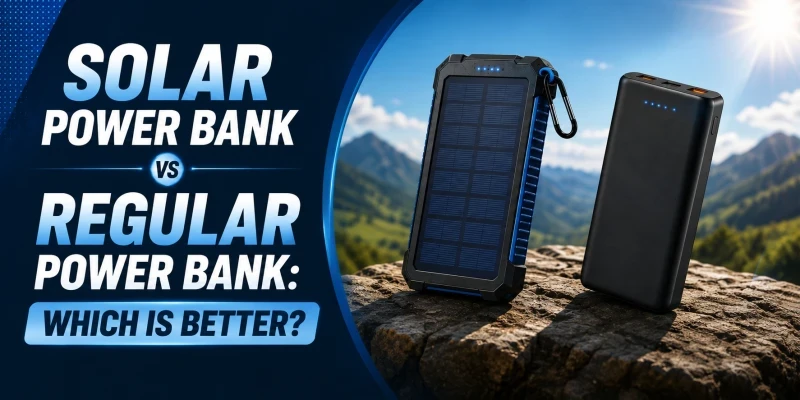
A small solar panel glued to the back of a power bank sounds like a neat idea. Free energy, no electricity bill, charge it just by leaving it on a windowsill. It's also one of the most oversold features in the entire power bank market, and if you've ever actually tried to charge one using nothing but sunlight, you already know the punchline. Let's go through what a solar power bank can and can't do, and where a plain, ordinary power bank still wins.
What Is a Solar Power Bank?
A solar power bank is a regular lithium-ion battery pack with a small photovoltaic panel built into its casing, or attached as a fold-out panel on some larger camping-focused models. The panel converts sunlight into a trickle of electricity that tops up the internal battery. Nearly every solar power bank on the market also charges normally through a USB-C or micro-USB input, since relying on the panel alone would leave you waiting days for a usable charge.
What Is a Regular Power Bank?
A regular power bank charges only through a cable, either from a wall adapter, a laptop, or another power source. There's no panel, no reliance on weather, and no folding parts to worry about. This is what the overwhelming majority of power banks sold in Bangladesh actually are, and for good reason: it's the format that reliably works.

Solar Power Bank vs Regular Power Bank: Key Differences
Charging Method
Solar power banks charge through both USB and sunlight. Regular power banks charge only through USB. In reality, however, solar owners use the USB port almost every time and use the panel as an emergency charging system.
Charging Speed
This isn't close. A regular power bank plugged into an 18W–45W wall adapter fills up in two to five hours. The same capacity power bank relying purely on its built-in solar panel can take a minimum of 15-20 hours of unbroken direct sunlight, according to specs published by several solar power bank manufacturers, and considerably longer under Bangladesh's frequent cloud cover during monsoon months.
Convenience
Regular power banks are also more convenient. You just plug in and walk away. Solar charging needs a clear sky with direct exposure and nothing blocking the panel. On top of that, you need hours of patience to charge up the power bank. These conditions don't always line up with an actual travel or work schedule.
Portability and Weight
The panel and its protective casing add more weight without adding meaningful battery capacity. A solar power bank of the same mAh rating as a regular one is usually thicker and heavier.
Price and Value
Solar power banks generally cost more per mAh than an equivalent regular model, since you're having to pay extra for the panel that rarely gets used. A well-reviewed 20,000mAh regular power bank with 22.5W–45W fast charging sells for around Tk 1,900 to Tk 3,500 in Bangladesh right now. A comparable solar model tends to cost more for the same charging speed.
Best Use Cases
Solar only makes sense when you’re out trekking, doing fieldwork in remote places, or travelling off-grid with no way to get electricity to recharge your devices. A regular power bank is the better fit for almost everything else, like commuting, travel with hotel access, office use, and load-shedding backup at home.
Quick Comparison Between Regular and Solar Power Banks
Factor | Regular power bank | Integrated solar power bank | Fold-out solar model |
Wall recharge | Fast | Fast | Fast |
Solar recharge | None | Extremely slow | Slow |
Weight | Lowest | Higher | Highest |
Weather dependence | None | High for solar | High for solar |
Daily use | Best | Usually poor value | Usually unnecessary |
Multi-day off-grid | Limited by stored charge | Emergency backup | More useful |
Load shedding | Best choice | Usually unnecessary | Usually unnecessary |

Do Solar Power Banks Really Work?
Technically, it does work. The panel does generate electricity, and it will slowly top up the battery when put in direct sunlight. But a typical small integrated panel produces somewhere between 0.5W and 6W under good sunlight, which is nowhere near the 20W–45W a wall adapter delivers. The spec sheets for 20,000mAh solar power banks from various manufacturers list full solar-only recharge time at 15 hours to multiple days. This is, of course, in direct, uninterrupted sunlight. Independent users report that cheaper single-panel models take considerably longer, sometimes weeks, under real-world cloudy or partial-shade conditions. It is thus better to treat the solar panel as an alternate charging source during emergencies and not a replacement for your charger.
How Long Does a Solar Power Bank Take to Charge?
Charging Method | Typical Time (20,000mAh) |
USB-C wall adapter (18W–22.5W) | 3.5–5 hours |
USB-C PD fast charging (30W–45W) | 1.5–3 hours |
Solar panel, direct clear sunlight | 15–20 hours (multi-panel models) |
Solar panel, partial cloud or shade | Multiple days, unreliable |
Which One Is Better for Daily Use?
A regular power bank, without much debate. Daily use means predictable charging: you plug it in at night or at your desk, and it's ready when you need it. Waiting on sunlight to line up with your schedule just isn't practical for a normal day in Dhaka or any other city.
Which One Is Better for Travel and Camping?
It depends on the trip. A weekend trip with hotel access or a charging point every night doesn't need solar at all; a regular power bank covers it fine. A genuine multi-day trek with no outlet anywhere changes the calculation, and that's the one scenario where carrying a solar panel actually starts to pay off, purely as a backup source alongside a regular power bank, not instead of one.
Which One Is Better for Emergencies and Load Shedding?
For Bangladesh's typical load-shedding pattern, a regular power bank wins clearly. You know the outage is coming, or at least that it's possible, so you charge the power bank in advance and it's ready the moment the power cuts. Solar only becomes genuinely useful in an extended, unpredictable outage lasting several days, which is a far less common scenario than routine load shedding.

Common Mistakes to Avoid Before Buying
Expecting Fast Charging From Small Solar Panels
One of the most common disappointments when it comes to solar power banks. A phone-sized solar panel simply can't match wall-adapter speeds, no matter what the marketing photos suggest.
Buying Based Only on High mAh Claims
Cheap solar power banks sometimes falsely claim very high capacity numbers. They should clearly be avoided. So it is best to stick to established brands with verifiable specs rather than the highest number you can find.
Ignoring USB Charging Speed
Since you'll be using the USB port most of the time anyway, its wattage matters more than the solar panel's. Check that spec before anything else.
Not Checking Waterproof or Rugged Features
If you're actually buying solar for outdoor use, an IPX4 or higher water-resistance rating matters more than the panel's peak wattage. A solar power bank without proper weatherproofing defeats its own purpose.
Regular Power Banks Available in Bangladesh
Solar power banks are mostly sold through generic marketplace listings in Bangladesh. Established electronics retailers rarely stock such devices as they do not provide much practical value. For everyday charging, including load-shedding backup, these regular power banks cover the same use cases with faster and more predictable charging.
Model | Capacity | Output | Price |
20,000mAh | 45W PD | Tk 3,000-3,500 | |
20,000mAh | 45W | Tk 2,800-3,200 | |
20,000mAh | 22.5W PD | Tk 1,700-2,000 | |
20,000mAh | 45W, built-in cable | Tk 3,000-3,500 | |
20,000mAh | 22.5W | Tk 2,000-3,200 |
Disclaimer: Prices are subject to change. Please verify the current prices before making a purchase decision.
Shop Reliable Power Banks at SMS Gadget
If a solar power bank is what brought you here, the honest advice is to make sure it is for an off-grid trip and to buy a regular power bank alongside it regardless. SMS Gadget stocks original, warrantied power banks from QCY, Baseus, AWEI, Anker, Foneng, and Oraimo, all tested for real-world charging performance. Browse our collection of Solar Power Bank and Regular Power Bank in Bangladesh with nationwide delivery, or visit an SMS Gadget store near you.
Frequently Asked Questions
Only in some very specific cases. They are useful mainly for multi-day camping or genuine off-grid emergencies. For daily use, a regular power bank is faster, cheaper, and more reliable.
Yes, it can, but it needs at minimum 15 to 20 hours to do so for a 20,000 mAh battery. That too in direct and uninterrupted sunlight. This can become considerably longer on a cloudy or partly shaded day.
Very slowly, if at all. Solar panels need direct, strong sunlight to generate power, and cloud cover or shade cuts the output sharply.
Generally yes, though leaving any lithium battery in direct heat for extended periods adds thermal stress over time. Avoid leaving one in a closed car or on hot pavement for hours.