
Power Bank vs Portable Charger: Are They the Same?
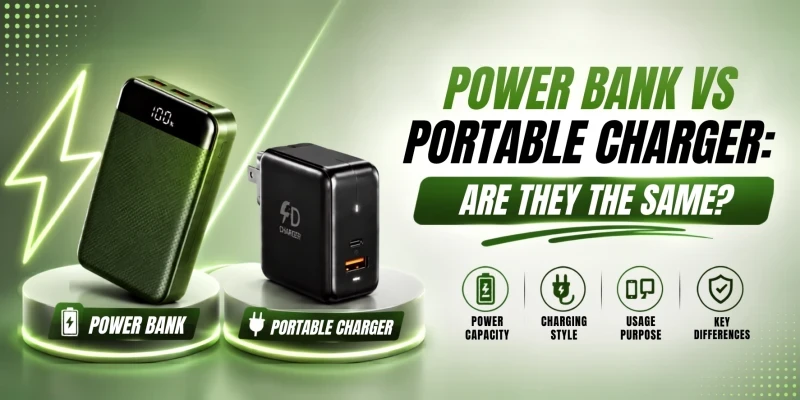
While shopping for phone accessories in Bangladesh, you’ve probably heard the terms “power bank” and “portable charger” used interchangeably. Ask for one, and you’re likely to be shown the other. So is there actually a difference between them, or are they simply two names for the same device? In most everyday situations, the answer is straightforward, but there are a few distinctions worth knowing.
Are Power Banks and Portable Chargers the Same?
Yes. "Power bank" and "portable charger" usually describe the identical product: a rechargeable battery pack with a USB output that you carry with you to top up a phone, earbuds, or tablet away from a wall socket. The term "power bank" is more common in Asia, including Bangladesh, China, and India. "Portable charger" shows up more in American product listings. Retailers in Dhaka use both terms on the same product page for search purposes, and that's not a trick; it's just how the vocabulary splits by region.
What people usually mean to ask, without quite phrasing it that way, is: "is this the same as the small plug that goes into the wall?" It isn't. That's a wall charger or charging adapter, and the difference there is real and worth understanding before you buy anything.
However, very rarely a large portable power pack or solar charger may be called a portable charger. But they have their own designated terms and should not be mistaken as a power bank.
What Is a Power Bank?
A power bank is a self-contained battery pack. Inside the casing are one or more lithium-ion or lithium-polymer cells, a small circuit board to manage charging, and one or more USB output ports (USB-A, USB-C, or both). You charge the power bank itself from a wall adapter, and it stores that energy until you plug your phone into it later.
Capacity is written in milliamp-hours, shortened to mAh. A 10,000mAh power bank holds roughly enough charge to refill an average smartphone battery about one and a half to two times, though the exact number depends on your phone's own battery size and the conversion losses explained further down this page.
What Is a Portable Charger?
A portable charger is built the same way, uses the same lithium cells, and does the same job. There is no technical spec sheet anywhere that separates a "portable charger" from a "power bank" as distinct product categories. If a listing calls something a portable charger and it has a battery inside with a USB output, it's a power bank by every functional definition.
The only place the wording occasionally trips people up is when "charger" gets used loosely for the wall adapter too. Read the spec box: if it lists a battery capacity in mAh, it's a power bank regardless of what the label says.

Power Bank vs Portable Charger: Key Difference
The one particular difference that may be considered is that some large battery packs or solar chargers may be called a portable charger and not power banks. Besides that slight nuance, portable chargers and power banks have no differences.
Meaning and Common Usage
Both terms refer to the same rechargeable battery accessory. Regional habit decides which word a shop, brand, or website uses, not the hardware.
Battery Capacity
Whether it's labeled power bank or portable charger, capacity is always expressed in mAh, commonly 5,000mAh, 10,000mAh, 20,000mAh, or 30,000mAh and above in the Bangladeshi market.
Charging Ports
Both come with USB-A, USB-C, or a mix of the two. Some newer models add a built-in cable so you don't need to carry a separate one, a feature you'll find under either name.
Fast Charging Support
Whether fast charging is present depends on the internal chipset supporting USB Power Delivery (PD) or Qualcomm Quick Charge (QC), not on which of the two names is printed on the box.
Device Compatibility
Compatibility is set by the output port type and wattage, again regardless of naming. A USB-C PD power bank works with an iPhone just as well as a portable charger with the same port and wattage rating.
Power Bank vs Wall Charger
This is the comparison that matters. A wall charger, also called a charging adapter, has no battery at all. It's a small block that plugs into a mains socket and converts household AC power into the DC voltage for your phone. Unplug it from the wall, and it does nothing. A power bank carries its own stored energy and lets you use it later on while you are on the go.
Aspect | Power Bank | Wall Charger / Adapter |
Contains a battery | Yes | No |
Works without mains power | Yes | No |
Typical use | Charge on the move | Charge at home, office, or a socket |
Rated in | mAh (capacity) and W (output) | W (output) only |
Example | QCY PB20A 20000mAh 45W | Anker Nano 45W adapter |
n practice, most people need both: a wall charger for overnight charging at home, and a power bank for the hours in between when there's no socket nearby.
Power Bank vs Battery Pack
"Battery pack" is an older, more generic term that predates the smartphone era; it originally described any external battery, including ones built for cameras, laptops, or radios. Today, when someone says battery pack in the context of phone charging, they almost always mean a power bank. The terms have effectively merged in casual use, though "battery pack" occasionally still refers to a bare cell array without the USB circuitry built in, which isn't something you'd buy off a retail shelf as a finished consumer product.
Power Bank vs Portable Power Station
Now this is where the size and purpose differences appear. A portable power station is a much bigger device weighing several kilograms, built around a much bigger battery measured in watt-hours (Wh) rather than mAh. These usually output AC power through not just USB, but also the sockets like the ones you have in your home. Power stations are meant for camping, load-shedding backup at home, or running small appliances like a fan or a light. They are definitely not for slipping into a backpack to charge a phone. A power bank's capacity is usually between 5,000 to 50,000 mAh (roughly 18.5–185Wh), but a power station starts well above that and can reach several kilowatt-hours.

Which One Should You Buy?
The naming question is settled, so the buying question is really about capacity and wattage for your actual routine. Here's how that breaks down.
Best Option for Daily Phone Charging
A 10,000mAh model with 18–22.5W output covers a normal day comfortably and stays light enough to forget it's in your bag. The Baseus 20W Mini 10000mAh from SMS Gadget fits this exactly.
Best Option for Travel
For bus journeys, flights, or a weekend outside Dhaka, 20,000mAh with fast charging in the 22.5W–45W range gives two to three full phone charges plus earbuds. The QCY PB20A (20,000mAh, 45W PD) and AWEI C03 (20,000mAh, 45W) are built for this.
Best Option for Laptop Charging
Capacity alone won't charge a laptop; the output wattage has to match the laptop's input wattage. It’s usually 45W through USB-C PD, which is a practical minimum for lighter ultrabooks and 65W or higher for most mainstream laptops. Check your laptop's own charger label for its wattage before assuming any power bank will do the job.
Best Option for Emergency Backup
During load-shedding or a long power cut, a 20,000–30,000mAh power bank with multiple output ports lets you keep a couple of devices charged. The Baseus Comet Series 20,000mAh, which ships with its own cable, is a great pick here since you're less likely to be caught without one during a cut

Important Features to Check Before Buying
mAh Capacity
Greater capacity isn't automatically better. It's a trade-off against weight and pocket space. You should buy a power bank with capacity based on how many charges you actually need between opportunities to recharge the bank itself.
Output Wattage
This determines charging speed, not battery life. A high-mAh power bank with weak 10W output will still charge your phone slowly. Look at the W rating on the box as well as the mAh.
USB-C and Fast Charging
USB-C with Power Delivery (PD) is now the standard for both Android and recent iPhones. Quick Charge (QC) is Qualcomm's equivalent, common on Android USB-A ports. Fast charging only works when the power bank, the cable, and the phone all support the same protocol. So an unmarked or very cheap cable can quietly cap your speed even with a good power bank.
Safety Protection
Look for over-charge, over-discharge, short-circuit, and over-temperature protection, usually listed in small print on the box or product page. These are the specs that protect your phone's battery and prevent the power bank from overheating, and it matters more than a flashy digital display.
Size and Weight
A 20,000mAh power bank typically weighs somewhere around 350–450 grams depending on the brand and build, noticeably heavier than a 10,000mAh unit. If you carry it daily in a small bag or pocket, weight matters as much as capacity.

Common Mistakes Buyers Make
Confusing Power Banks With Wall Chargers
Buying a wall adapter thinking it will work without a socket, or expecting a power bank to charge as fast as it can be plugged into it, is a silly mistake. They solve different problems.
Buying Based Only on mAh
A high mAh number with no fast-charging support and no safety certification is a poor trade against a smaller, well-built unit. Capacity is one spec among several, not the whole decision.
Ignoring Output Wattage
Two 20,000mAh power banks can charge at very different speeds if one outputs 10W and the other 45W. Always check both numbers together, capacity and wattage, before comparing price.
Choosing Fake or Cheap Models
Unbranded power banks sold without any safety protection can be a fire and battery-health risk. Buying from an authorized retailer with a warranty is the simplest way to avoid this.
Popular Power Banks in the Bangladeshi Market
The prices listed below are subject to change from the time of writing this article. Please check power bank prices here before making a purchase.
Model | Capacity | Output | Price (SMS Gadget) |
20,000mAh | 45W PD fast charging | Tk 3,000-3,500 | |
20,000mAh | 45W fast charging | Tk 3,000-3,300 | |
20,000mAh | 22.5W fast charging | Tk 3,000-3,300 | |
20,000mAh | 45W, built-in cable | Tk 3,000-3,500 | |
20,000mAh | 22.5W PD, metal body | Tk 1,600-2,000 | |
20,000mAh | 22.5W, cable included | Tk 1,800-3,200 | |
10,000mAh | 35W, built-in dual cable | Tk 3,300-3,700 |
Shop Power Banks at SMS Gadget
Every power bank at SMS Gadget is an original unit backed by proper warranty support. We feature various models from trusted brands like QCY, Baseus, AWEI, Anker, Foneng, Oraimo, Joyroom, and more. Explore our complete collection of power banks with nationwide delivery, or visit SMS Gadget stores across Bangladesh to check capacity, design, and build quality before making your purchase.
Frequently Asked Questions
Neither is "better" since they're the same product category. What varies is the specific model's capacity, wattage, and safety certification.
Most modern power banks with a USB-A or USB-C port can charge any phone that uses the same connector. Charging speed will vary depending on whether both devices support the same fast-charging protocol.
For most people, yes. It usually covers one and a half to two full smartphone charges, enough for a normal workday plus commute.
Yes, in carry-on luggage only. You can’t take them in checked baggage. 100Wh is the maximum capacity allowed in civilian flights. Anything above 100Wh is strictly forbidden in most parts of the world. However, in some countries like the US, you are allowed to take up to 160Wh with the airline's approval. A 20,000mAh power bank works out to roughly 74Wh at the standard 3.7V cell rating, well within the unrestricted limit.