
Lithium-ion vs Lithium-polymer Power Bank: Which Is Better?
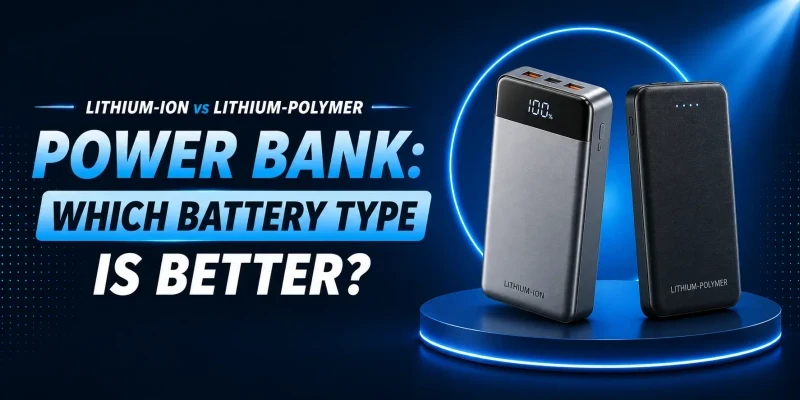
Flip over almost any power bank box, and you'll find a small line reading either "Li-ion" or "Li-polymer." Marketing copy treats these like two completely different technologies, one implicitly safer or more advanced than the other. That framing is a bit misleading. They're the same core electrochemistry wearing different packaging, and once you understand what actually changed between them, the buying decision gets a lot simpler.
What Is a Lithium-ion Power Bank?
A lithium-ion power bank uses cells built in the traditional way. A liquid or gel electrolyte is sealed inside a rigid metal can, usually cylindrical, like the familiar 18650 or 21700 formats used across the electronics industry. Lithium ions shuttle between a graphite anode and a metal-oxide cathode through that liquid electrolyte during charge and discharge. This is the oldest, most standardized form of consumer lithium battery, commercialized by Sony back in 1991, and decades of mass production have made these cylindrical cells cheap, consistent, and easy to source.
What Is a Lithium-polymer Power Bank?
A lithium-polymer power bank uses cells built with a gel-like or solid polymer electrolyte instead of a free liquid one, packaged in a flexible foil pouch rather than a rigid can. According to Battery University's own technical breakdown, the chemical makeup is nearly identical to a standard lithium-ion cell. The real innovation is that the polymer electrolyte doesn't need a rigid container to hold it in place, so manufacturers can shape the cell into thin, flat, or irregular forms that a cylindrical can never could. That's the entire story behind why slim power banks and phone batteries are almost always lithium-polymer.

Lithium-ion vs Lithium-polymer Power Bank: Key Differences
Battery Chemistry
This is the point worth slowing down on: there isn't really a chemistry difference. Lithium-polymer is a lithium-ion battery. The electrolyte formulation and the packaging change, not the underlying reaction of lithium ions moving between electrodes. Treat "Li-ion vs Li-Po" as a packaging comparison, not a chemistry comparison, and the rest of this article will make a lot more sense.
Size and Weight
Li-polymer takes the advantage here. Without a rigid metal can to contain a liquid electrolyte, pouch cells can be made thinner and shaped to fit oddly proportioned devices. This is why slim, card-style power banks and modern smartphones use pouch cells almost exclusively.
Energy Density
This one is contested among battery engineers, and different manufacturers report different numbers depending on cell design and quality. The cited specific energy ranges for both types overlap significantly, around 100–265 Wh/kg for polymer cells and for cylindrical lithium-ion cells almost similar to that. In practice, energy density depends more on a specific cell's engineering and manufacturing quality than on which of the two packaging styles it uses.
Charging Speed
Charging speed is set mainly by the battery management system and the cell's internal resistance, not by the Li-ion vs Li-Po itself. Pouch cells can sometimes handle slightly higher charge and discharge rates because of their shorter internal current path, but a well-engineered cylindrical Li-ion power bank with a good controller chip will still out-charge a poorly designed Li-Po one.
Lifespan
Cylindrical Li-ion cells have a long track record in consumer electronics. They are often associated with solid, predictable cycle life thanks to decades of standardized manufacturing. Li-Po pouch cells can match or exceed that in well-engineered products, but cheaper pouch cells are also more common in budget accessories, which is part of why "Li-Po degrades faster" became a common claim. The honest answer is that manufacturing quality affects lifespan more than the packaging category does.
Safety
Both formats fail differently rather than one being categorically safer. A cylindrical Li-ion cell has a rigid metal casing as well as often a built-in pressure-relief vent, which offers some physical protection but can, in rare failure cases, fail without much visible warning. A Li-Po pouch cell is more vulnerable to punctures because of its thin foil packaging, but it also tends to swell visibly when it's degrading or has been damaged, which doubles as an early warning sign to stop using it. Both are safe in normal use when built with proper protection circuitry, and both can fail if abused, overcharged, or physically damaged.
Cost
Cylindrical Li-ion cells are generally cheaper to produce, since 18650 and 21700 formats are commodity items manufactured at enormous global scale. Li-Po pouch cells cost more per Wh due to the more delicate sealing process and the custom shapes many products need, which is part of why slim premium power banks often carry a higher price tag.

Pros and Cons of Lithium-ion Power Banks
- Pro: generally cheaper per mAh, since cylindrical cells are mass-produced commodity parts.
- Pro: long, well-documented track record in consumer electronics.
- Pro: rigid casing offers decent physical protection against minor impacts.
- Con: bulkier and heavier, since the rigid can adds size that a pouch cell doesn't need.
- Con: less flexible in form factor, which limits how slim a design can get.
Pros and Cons of Lithium-polymer Power Banks
- Pro: enables thin, light, and custom-shaped power banks.
- Pro: swelling gives a visible, early warning sign of degradation before failure.
- Pro: shorter internal current path can support strong charge and discharge rates in well-designed cells.
- Con: thin foil pouch is more vulnerable to punctures and physical damage.
- Con: typically costs more to manufacture than an equivalent cylindrical Li-ion cell.
Which Battery Type Lasts Longer?
Neither type has a clear, universal edge once you control for build quality. A well-made power bank from an established brand, cylindrical or pouch, will typically hold up for a few hundred to over a thousand charge cycles before capacity noticeably drops. What actually shortens lifespan in daily use is heat, frequent full discharges, and cheap, uncertified cells, not the packaging category printed on the spec sheet.
Which Battery Type Is Safer?
Both are safe in a properly engineered power bank with working protection circuitry. If anything, Li-Po's tendency to swell before it fails can be taken as a warning : it gives you a visible signal to stop using it, whereas some cylindrical cell failures can happen with less external warning. The bigger safety factor, by far, is whether the power bank has genuine over-charge, over-discharge, and short-circuit protection, which has far more to do with the brand and build quality than the battery type.
Which Battery Type Is Better for Travel?
Lithium-polymer, mainly because of weight and shape. A slim Li-Po power bank slides into a bag pocket more easily than a bulkier cylindrical-cell model of the same capacity, which matters more the more you're carrying around.
Which Battery Type Is Better for Daily Use?
Either works fine for daily charging. If you want the lowest price for a given mAh figure, cylindrical Li-ion models tend to be cheaper. If you want something slim enough to forget it's in your bag, Li-Po is the better fit. Daily reliability comes down to the brand and safety certification far more than the cell type.
Which Battery Type Should You Buy?
Best Choice for Budget Buyers
Cylindrical Li-ion power banks generally offer the lowest price per mAh, since the cells themselves are cheaper commodity parts.
Best Choice for Slim Design
Li-polymer, without much competition. If a slim profile matters to you, check the spec sheet for polymer cells specifically.
Best Choice for High Capacity
Cylindrical Li-ion is common in high-capacity 20,000mAh–30,000mAh power banks, since stacking standardized cylindrical cells is a cost-effective way to reach large capacities.
Best Choice for Everyday Phone Charging
The one which comes from a brand with proper safety certification and a warranty is almost always a better choice. At this point in the article, that should be the clearer takeaway than the chemistry label itself.

Common Mistakes to Avoid Before Buying
Choosing Only by mAh
A high capacity number does not say anything about the cell's build quality, safety protection, or actual charging speed. Look at the full spec sheet and decide whether it is good for you personally or not.
Ignoring Safety Protection
Over-charge, over-discharge, and short-circuit protection matters significantly more than the cell's shape being cylindrical or pouch-shaped. Don't skip checking for such features, as they are more important than just the mAh numbers.
Buying Fake or No-Name Power Banks
Unbranded power banks without cell specifications or safety certification carry a real risk regardless of whether it has Li-ion or Li-Po inside. The label on the box means little if there's no accountable manufacturer behind it.
Not Checking Warranty and Brand Reliability
A one-year warranty from an established brand tells you more about how the power bank will hold up than the battery chemistry printed on the spec sheet.
Power Banks Available in Bangladesh
The following are some of the most popular power banks available in Bangladesh right now. Prices are subject to change. Please check the current power bank pricing before making a purchase decision.
Model | Capacity | Output | Price |
20,000mAh | 22.5W PD | Tk 1,500-2,000 | |
20,000mAh | 45W PD | Tk 3,000-3,500 | |
10,000mAh | 35W, built-in cable | Tk 3,300-3,800 | |
20,000mAh | 45W, built-in cable | Tk 3,000-3,500 |
Shop Certified Power Banks at SMS Gadget
Whether a power bank uses cylindrical or pouch cells matters less than whether it comes from a brand that stands behind its products. SMS Gadget offers genuine, warrantied power banks from QCY, Baseus, AWEI, Anker, Foneng, Oraimo, and many other brands, with proper safety protection built in. Browse our collection of power banks in Bangladesh with nationwide delivery, or visit an SMS Gadget store to check the build quality in person.
Frequently Asked Questions
No, they differ very slightly in terms of electrolyte and packaging. Lithium-polymer is just a lithium-ion battery with a different electrolyte and packaging. It's better for slim and lightweight designs. Cylindrical lithium-ion is often cheaper and common in a lot of models.
Both are safe when built with proper protection circuitry. Li-Po tends to swell visibly before failing, which acts as an early warning sign. Cylindrical Li-ion cells have a rigid casing and vent mechanism. Build quality as well as certification is more important than the category.
Often, yes, per mAh of capacity, mainly because pouch cells cost more to manufacture and are commonly used in slimmer, more premium-positioned products.
Any lithium battery can fail if it's damaged, overcharged, or manufactured without proper safety protection, regardless of type. A certified power bank from a reputable brand carries a very low real-world risk.
Check the product spec sheet or manufacturer listing. As a visual guide, thicker power banks with a slightly rounded profile more often use cylindrical Li-ion cells. The very slim and flat models are almost always lithium-polymer.