
Best Wireless and MagSafe Power Bank: Which One Should You Buy?
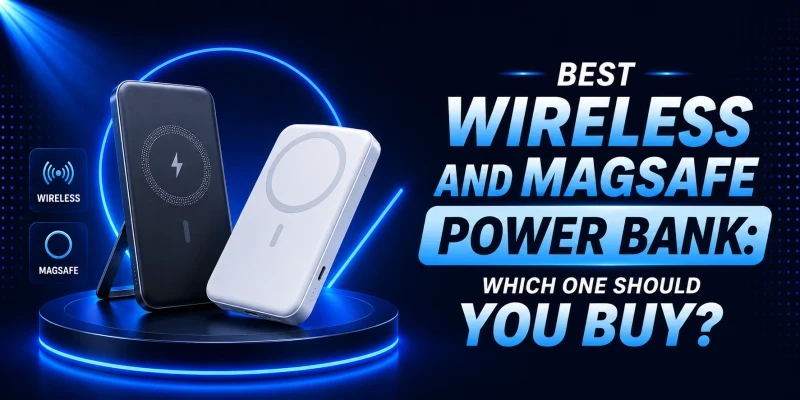
MagSafe power banks have a certain appeal: the satisfying snap when it locks onto the back of an iPhone, the way it just sits there charging without a cable dangling off the side. It looks pretty cool. But "MagSafe" and "wireless" get used almost interchangeably in product listings, and that's where a lot of buyers end up with the wrong device for what they actually need. Let's sort out what each one really is before you spend money on the wrong magnet.
What Is a Wireless Power Bank?
A wireless power bank charges a phone through electromagnetic induction rather than a cable. You lay the phone flat on the pad, and current flows across the small gap between two coils, one in the power bank, one inside the phone. This works with any phone that has a built-in Qi receiver, which covers most flagship and some mid-range phones from the past several years, both iPhone and Android.
What Is a MagSafe Power Bank?
A MagSafe power bank is a wireless power bank with a ring of magnets built around the coil, precisely matched to the magnet ring inside iPhone 12 and later models, with the exception being iPhone 16e. Apple introduced the MagSafe technology back in 2020. The magnets exist for one purpose: keeping the phone perfectly centered on the coil so charging stays consistent instead of drifting out of alignment. Since Qi2 launched, the same magnetic alignment idea has become an open industry standard, so a growing number of Android phones now support it too, though iPhone remains where you'll find it most often in the Bangladeshi market.

Wireless vs MagSafe Power Bank: Key Differences
Charging Method
Both methods charge using electromagnetic induction. The only difference is the magnet ring. MagSafe models have them, but the Qi pads don't.
Magnetic Alignment
This is MagSafe's whole reason for existing. A flat Qi pad depends on you placing the phone in roughly the right spot, and drifting off-center mid-charge is a common annoyance. The magnets solve that problem outright, snapping the phone into the same spot every time.
Charging Speed
Apple's own official MagSafe charger reaches a maximum of 25W on some of the latest iPhone models, but still caps out at 15W on the older ones. Third-party magnetic power banks sold in Bangladesh do not have Apple's MFi certification or Qi2 certification. So they cap out lower, often around 7.5W, since the charging chip inside determines the real ceiling regardless of what the box advertises. However, in the latest models of iPhones and Qi2 android models, the charging speed has gotten a significant bump up to 25W from the previous ceiling of 15W. Although, a wired USB-C PD power bank in the 25W–45W range will still out-charge either wireless option.
Charging Efficiency
Wireless charging, magnetic or not, loses more energy as heat than a direct cable connection does. Usually landing in the 60%–80% efficiency range against roughly 85%–95% for wired. The magnets don't change this part of the physics; they only fix alignment, not the fundamental induction losses.
Heat and Battery Drain
Because more energy converts to heat during wireless charging, both the power bank and the phone run at a higher temperature than they would over a cable. This matters more in Bangladesh's climate than somewhere cooler, and it's worth keeping in mind if you plan to wireless charge for extended periods.
Device Compatibility
A normal Qi wireless power bank works with any Qi-enabled phone. The magnets in a power bank with MagSafe only align properly with iPhone 12 and later models, or with Android phones that have Qi2 certification. Older iPhones and most budget Android phones can sometimes still charge on a MagSafe pad by resting flat on it.
Price and Value
MagSafe and magnetic wireless power banks generally cost more than an equivalent-capacity wired model, since you're paying for the coil, the magnet ring, and often a kickstand or ring-holder design on top. A 10,000mAh magnetic wireless power bank in Bangladesh typically runs somewhat higher than a 10,000mAh wired model with comparable build quality.

Pros and Cons of Wireless Power Banks
- Pro: works with any Qi-compatible phone, not locked to one brand or generation.
- Pro: cable-free convenience at a desk or bedside.
- Con: phone can drift off the coil mid-charge without magnets to hold it centered.
- Con: slower and less efficient than wired charging.
Pros and Cons of MagSafe Power Banks
- Pro: magnets keep the phone perfectly aligned, so charging stays consistent.
- Pro: doubles as a kickstand on many designs, useful for video calls or watching something.
- Con: only aligns properly with iPhone 12 and later, or Qi2-certified Android phones.
- Con: third-party models often cap well below Apple's 25W ceiling, sometimes as low as 7.5W.
Which One Is Better for iPhone Users?
If you have an iPhone 12 or newer, a MagSafe power bank is a great choice for everyday convenience. The alignment with the magnets keeps your phone in place. For anyone who's ever had a phone slide off a flat wireless pad mid-charge, this feature might just save it from falling over in the future. Just don't expect it to match a wired charger for speed.
Which One Is Better for Android Users?
A plain Qi wireless power bank makes more sense, unless your specific phone is Qi2-certified, in which case some magnetic models will work with it too. Check your phone's exact spec sheet rather than assuming, since Qi2 support still varies a lot across Android models sold in Bangladesh.
Which One Is Better for Travel?
Wired, honestly, for most travel. It's faster when you're in a hurry at a gate or bus stop, and it works regardless of which phone you or a travel companion happen to be carrying. A MagSafe power bank is a nice-to-have for a commute or a day out, less so for a trip where charging speed and universal compatibility matter more.
Which One Is Better for Daily Use?
For an iPhone owner who mostly charges at a desk or nightstand, MagSafe is a great choice for convenience if speed doesn’t matter to you as much. For anyone who wants a quick top-up before heading out the door, wired remains the more dependable daily habit.

Important Features to Check Before Buying
Battery Capacity
10,000mAh is a comfortable middle ground for a compact magnetic power bank. Going much higher usually means a noticeably bulkier, heavier unit that partly defeats the point of a slim magnetic design.
Wireless Charging Speed
Check the actual wireless wattage, not just the wired USB-C figure printed in bold on the box. They're often two very different numbers, and the wireless one is what determines how fast your phone actually charges on the pad.
USB-C Fast Charging
Most magnetic power banks also include a USB-C port for wired charging. You wouldn’t want to charge at a meager 7.5-15W every time. When you’re in need of an urgent top-up, just charge wired. Confirm it supports PD, not just a generic 5V/2A output.
Magnetic Strength
Weak magnets are a common complaint on cheaper models, since the phone can shift or fall off during movement. Reviews and product videos would give you a better understanding of the magnetic strength than the spec sheet numbers.
Stand or Kickstand Design
Several magnetic power banks fold out into a stand, useful for video calls or watching something while charging. It's a genuine convenience if you'll actually use it, and dead weight if you won't.
Safety Protection
Over-temperature protection matters more for a wireless power bank than a wired one, given how much more heat wireless charging generates. Don't skip this spec just because the magnetic design looks premium.
Size and Weight
Magnetic power banks are bulky because of the coil and magnet ring compared to an equivalent slim wired model. If pocket comfort matters to you, check the dimensions of the power bank you’re planning to buy and make a decision based on what you prioritize more.

Common Mistakes to Avoid Before Buying
Buying MagSafe Without Checking Phone Compatibility
A very common mistake is people buying a MagSafe power bank while their phones don’t support it. Confirm you actually have an iPhone 12 or later, or a Qi2-certified Android phone, before paying extra for magnets that won't align with your device.
Ignoring Charging Speed
Most magnetic power banks only deliver around 7.5-15W wireless, with the exception of some flagship models supporting a maximum of 25W. It will feel considerably slower than a wired model in daily use. If speed matters to you, you must take that into account before buying.
Choosing Only by mAh
A bigger battery with weak magnets or slow wireless output is still a frustrating daily-use product. So capacity shouldn’t be the main factor when deciding to buy a wireless or MagSafe power bank.
Using a Thick or Non-Magnetic Phone Case
Thick cases, card holders, and cases without embedded magnets can all block or weaken the magnetic connection. So check whether your case negatively affects the charging process.
Buying Cheap Models With Weak Magnets
Unbranded magnetic power banks sometimes use small magnets that don't hold up your phone securely, which defeats the entire point of buying MagSafe in the first place. It’s best to stick to established brands with good reviews.
Wireless and MagSafe Power Banks Available in Bangladesh
The following are some of the most popular power banks currently available in the market. Prices are subject to change, so please check the current price listing before buying.
Model | Type | Capacity | Output | Price |
Magnetic wireless | 10,000mAh | 20W USB-C / ~15W wireless (max) | Tk 2,000-2,500 | |
Wired | 20,000mAh | 45W PD | Tk 3,000-3,500 | |
Wired | 20,000mAh | 22.5W | Tk 1,500-2,000 | |
Wired, built-in cable | 10,000mAh | 35W | Tk 3,300-3,800 |
Shop Wireless and MagSafe Power Banks at SMS Gadget
Whichever way you lean, SMS Gadget stocks original power banks with proper warranty, including the JOYROOM JR-PBM08 Pro magnetic wireless model, alongside a full range of wired options from QCY, Baseus, AWEI, Anker, Foneng, and Oraimo. Browse our Wireless and MagSafe Power Banks in Bangladesh for the latest models and pricing, with nationwide delivery available, or check the magnet strength and build quality in person at SMS Gadget stores across Bangladesh.
References
- MagSafe wattage and iPhone 12+ compatibility — Apple official MagSafe documentation, apple.com
- Wireless charging efficiency data (60–80% range) — Wireless Power Consortium and independent efficiency studies
Frequently Asked Questions
Yes, but only for people who own iPhone 12 or later versions, and prioritize convenience over speed. If raw charging speed matters more to you, a wired power bank will still outperform it.
Yes, almost always. Most genuine wireless power banks peak around 15W while the third-party magnetic models often sit closer to 7.5W. A very few models support a maximum of 25W wireless charging speed. Wired USB-C PD power banks commonly reach 20W to 45W.
Not inherently, but the extra heat generated during wireless charging adds more long-term thermal stress to a battery than wired charging does with repeated daily use. Occasional use isn't a concern.
It covers around 50-70% of a full phone charge for most modern phones. It’s enough for a top-up during the day but not a full recharge. 10,000mAh is a better choice if you want a full charge or more.