Which Bluetooth Version Is Best for a Neckband? Complete Guide
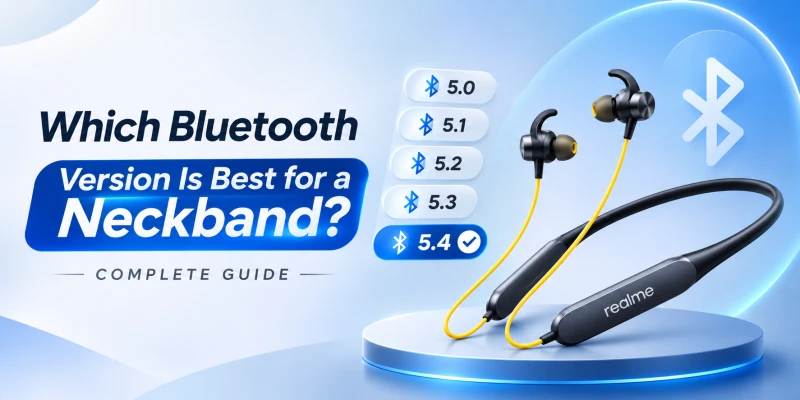
Bluetooth 5.3, 5.4 or 6.x for a neckband? See what each version changes, why codecs and chipsets matter more, and what to check before you buy.
When you're comparing neckbands, you might end up in a situation where all the specs are the same for two neckbands, but they differ in Bluetooth version. One says Bluetooth 5.3 or 5.4 on the box; the other says Bluetooth 6.0. It feels like the biggest number should win. But that might not be true.
The version tells you which edition of the Bluetooth rulebook the chip was built to. It doesn't tell you how the neckband sounds, how quickly it reacts in a game or how long the battery lasts. Our Neckband Buying Guide explains what each Bluetooth version really adds, what matters more, and what to check before you pay.
Which Bluetooth Version Is Best for a Neckband?
For most people, Bluetooth 5.3 or 5.4. Both connect to any phone, and the newer features in 5.4 and 6.x are aimed at shop labels and sensors, not headphones. If two neckbands cost the same, take the higher version. If one costs more only because of the version number, don't pay it. Here's why, one factor at a time.
Stable Connectivity
A neckband holds its connection because of its antenna, its chip and its firmware. The version is a weak clue at best. A well-built Bluetooth 5.0 neckband can hold a link better than a badly built 5.3 one.
Device Compatibility
Bluetooth is backward compatible. This means a 5.4 neckband connects to a 5.0 phone and the other way round. You just get the features both sides share.
Codec Support
The codec determines how the music is compressed. It shapes the sound far more than the Bluetooth version does. Most budget neckbands carry SBC and AAC, and some pricier ones add aptX. Read the codec line on the spec sheet.
Low Latency
Delay comes from the codec, the neckband's buffer and its gaming mode. A version number can't fix any of those.
Power Efficiency
Most of the power-saving features added since 5.0 belong to Bluetooth Low Energy. Ordinary music streaming runs on Classic audio, so the chip's design matters more than the number printed on the box.
Multipoint Connectivity
Connecting to two devices at once is a firmware feature. Plenty of 5.3 and 5.4 neckbands don't have it.
LE Audio Support
LE Audio needs a chip built to Bluetooth 5.2 or newer, but a 5.2 or newer chip doesn't guarantee it. The maker also has to add LC3 and the LE Audio profiles.

What Does Bluetooth Version Mean in a Neckband?
The Bluetooth SIG, the group that owns the standard, publishes a new Core Specification every so often. The version on the box says which edition the neckband's chip follows.
Bluetooth Core Version vs Bluetooth Features
A core version is like an index. It lists what a chip is allowed to do, and most of them are optional. A maker can print 5.4 on the box without using a single feature that 5.4 introduced.
Why Two Neckbands With the Same Bluetooth Version Can Perform Differently
Two neckbands can share a Bluetooth version and still behave differently. One has a better chip, a smarter antenna layout or a bigger battery. The other might have better tuning on its drivers. Even though the version is the same, the product isn't.
Bluetooth Hardware, Firmware, and Software Implementation
There are three layers that decide what you experience. The chip and antenna are the hardware. The firmware sets which codecs, gaming mode and multipoint are switched on. Your phone's Bluetooth software is the third layer. If one of them is weak, you can feel the difference.
Bluetooth Versions Comparison
Here's what each release added, and whether a neckband owner would notice.
Bluetooth 5.0
The big jump over 4.2. It doubled the raw speed of the Low Energy radio with the 2M PHY and added a long-range mode. Both are Low Energy features, so ordinary Bluetooth music streaming doesn't use them.
Bluetooth 5.1
5.1 added a directional finding feature. Direction finding lets a device work out which way a signal came from. That suits asset tags and indoor navigation. It does nothing for headphones.
Bluetooth 5.2
This is where LE Audio began. Isochronous Channels let the Low Energy radio carry time-sensitive audio. LE Power Control adjusts power transmission to save energy.
Bluetooth 5.3
This was a tune-up release. Connection subrating lets Low Energy devices swap quickly between fast and slow connection rates, and devices got better at reporting which channels are noisy. You won't hear a difference.
Bluetooth 5.4
Arrived in February 2023. Its main feature, Periodic Advertising with Responses, is aimed by the Bluetooth SIG at electronic shelf labels in shops. Nothing in it targets headphones.
Bluetooth 6.x
Covered in its own section below. The short version: the additions are about distance measuring, privacy and input devices.

Is Bluetooth 5.3 Better Than Bluetooth 5.0 for a Neckband?
Slightly, and mostly because 5.3 chips are newer, not because of the spec itself.
Connectivity
5.3 improves how Low Energy devices avoid noisy channels. For a music link, antenna and chip quality still count for more. A good 5.0 neckband is still fine.
Power Efficiency
Newer chips waste less energy, but a neckband's runtime comes mostly from battery size, ANC use and codec. Our charging and storage guide covers how to keep the cell healthy over time.
Compatibility
No difference. Both connect to any phone.
Latency
No meaningful difference. Gaming mode matters far more.
Sound Quality
None from the version. Codec and tuning decide.
Is Bluetooth 5.4 Better Than Bluetooth 5.3 for a Neckband?
On paper, yes. In your ears, no. The headline 5.4 features serve shop labels and sensor networks.
Does Bluetooth 5.4 Improve Music Quality?
No. Sound depends on the codec, the drivers and the tuning.
Does Bluetooth 5.4 Reduce Latency?
No. Latency depends on the codec, the buffer and gaming mode.
Does Bluetooth 5.4 Improve Battery Life?
Not by itself. Battery size, codec and ANC set the runtime. If 5.4 costs the same as 5.3, take 5.4. If it costs more, ask what else you're getting for the extra money.
What About Bluetooth 6.0, 6.1, 6.2, and 6.3?
The Bluetooth SIG now releases a new Core version twice a year, so the 6.x series is growing quickly. None of it has changed how a neckband plays music yet.
What Changed With Bluetooth 6.0?
Released in August 2024, its headline feature is Channel Sounding. This feature measures the distance between two devices precisely, like locating digital car keys and finding lost items. It also improved the isochronous adaptation layer, which helps LE Audio.
What Changed With Bluetooth 6.1?
Published in May 2025. It randomizes the timing of private address changes, which helps privacy and trims power use. You won't notice it in headphones.
What Changed With Bluetooth 6.2?
Released in late 2025. Its main addition lets Low Energy connections use intervals as short as 375 microseconds, down from 7.5 milliseconds. That targets mice, keyboards, game controllers and sensors. It also hardened Channel Sounding against attacks and simplified how USB hosts handle LE Audio.
What Changed With Bluetooth 6.3?
Released in May 2026. It refines Channel Sounding accuracy, expands the host-controller interface so future features fit, and aligns some radio limits between Classic and Low Energy. It's housekeeping for chip designers more than a feature for buyers.
Do You Need Bluetooth 6.x in a Neckband?
No. Nothing in 6.0 to 6.3 changes how a neckband plays music or handles a call today. A 6.x neckband is fine if it costs the same as a 5.3 or 5.4 one. Paying extra for the same specs would be unwise.

Does Bluetooth Version Affect Sound Quality?
Not directly. A Bluetooth link has far more room than music needs. Classic Bluetooth's EDR modes reach a raw rate of 3 Mbps, while a high-quality SBC stream runs at a few hundred kbps. It’s the codec's bitrate ceiling that limits what you can hear.
Bluetooth Version vs Audio Codec
The Bluetooth version describes the radio. The codec, on the other hand, determines how the music is compressed before it's sent. Sound quality depends on the codec
Why Codec Support Matters for Audio Quality
The phone and the neckband agree on the best codec they both support. If the neckband lists AAC but your Android phone doesn't use it, you get SBC. iPhones use AAC and SBC only. Our Ultimate Earbuds Buying Guide covers the same codec rules for earbuds.
Can an Older Bluetooth Version Sound Better Than a Newer One?
Easily. A 5.0 neckband with AAC and well-tuned drivers can beat a 5.4 one stuck on SBC with sloppy tuning. Drivers and tuning do most of the work.
What Is Bluetooth LE Audio?
LE Audio is the newer Bluetooth audio system. It runs on the Low Energy radio, whereas Classic audio runs on the older Classic radio, and it comes with its own codec, LC3. The Bluetooth SIG's LE Audio FAQ lists better efficiency, hearing aid support and Auracast broadcast audio among the gains.
Classic Audio vs LE Audio
Classic Audio uses the A2DP profile with SBC as the required codec. LE Audio uses isochronous channels, LC3 and a newer set of profiles. They're separate paths, and a device can support one or both.
What Is LC3?
LC3 stands for Low Complexity Communication Codec. Every LE Audio product must support it.
Does LE Audio Improve Battery Efficiency?
It can. The SIG says LC3 can match SBC quality at less than half the bit rate, which cuts radio time. The same FAQ adds that real savings depend on how the maker builds the product.
Does LE Audio Improve Sound Quality?
In the SIG's listening tests, LC3 scored better than SBC at the same bitrate. That's a lab result. A neckband's drivers and tuning still shape the final sound.
Do Both Devices Need LE Audio Support?
Yes. If either the phone or the neckband lacks it, the link falls back to Classic Audio. Android added LE Audio support in Android 13, but the phone maker and chipset still have to switch it on.
What Is the LC3 Codec?
LC3 is the codec built for LE Audio. Its pitch is quality at a low bitrate.
LC3 vs SBC
SBC was designed for compatibility and needs a high bitrate to sound good. LC3 was designed for efficiency. In the SIG's tests, it matched SBC's quality at well under half the bitrate.
LC3 and Power Efficiency
A lower bitrate means less data to send and less radio time. That saves power in both the neckband and the phone.
Is LC3 Automatically Better Than Other Codecs?
No. AAC, aptX and LDAC are good codecs too, and LDAC runs at far higher bitrates than LC3. LC3's edge is efficiency, not top-end quality. It also needs LE Audio on both devices, so an LC3 neckband does nothing for you on a phone without it.

Does Bluetooth Version Affect Battery Life?
Barely. A handful of other things set a neckband's runtime first.
Bluetooth Version and Power Efficiency
Newer versions add power features, mostly for Low Energy devices like fitness bands and tags. A neckband streaming music over Classic Audio benefits less.
Chipset Efficiency
The chip matters. A newer chip design wastes less energy than an old one, whatever version it reports.
Codec and Battery Consumption
A codec that needs more processing and more bitrate draws more power.
ANC and Battery Consumption
ANC keeps microphones and processors running the whole time it’s turned on. It shortens playtime while turned on, which is why makers often quote separate numbers with ANC on and off.
Why Bluetooth Version Alone Cannot Predict Battery Life
Battery capacity, drivers, ANC, volume and codec all add up. The version is one small input among them.

Does Bluetooth Version Affect Gaming Latency?
Not on its own. Bluetooth audio always adds delay, and most of it sits in the codec and the buffer.
Bluetooth Version vs Latency
A newer version doesn't shrink the delay of a Classic Audio stream. LE Audio is designed to support lower delay, but it needs support on both sides.
Gaming Mode and Latency
Gaming mode reduces the neckband's audio buffer. It reduces delay and leaves less room to absorb a signal hiccup.
Codec and Latency
SBC and AAC both add noticeable delay. Fast shooters expose it. Story games and videos hide it, since many video apps adjust for Bluetooth delay automatically.
Phone Compatibility and Latency
The phone's Bluetooth software and the game's audio path add their own delay. The same neckband can feel different on two phones.
Does a Newer Bluetooth Version Give You Better Range?
Not in practice. The long-range mode from 5.0 is for Low Energy devices and isn't used in ordinary music streaming. Retailer spec sheets for neckbands usually quote about 10 meters.
Advertised Range vs Real-World Range
A 10-meter figure assumes a clear line of sight. Walls, doors and bodies cut it down.
Indoor vs Outdoor Bluetooth Range
Out in the open, you can get close to the rating. Indoors, concrete walls and floors can shrink it to a room or two.
What Causes Bluetooth Dropouts?
Bluetooth works in the 2.4 GHz band, and water absorbs that band. Your body is mostly water, so with the phone in a back pocket and the neckband at your neck, you're sitting in the signal path. Add a Wi-Fi router, a microwave oven or a packed bus, and the link has to work harder.

How Important Is Bluetooth Connection Stability?
More important than any version number. A neckband that stutters every few minutes is a bad neckband, whatever the box says.
What Causes an Unstable Neckband Connection?
A weak antenna, a body in the signal path, a crowded 2.4 GHz band, a low battery in either device, and phone battery savers that pause background Bluetooth.
Does a Newer Bluetooth Version Prevent Dropouts?
Newer chips handle interference somewhat better, but a version number can't fix a badly placed antenna.
Bluetooth Interference and Crowded Wireless Environments
Classic Bluetooth hops between 79 channels to dodge noise, but it still shares the band with Wi-Fi. If dropouts only happen in one spot, such as next to a router, that's your answer. For reset and re-pairing steps, see our TWS pairing issues guide.
Does Bluetooth Version Affect Call Quality?
Not much. Calls depend on the microphone, the noise suppression and the call codec.
Bluetooth Profiles and Calling
Calls on Classic Bluetooth use the Hands-Free Profile. Basic calls run at narrow bandwidth, and wideband speech with the mSBC codec sounds clearer when both the phone and the neckband support it.
ENC vs Bluetooth Version
ENC cleans up what the microphone picks up, so the person you're calling hears you and not the wind. That does more for call quality than any version number.
Connection Stability vs Microphone Quality
A stable link stops words from cutting out. A good mic and ENC make the words clear. You need both, and the version helps with neither directly.
What Is Multipoint Bluetooth in a Neckband?
Multipoint lets a neckband stay connected to two devices at once.
How Multipoint Works
The neckband keeps two links open. Audio from one device plays, and if the other device rings, the neckband switches to the call. How smoothly it does that comes down to the firmware.
Phone and Laptop Connection
For most people, the setup is a phone for calls and a laptop for videos. Read reviews for how fast the switch feels, because some neckbands lag.
Does Bluetooth Version Guarantee Multipoint?
No. Plenty of 5.3 neckbands skip it, and the feature isn't part of the version number. Look for "multipoint" or "dual connection" on the spec sheet.
How Does Bluetooth Version Affect Different Neckband Uses?
It rarely decides anything. Here's what does.
Which Bluetooth Version Is Best for Music?
Codec, drivers and tuning decide. For music, 5.0, 5.3 and 5.4 are equal.
Which Bluetooth Version Is Best for Calls and Meetings?
Priority should be mic quality and ENC, and then a stable link. If you switch between a phone and a laptop a lot, multipoint connection should be considered as well. 5.3 or 5.4 is a sensible pick.
Which Bluetooth Version Is Best for Gaming?
Gaming mode and codec. A version number won't fix delay, so pick a 5.3 or 5.4 neckband with a low-latency toggle.
Which Bluetooth Version Is Best for Everyday Use?
5.3 or 5.4 with decent battery life covers it.

Is a Newer Bluetooth Version Always Better?
No. It's a good tiebreaker, not a reason to pay more.
Bluetooth Version vs Codec
A newer neckband stuck on SBC can sound worse than an older one using AAC on an iPhone.
Bluetooth Version vs Chipset
A well-engineered chip on an older version can beat a cheap chip on a newer one.
Bluetooth Version vs Firmware
Firmware decides multipoint, gaming mode and how the neckband reconnects.
Bluetooth Version vs Product Implementation
Antenna placement, battery size, and build quality decide whether the spec ever turns into a good experience.
Is Bluetooth Backward Compatible?
Yes. Every Bluetooth version is built to talk to the older ones. The two devices agree on the best feature set they share.
What Happens When Your Phone Has an Older Bluetooth Version?
A 5.0 phone with a 5.4 neckband works fine. You get what the 5.0 phone supports, which still covers music and calls.
What Happens When the Neckband Has an Older Version?
The reverse works too. A 5.0 neckband on a brand-new phone can't use the phone's newer features.
Will You Lose Bluetooth Features?
Only the ones that need support on both sides, like LE Audio, LC3 and any codec only one device has. Basic music and calls keep working.
How to Check Your Phone's Bluetooth Compatibility
Five quick checks. None need special tools.
Check Phone Specifications
Look up your model on the maker's spec page for its Bluetooth version and supported codecs.
Check Codec Support
On most Android phones, Developer options has a Bluetooth audio codec setting that shows which codec is in use once a neckband is connected. iPhones use SBC and AAC only.
Check LE Audio Support
Search the phone's spec page or release notes for LE Audio or LC3. Android 13 added the framework, but each phone maker and chipset has to enable it.
Check Multipoint Requirements
Multipoint is a neckband feature, so the neckband needs it. Your phone and laptop just connect to the neckband the usual way.
Check Manufacturer Compatibility Information
Trust the maker's product page or manual over a retailer listing. Retailers copy each other, and they don't always agree. One Bangladeshi shop lists the OnePlus Bullets Wireless Z3 as Bluetooth 5.3, while most list 5.4.
What Bluetooth Specifications Should You Check Before Buying a Neckband?
Bring this list to any product page.
Bluetooth Core Version
5.3 or 5.4 is the sweet spot. 5.0 is acceptable at a low price.
Audio Codecs
AAC is the designated codec for an iPhone. On Android, check what your phone supports.
LE Audio and LC3
Only worth caring about if your phone supports it too. Otherwise the feature sits unused.
Multipoint
Worth having if you use a phone and a laptop together.
Gaming or Low-Latency Mode
Look for a low-latency mode you can switch on and off.
Supported Bluetooth Profiles
Most neckbands cover A2DP for music, AVRCP for controls and HFP for calls. If the page lists none, check the manual.
Bluetooth Range
About 10 meters is standard. Don't pay extra for a greater range, as it is quite unnecessary.
App Support
A companion app with EQ presets and firmware updates adds real value. OnePlus's HeyMelody app is one example.
Android and iPhone Compatibility
Check that the neckband works with your phone, and that its codec list fits it. iPhone users should look for AAC.

Common Bluetooth Neckband Buying Mistakes
Assuming the Newest Version Has the Best Sound
Sound comes from the drivers, the tuning and the codec.
Assuming Bluetooth 5.3 Means Low Latency
5.3 says nothing about delay. Look for a gaming mode and read reviews on how well it works.
Ignoring Codec Support
An iPhone user buying a neckband without AAC gets SBC instead.
Ignoring Phone Compatibility
LE Audio, LC3 and some codecs need your phone's help to work.
Assuming Bluetooth Version Guarantees Multipoint
It doesn't. Multipoint is a separate firmware feature.
Confusing Bluetooth Core Version With LE Audio Support
A 5.4 neckband isn't automatically an LE Audio neckband. LE Audio is its own feature set.
Ignoring Real-World Connection Stability
A spec sheet can't say whether a neckband drops out in your pocket. Read user reviews from people with a phone like yours.
Buying by Specification Number Alone
Listings copy numbers from each other, and a counterfeit can print any number it likes. Our guide to spotting fake earbuds shows what to check on the product itself.
Quick Bluetooth Neckband Buying Checklist
|
Check |
What to look for |
|
Core version |
5.3 or 5.4. 5.0 is fine at a low
price |
|
Codec |
AAC for iPhone. For Android, match
your phone's supported codecs |
|
LE Audio and LC3 |
Only if your phone supports them
too |
|
Multipoint |
Worth it if you use a phone and a
laptop |
|
Gaming mode |
A low-latency toggle, with reviews
that confirm it works |
|
Mic and ENC |
Present, if you take calls often |
|
Battery |
Hours quoted with ANC on and off |
|
App |
EQ presets and firmware updates |
|
Warranty |
Official warranty, with the box
kept |
Final Decision: Which Bluetooth Version Should You Choose for a Neckband?
For General Use
Bluetooth 5.3 or 5.4 serves every purpose you may have. You should have AAC if you use an iPhone and a battery rated for the hours you need.
For Music
Any of 5.0, 5.3 or 5.4 will do. Spend your attention on the codec and the tuning.
For Gaming
Bluetooth version doesn’t matter much for gaming. A good gaming mode with low latency is what you require. A 5.3 or 5.4 neckband with a low-latency toggle is enough.
For Calls
A neckband with ENC and a stable link is what you need for calls. Multipoint becomes useful if you switch between two devices.
For Battery Life
Look at battery size and the hours quoted with ANC off. The version tells you almost nothing here.
For LE Audio and Newer Bluetooth Features
Buy for LE Audio only if your phone supports it today. For 6.x, wait until it comes free with a decent neckband.
Shop neckbands at SMS Gadget
If you’re looking to buy a new neckband, SMS Gadget stocks neckbands from OnePlus, Realme, Nothing, QCY, Oraimo and JBL. Explore our Neckband collection, featuring popular models like the OnePlus Bullets Z3, OnePlus Bullets Z2 ANC, Nothing Neckband Pro and Realme Buds Wireless 5 ANC. Before ordering, check the Bluetooth version, supported audio codecs and warranty details on each product page.
References
- Bluetooth SIG, LE Audio FAQs
- Bluetooth SIG, Bluetooth LE supercharges electronic shelf labels for retail (Core 5.4)
- Bluetooth SIG, Just released: Bluetooth Core 6.3
- Nordic Semiconductor, LE Audio through a technical lens
Frequently Asked Questions
Bluetooth 5.3 or 5.4. Either one handles everything a neckband needs, so choose between them on codec, battery and microphone quality.
No. Its features cover distance measuring, privacy and input devices, none of which a neckband uses.
No. The two devices fall back to whatever features they share.
Yes. It works fine, and you get what the 5.0 phone supports.

