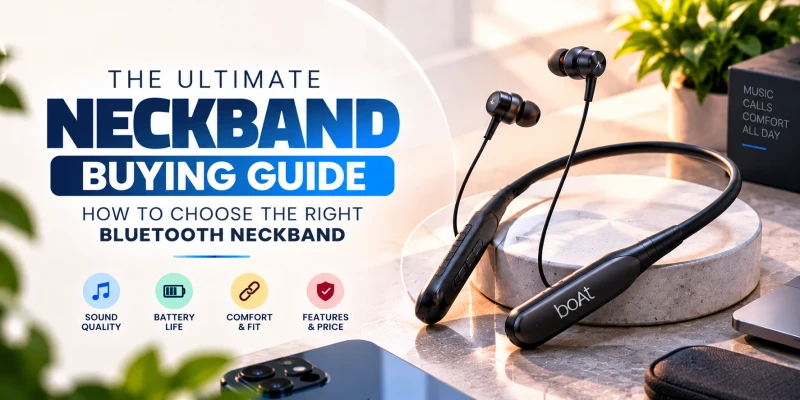
The Ultimate Neckband Buying Guide: How to Choose the Right Bluetooth Neckband
Neckbands are one of the most popular accessories in Bangladesh right now. They’re very convenient to use, and you are less likely to lose them since they’re on your neck all the time. Choosing a Bluetooth neckband used to be quite simple. But nowadays, there are so many specs involved that you’d have to do some proper market research to get the most value out of your money. To help you do exactly that, this guide breaks down what to check for in a neckband for your specific use case, whether that is the gym, long calls, gaming, or just the daily commute.
What Is a Bluetooth Neckband and How Does It Work?
A Bluetooth neckband is a pair of earbuds connected by a flexible band that rests around your neck. The band itself houses the parts a fully wireless earbud has to squeeze into two tiny shells: the battery, the Bluetooth chip, and usually the microphone. Because there is more physical room to work with, neckbands typically pack in bigger batteries and stronger mics than similarly priced true wireless earbuds.
- Wireless audio: paired over Bluetooth, no cable to your phone
- Built-in battery lives in the band, not in each earbud
- Earbuds are often magnetic and snap together to automatically power off
- Microphone sits closer to your jaw or collar, often picking up your voice more clearly
- Bluetooth connection range is usually around 10 meters indoors
Neckbands trade a bit of pocketability for battery life, call quality, and a design where you cannot lose a single earbud in a couch cushion. If that last part already annoys you about true wireless earbuds, this trade-off alone might settle the category question.
What Should You Look for When Buying a Neckband?
Before comparing specific models, run through this checklist. It covers everything the rest of this guide unpacks in detail.
- Battery life for how you actually use it, not the marketing number
- Sound signature: bass-heavy, balanced, or vocal-focused
- ANC and/or ENC, depending on whether you need quiet or clear calls
- Microphone quality for calls and meetings
- Codec support
- Bluetooth version
- Comfort and weight of the band around your neck
- IP rating if you sweat, run, or get caught in rain
- Device compatibility across Android, iPhone, and laptops
How Much Battery Life Do You Need in a Neckband?
|
Battery
Life |
Best For |
|
Under 15 hours |
Light, occasional use |
|
15 to 25 hours |
Daily use |
|
25 to 40 hours |
Heavy daily use |
|
40 to 60+ hours |
Travel and long stretches
without charging |
The battery life of a neckband is usually tested at a fixed volume, with ANC switched off. So it isn’t a useful value for real use cases. If you turn ANC on, push the volume up, or use a power-hungry codec like LDAC, then the real-world runtime decreases quite significantly. Temperature has a significant effect on battery lifetime too. A neckband rated for 30 hours in a lab might only give you 22 to 24 hours in a hot environment. If you want to squeeze more life out of whatever you buy, our guide on how to make earbud batteries last longer covers charging habits and storage that actually extend the numbers on the box.

How to Choose a Neckband for Sound Quality
Bass-Heavy Sound
Some neckbands are made for heavy bass. They are perfect for bass and energetic music lovers . Look for a dedicated bass boost mode in the companion app.
Balanced Sound
The safest pick for daily listening. The tuning is balanced between bass and treble. So it performs quite well across genres, podcasts, and calls equally well.
Vocal-Focused Sound
Useful for podcasts, calls, and vocal-heavy music. These neckbands prioritize clear mids over deep bass, so dialogue and speech stay intelligible.
Codec Support
A codec only helps if both your phone and neckband support it. SBC is the default and works everywhere as a fallback. AAC is for iPhone users. aptX and LDAC only make a difference on specific Android phones that support them; a neckband advertising LDAC does nothing extra when paired with an iPhone, since iOS does not support that codec at all.
ANC vs ENC: Which One Do You Need?
People mix these up constantly because both use microphones and both get marketed as noise cancellation. ANC cancels outside sound before it reaches your ears while you listen. ENC cleans up your voice before it reaches the other person on a call. One is for you, the other is for whoever you are talking to.
Choose ANC If You Want Less Outside Noise
Useful for:
- Flights
- Commuting
- Office environments
- Listening to music
Choose ENC If Call Quality Matters More
- Office calls
- Meetings
- Outdoor calls
- Work from home
Choose Both If You Need Music and Calling Features
Most mid-range and premium neckbands now come with both ANC and ENC. If you cannot decide, or if you listen to music, commute, and have to take calls regularly, having both is the best way to go about it.
How to Choose a Neckband for Calls and Meetings
For anyone spending a lot of time on calls, prioritize these over sound tuning:
- Microphone quality
- ENC to filter background noise from your voice
- Multiple microphones (2 to 5 mics) for better voice pickup
- Wind-noise handling if you take calls outdoors or while commuting
- Multipoint, so you can stay connected to your phone and laptop at once
- Long battery life to survive back-to-back meetings
- Comfort if wearing for long hours

How to Choose a Neckband for Gaming
Check Low-Latency Mode
Low-latency is an absolute necessity for gaming. Try to go for a neckband with under 60ms latency which also has a dedicated low-latency or game mode. Competitive players should look closer to 40ms.
Check Bluetooth Stability
You have to make sure the connection is stable. If the Bluetooth connection is stable, then you can look to increase range. It’s best practice to watch or read reviews that test for connection dropouts during gaming.
Check Microphone Quality
Communication is a big part of competitive gaming. If you play with a squad, the mic is as important as latency. A clear ENC mic keeps team callouts intelligible.
Check Comfort for Long Gaming Sessions
A light band and soft ear tips will provide comfort over a long gaming session. If you regularly play for long periods of time, then you should prioritize comfort.
Don't Judge Gaming Performance by Advertised Latency Alone
A bunch of factors affect the overall latency during gaming, such as your device, the codec, the game's built-in audio engine, etc. Advertised numbers give an estimate but are usually not correct in practice; test before committing to competitive titles where every millisecond counts.
Which Bluetooth Version Is Best for a Neckband?
Bluetooth versions differ mainly in range, stability, and power consumption. Bluetooth 5.2 or newer is a safe choice, and most current neckbands have 5.3 or 5.4 built in. But a newer Bluetooth version does not automatically mean better sound. Codec support, antenna design, software, and how well the neckband works with your device all matter just as much as the Bluetooth version.
How to Choose a Neckband for Your Device
Neckband for Android Phones
- Codec compatibility with your specific phone model
- Fast pairing support
- Multipoint for switching between devices
- Gaming features if that matters to you
Neckband for iPhone
- AAC support (this is the codec that actually matters on iOS)
- General Bluetooth compatibility and firmware stability
- Call quality, since iPhone users cannot rely on aptX or LDAC at all
Neckband for Samsung Phones
- Codec compatibility, including Samsung's own Scalable codec where supported
- Multipoint for switching between a Samsung phone and tablet or laptop
- Call features tuned for Samsung's ecosystem
Neckband for Laptop and PC
- Microphone quality for meetings
- Multipoint so you are not re-pairing constantly
- Stable connection over longer working sessions
- Meeting performance under real call conditions, not just music playback
How to Choose a Neckband for Different Uses
Neckband for Gym and Workout
- Sweat resistance rated at least IPX4
- Secure fit that will not shift mid-set
- Lightweight design that does not bounce
Neckband for Running and Cycling
- Stable fit through repetitive motion
- Water resistance for rain and sweat
- Good physical controls you can use without looking
Neckband for Office Use
- ENC for clean calls
- Multipoint for phone and laptop
- Strong microphone quality
- All-day comfort
Neckband for Students
- Great battery life for long class days
- Comfort for wearing in long sessions
- Decent call quality for group projects and family calls
- Affordable price
Neckband for Travel
- ANC for flights and noisy terminals
- Long battery life
- Fast charging for layovers
- Comfort for long-term wear
Neckband for Music and Movies
- Sound tuning that matches your taste
- Codec support that matches your phone
- Low latency so audio stays in sync with video
- Comfort for long viewing or listening sessions

Neckband vs TWS Earbuds: Which Is Better?
|
Factor |
Neckband |
TWS Earbuds |
|
Battery life |
Usually longer |
Depends on the case |
|
Risk of losing an earbud |
Lower |
Higher |
|
Portability |
Good |
Excellent |
|
Calls |
Often good |
Model-dependent |
|
Gym use |
Very good |
Very good |
|
Charging case |
Usually not needed |
Usually required |
Neither format wins outright. Neckbands tend to win on battery life, mic quality, and peace of mind about losing a bud. TWS earbuds win on pure portability and a smaller in-ear footprint. If you are still weighing the two, our Ultimate Earbuds Buying Guide covers the TWS side of this decision in more depth.
Neckband vs Wireless Headphones
- Portability: neckbands fit in a pocket or bag easily; over-ear headphones need more space
- Comfort: headphones distribute weight across the head; neckbands rest on the neck and shoulders
- Battery: over-ear headphones have bigger shells for bigger batteries
- ANC: over-ear headphones can achieve deeper noise cancellation due to a full ear seal
- Sound: larger over-ear drivers often deliver richer sound at the same price point
- Heat: over-ear cups trap more heat around the ears in humid weather; neckbands stay cooler
- Travel suitability: neckbands are smaller for carry-on bags and daily commutes
Wired Earphones vs Bluetooth Neckband
- Latency: wired earphones have effectively zero latency; neckbands depend on Bluetooth and codec
- Sound: wired earphones often sound better per taka, since there is no Bluetooth chip to pay for
- Convenience: neckbands win here, no cable to snag on doorknobs or bag zippers
- Charging requirement: wired earphones need no charging at all; neckbands need to be charged regularly
- Mobility: neckbands allow more freedom of movement without a cable to your phone
- Device compatibility: wired earphones depend on your phone having the right port (3.5mm or USB-C); neckbands just need Bluetooth
What IP Rating Should a Neckband Have?
IPX4
Good for light sweat and splashes of water. Fine for casual walks and light workouts. Can also handle a bit of drizzle.
IPX5
Better for heavier workouts and sweat. This is a great choice for regular gym use.
IPX7
A higher water-resistance level, capable of surviving brief submersion. Always check the manufacturer's specific depth and time limits rather than assuming full waterproofing.

How to Check Neckband Quality Before Buying
- Sound quality across a few genres, not just one demo track
- Battery life under your actual listening habits
- Real charging time, not just the advertised fast-charge headline number
- Bluetooth stability, especially at a distance or through a bag
- Microphone quality, tested with an actual phone call
- ANC and ENC performance in a genuinely noisy environment
- Comfort over at least 30 continuous minutes of wear
- IP rating that matches how you will actually use it
- Build quality: hinges, magnets, and the band's flex point
- Warranty terms and where you can actually claim it
It is also worth checking that what you are buying is genuine. Bangladesh's market has its share of counterfeit audio gear sold at suspiciously low prices, and our guide on spotting original versus fake AirPods and counterfeit earbuds covers red flags that apply to neckbands too, from packaging quality to how a serial number checks out.
Common Neckband Buying Mistakes
- Choosing only by battery life: a 60-hour neckband with poor drivers still sounds bad.
- Assuming bigger drivers always sound better: tuning matters as much as raw driver size.
- Confusing ANC with ENC: one is for you, one is for the person you are calling.
- Ignoring codec compatibility: paying extra for LDAC on an iPhone changes nothing.
- Buying a gaming neckband only by advertised latency: real latency depends on your phone and the game.
- Ignoring comfort and weight: a heavy band around your neck for 8 hours a day gets old fast.
- Ignoring water resistance: sweat damage is rarely covered under warranty.
- Assuming newer Bluetooth always means better audio: the version number is not a sound quality metric.
- Ignoring microphone quality: most buyers only test music in-store and never test a call.
- Buying only based on price: extremely cheap neckbands usually cut the battery and driver first.
What You Should Look For Depending on Your Priority
|
Your Priority |
Look For |
|
Music |
Good tuning + codec support |
|
Bass |
Bass-focused tuning |
|
Calling |
Good mic + ENC |
|
Office |
Multipoint + mic + comfort |
|
Gaming |
Low latency + stable Bluetooth |
|
Travel |
ANC + long battery |
|
Gym |
IP rating + secure fit |
|
Students |
Battery + comfort + value |
|
iPhone |
AAC + good call quality |
|
Android |
Compatible codecs + useful
features |
|
Long use |
Lightweight design + long
battery |
Where to Buy in Bangladesh
Are you thinking of buying a new neckband? SMS Gadget offers a wide range of genuine neckbands from popular brands, including OnePlus, Realme, CMF by Nothing, Oraimo, and QCY, all with official warranty and nationwide delivery across Bangladesh. Explore the latest neckband collection and easily filter products by battery life, ANC features, or price to find the perfect neckband that matches your needs and budget.
Final Thoughts
Unfortunately, like most things in life, there is no universal best neckband. Only ones that match your use case can be considered best for you specifically. You might optimize for calls, commute, workouts, or your gaming sessions. Prioritize your main use case first. When you get that sorted out, check for good battery life, confirm the correct codec, and the rest of the spec sheet mostly sorts itself out.
Frequently Asked Questions
For daily use, 15 to 25 hours covers a full week of commuting and office use with only two or three charges. If you travel often or forget to charge things, look for 40 or more hours instead.
Yes, it’s enough for daily users. Twenty hours usually covers three to four days of normal use. You would need to recharge again after that. However, heavy ANC use or gaming will cut that down to around two days.
Driver size affects potential bass output, but tuning and the acoustic chamber design matter just as much. A well-tuned 10mm driver can sound better than a poorly tuned 13mm one.
ANC blocks outside noise from reaching your ears while you are listening to something. ENC cleans up your voice on calls so the other person hears you clearly, even in a noisy room.
Yes. Any Bluetooth neckband can pair with an iPhone over standard Bluetooth. But features like aptX or LDAC will not activate since iOS does not support those codecs. AAC support is the best option for an authentic iPhone experience.

