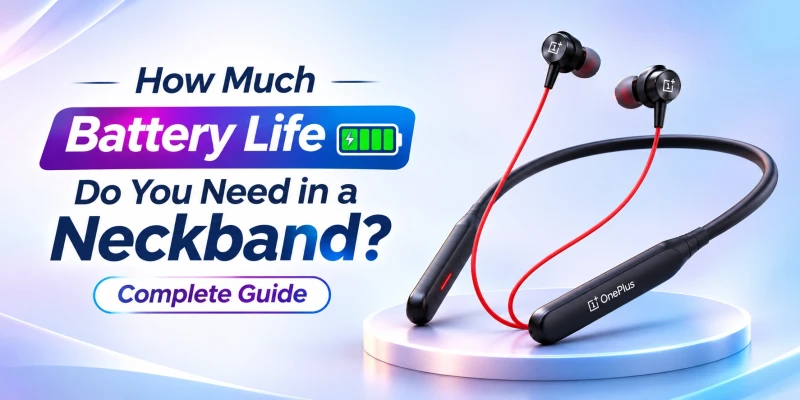
How Much Battery Life Do You Need in a Neckband? Complete Guide
For most people, 20 to 30 hours of rated playback is plenty. If you use noise cancellation, read the ANC-on figure. ANC cuts listed playback by about 35 to 38 percent. Light users can get by on 10 to 15 hours. Heavy users, all-day callers and frequent flyers should look for 30 hours or more, or a shorter rating with quick charging. Your own number (in the mode you use): hours per day × days between charges × 1.25. Three hours a day with a weekly charge comes to about 26 hours.
Consider this scenario: two neckbands sit side by side on the shelf. Everything same except that one claims 40 hours of battery life and the other only 24. Which one will you pick? Seems like a very obvious choice, doesn’t it? Well, that’s where people end up making a mistake. The battery lifetime depends on various factors that need to be taken into consideration. Those two neckbands might have been tested under two very different circumstances.
To help you make an informed decision, our complete neckband buying guide explains what battery-life ratings actually mean, the factors that affect battery performance, how many hours you need for music, calls, gaming, workouts, and travel, and when a bigger battery stops offering real value.
That extra quarter in the formula covers the gap between lab conditions and real ones, and the sections below explain where that gap comes from.
What Does Neckband Battery Life Actually Mean?
A spec sheet usually gives you multiple battery numbers, each measuring something different.
Playback Time
Playback time is how long the neckband streams music on a full charge. It's usually the biggest number on the box, and it comes from a lab test at a fixed volume. Nothing tests its CMF Neckband Pro at 50 percent volume in AAC mode at 25°C; OnePlus quotes the Bullets Wireless Z3 at 50 percent, and boAt quotes its Rockerz 330 ANC at 60 percent. Two brands' figures only compare fairly when the conditions match, so check the volume, the codec and whether ANC was on.
Talk Time
Talk time is how long calls last on a full charge. It is lower than playback time because the microphones and voice processing stay active throughout the call. For example, the CMF Neckband Pro lasts up to 37 hours for music with ANC off, but 20.5 hours in call mode with ANC off.
Standby Time
Standby time means the neckband sitting powered on and connected but idle. Philips lists 160 hours of standby for its TAPN505 against 14 hours of playback. This figure basically tells you how fast a neckband drains power when you leave it powered on.
Battery Life With ANC On vs Off
A neckband with noise cancellation carries two battery figures, one with the ANC on and the other when ANC is off. The ANC section further down has the numbers. For now, keep one rule in mind: if you'll listen with ANC on, the ANC-on figure is the one that counts.

How Many Hours of Battery Life Do You Need?
The answer comes from two habits: how long you wear the neckband each day, and how many days you'd like to go between charges. Four common patterns follow.
Battery Life for Light Users
Under an hour a day, say a short walk or a few calls, and 10 to 15 hours stretches to a week or two between charges. A giant battery makes little sense here. Fit, comfort and sound quality deserve more of your attention.
Battery Life for Everyday Users
Two to four hours a day is ideal for a very large number of users. A neckband rated at 20 to 25 hours with ANC on lasts about a week at that usage rate. This is suitable for a charge-on-Friday habit.
Battery Life for Heavy Users
Six or more hours a day means a full workday of calls or music. To finish an eight-hour day with something left, look for a rated figure of at least 12 to 15 hours in your usual settings. If you'd rather charge every second day, aim closer to 30. Fast charging is very useful in this case.
Battery Life for Travelers
Travel is the one case where you plan around your worst day instead of your average one. A ten-hour flight with ANC on needs an ANC-on rating that comfortably beats ten hours, or a way to top up on the way. There's a full travel section further down.
How Long Does a Neckband Battery Usually Last on One Charge?
Most current neckbands list between 15 and 40 hours of music playback with ANC off. The models on the shelf in Bangladesh right now sit near the top of that range. The OnePlus Bullets Wireless Z3 lists up to 36 hours at 50 percent volume, the CMF by Nothing Neckband Pro lists 37 hours with ANC off and 23 with it on, the Realme Buds Wireless 5 ANC lists 38 hours, and the QCY BassBloom ANC N2 lists up to 40. An older Philips TAPN505 lists 14, which shows how far the average has moved.
Real-life usage does fall short in almost every case, though. Those tests use 50 to 60 percent volume at a mild 25°C, which is gentler than many people's habits and much cooler than Bangladesh in the hot season. Budget for about 75 to 80 percent of the claimed hours.

What Affects Neckband Battery Life?
Lab figures assume a tidy set of conditions. Six things pull real-world runtime away from them.
Listening Volume
Louder playback draws more power, but it matters less than most people assume. Philips rates the drivers in the TAPN505 at a maximum input of 10 mW, while its 180 mAh battery lasting 14 hours implies an average draw near 13 mA or nearly 50 mW at 3.7 V. So most of the energy goes elsewhere, into the Bluetooth radio, the processor and the audio electronics. Loud listening does shorten runtime, just far less than ANC does. It's also hard on your ears, and our hearing safety guide explains this in detail.
ANC and Noise Cancellation
ANC keeps microphones and a dedicated processing chain running the whole time you listen. It's the biggest single drain you can switch off. Spec sheets show it cutting listed playback by more than a third, and the ANC section below has the figures.
Bluetooth Connection Quality
A weak link requires the radio to do more work to send data. Busy places like stations and markets, where many devices share the same band, add interference. Keep the phone in a front pocket, on the same side as the neckband's controls, and it should help the link.
Audio Codec
The codec is a data compression-decompression protocol. A codec protocol determines how much data is exchanged. SBC is the universal default, AAC is made for Apple and Android phones, and codecs such as LDAC push far more data, keeping the radio busier. The Bluetooth SIG says its newer LC3 codec can match SBC's quality at less than half the bit rate, with power falling in proportion. Although the real saving depends on how the maker builds it in. That only helps when both your phone and your neckband support LE Audio.
Calls and Microphone Use
During calls, the microphones and voice processing run simultaneously, and data flows in both directions. So the battery loses charge faster than it does for music.
Gaming or Low-Latency Mode
Low-latency modes shrink the audio buffer, which allows the radio to send data more often. It requires more power, so runtime usually drops. But it doesn’t drop it as much as the other factors.

Does Battery Capacity in mAh Tell You How Long a Neckband Will Last?
It tells you half the story. Runtime is roughly capacity divided by average current draw, and the draw depends on the chipset, the features and your settings as much as on the cell.
If we look at the numbers on real models, we see that the OnePlus Bullets Wireless Z3 and the CMF Neckband Pro both use a 220 mAh cell, and they list 36 and 37 hours with ANC off. That works out to an average draw near 6 mA. Turn ANC on for the CMF and the same cell lasts 23 hours, which means the draw jumps to about 9.6 mA. The power draw changes significantly. Meanwhile the QCY BassBloom ANC N2 carries 300 mAh, about 36 percent more, and lists 40 hours, only three or four hours beyond the other two. A bigger tank helped, but not in proportion.
mAh still works for comparing neckbands with each other, because most use a single lithium cell at a nominal 3.7 V. Multiply the two and you get energy: 220 mAh × 3.7 V is about 0.8 Wh. What it can't do is compare neckbands with very different chips, or a neckband with a phone. Treat the listed hours and their test conditions as your main figure, and use mAh as a sanity check.
How Much Battery Life Do You Need for Music?
Music is the lightest job a neckband does, so the headline figures come closest to real life here. At two to four hours a day, a neckband with 20 hours of ANC-on playback lasts five to ten days on paper. After knocking off about a fifth for real-world losses, call it four to eight days. A rating of 20 to 25 hours with ANC on is comfortable for this use. If you rarely switch ANC on, 25 to 30 hours on the ANC-off figure leaves you the same margin.
How Much Battery Life Do You Need for Calls and Meetings?
Talk time is the number to check, and many listings bury it or leave it out. When it's missing, assume it sits well below the playback figure, as it does on the CMF page. A four-hour block of calls on a neckband with 20 hours of talk time uses a fifth of the battery. Six hours of calls a day pushes you toward daily charging unless talk time reaches 12 hours or so.
How Much Battery Life Do You Need for Gaming?
Long sessions and voice chat make gaming one of the heaviest use cases. A three-hour session with the microphone open and low-latency mode on can consume a big portion of the battery. Aim for 25 hours or more on the rated figure. You should also look for a brand that has a game mode and fast charging. Even in a low-latency mode, Bluetooth audio usually lags behind a wired connection, so serious competitive players may still want a cable. A bigger battery won't fix that.
How Much Battery Life Do You Need for Gym and Exercise?
Workouts last for an hour or two, so 10 to 15 hours of battery life is plenty. Weight, fit and sweat resistance matter more. The Z3, the CMF and the Realme 5 ANC all list IP55, while the QCY N2 lists IPX4. Both ratings handle sweat and splashes, and IP55 adds better dust protection. Wipe the neckband down after a session and let the charging port dry before you plug in. Outdoors, many people switch ANC off or use transparency mode so they can hear traffic.
How Much Battery Life Do You Need for Travel?
Travel loads a battery differently. You listen for long stretches, ANC is usually on, and outlets are scarce.
Neckband Battery Life for Daily Commuting
A daily commute is easy to plan around since not much changes. If you commute for two hours a day with ANC on, a neckband with 15 hours of battery life will cover about seven days. Six hours after considering real-world losses. Keep the neckband out of direct sun between trips, because heat reduces the battery life over time.
Battery Life for Long Flights or Train Journeys
Engine drone on a plane and rumble on a train are steady, low-frequency sounds, which is where ANC works best. So the ANC-on rating is the one to plan around. Pick a neckband whose ANC-on figure beats your longest journey by a healthy margin, start the trip fully charged, and carry a power bank and a short cable as backup. Neckbands charge from any standard USB source. Our guide on carrying a power bank on a plane covers the airline rules.
Why Fast Charging Matters for Travelers
On a trip, you might not get a full two hours at an outlet to recharge the neckband to 100%. Fast charging helps significantly in such cases. However, the quick-charging claims differ from band to band. OnePlus lists up to 27 hours from a 10-minute charge on the Bullets Wireless Z3, at 50 percent volume, which is three-quarters of its 36-hour rating. Nothing lists 18 hours from ten minutes on the CMF Neckband Pro, or 11 hours with ANC on.

How Important Is Fast Charging in a Neckband?
It's worth having, as insurance. It won't replace enough battery to begin with, but it stops a forgotten charge from ruining your day.
What Does Fast Charging Mean?
There's no standard definition. Brands quote "X hours of uptime from Y minutes of charging" using conditions they pick, as the figures above show. Lithium-ion cells also charge quickly while they're low and slow down as they approach full. So a quick-charge number describes the first few minutes, which are the easy part. The last stretch to 100 percent takes longer. Those claims also imply the cell takes on well over half its capacity in ten minutes, which is a high charge rate for a small cell. Battery University notes that high currents affect cycle life, so treat quick charging as a rescue tool and not a daily habit.
Fast Charging vs Large Battery Capacity
A bigger battery means fewer charges, more weight and a longer time to fill. Fast charging doesn't cut how often you charge, but it makes each emergency top-up cheap. I'd take a moderate battery of 20 to 30 hours with a quick top-up over a huge battery with slow charging. Heavy users and frequent travelers should look for both.
How Long Should a Neckband Take to Charge?
Among the spec sheets we checked, boAt lists about 1.5 hours for a full charge and Philips lists 2 hours. Under two hours is comfortable. Longer works overnight but annoys you if you count on a top-up before leaving the house. Read the full-charge time alongside the quick-charge figure, since the quick charge is what rescues a bad morning.
Is USB-C Better for a Neckband?
For convenience, yes. It is a common cable that most current phones share; the plug is reversible, and the port is sturdier than micro-USB. It doesn't make charging faster, though. The neckband's own charging circuit sets the speed, and small cells often charge at a modest current, whatever the port is. The Z3, the CMF and the QCY N2 all charge over USB-C, and their quick-charge claims differ widely. Check the quoted charge time and the quick-charge figure when buying.

Does ANC Reduce Neckband Battery Life?
Yes, and by a lot. Every manufacturer that lists both figures shows the same pattern.
|
Neckband |
ANC off |
ANC on |
Runtime lost |
|
Philips TAPN505 |
14 hours |
9 hours |
36% |
|
boAt Rockerz 330 ANC (Power Saver
mode) |
24 hours |
15 hours |
38% |
|
CMF by Nothing Neckband Pro |
37 hours |
23 hours |
38% |
That's roughly 35 to 38 percent less listed playback every time, whichever brand you pick.
Battery Life With ANC On
If you use ANC, plan with the ANC-on numbers, which in the table above are 9 hours, 15 hours and 23 hours. Transparency mode won't save you either. The CMF page lists 22 hours in transparency mode, no better than the 23 it gives for ANC.
Battery Life With ANC Off
Switching ANC off adds about 55 to 60 percent to runtime in those same examples, because a 35 to 38 percent loss on the way down is a bigger gain on the way back up. Turning it off in quiet places is the best way to lengthen a charge. It costs nothing and gives up nothing where there's no noise to cancel. Well-fitting ear tips still block some sound passively.
Should You Sacrifice Battery Life for ANC?
It depends on the noise around you. ANC works best on steady, low-frequency sound such as engine hum, fans and road rumble, and it does less for speech and sudden noises. On a bus, train or plane, it earns its battery cost. At a quiet desk, it's wasted. Our advice: buy on the ANC-on rating, then switch ANC off whenever you don't need it.
Does Bluetooth Version Affect Battery Life?
Slightly, and indirectly. Radios built for Bluetooth 5.x are more efficient than older ones, but among current neckbands, the version number predicts hours poorly. Take the four models in our table further down. The Z3 and the Realme 5 ANC use Bluetooth 5.4, the CMF and the QCY N2 use 5.3, and their listed ratings sit within four hours of each other, from 36 to 40.
Bluetooth 5.2 did add something real for battery. LE Audio needs a feature introduced in the 5.2 core specification, and it brings the LC3 codec. But it only helps when both the phone and the neckband support it, and the spec pages for the Z3, the CMF and the QCY N2 list AAC and SBC only. Moving from 5.2 to 5.3 refines connection handling without changing how audio streams.
How Long Does a Neckband Battery Last Before It Starts Degrading?
Every lithium cell loses capacity from the day it's made, and how fast depends on charge cycles, heat and age. Battery University puts a typical lithium-ion cell at roughly 300 to 500 full charge cycles when charged to the usual 4.20 V. A full cycle means using 100 percent of the battery, and two half-charges count as one.
In practice, someone who drains and refills the neckband every day will reach 300 to 500 cycles in approximately ten to sixteen months. You will probably notice a shorter runtime after that. A light user who charges weekly can get to around six to ten years on paper. But heat and age will probably cause more degradation first. Cell quality varies as well, which affects the battery lifetime.
Signs Your Neckband Battery Is Degrading
• The same listening habits now need charging more often than when the neckband was new.
• The percentage drops fast, for example, from 40 percent to dead in a short time.
• It shuts off at a level that used to be fine.
• It charges quicker than it used to, because there is less capacity to fill.
• The body feels warm during ordinary use.
If the casing looks swollen or deformed, or the neckband gets unusually hot, stop using it and take it to a service center.

How Can You Make a Neckband Battery Last Longer?
Most of these habits reduce heat or shrink the swing between empty and full. Our earbud battery care guide goes deeper on charging and storage, and the same principles apply to a neckband.
Avoid Constantly Draining the Battery Completely
Lithium-ion batteries have no memory effect, so there's no reason to run them flat. Shallower discharges are gentler on the cell. For common NMC cells, Battery University's figures show about 300 cycles at full depth against about 1,000 at 40 percent depth. Topping up at 30 or 40 percent beats waiting for the low-battery beep.
Avoid Excessive Heat
Battery University treats anything above 30°C as an elevated temperature for most lithium-ion cells, and heat combined with a full charge does the most harm. Its storage table shows a cell kept at full charge holding about 65 percent of its capacity after a year at 40°C, against about 85 percent when stored at 40 percent charge. At 25°C, the same comparison is about 80 percent against 96 percent. Keep the neckband out of parked cars, motorbike seats and direct sun, especially in Bangladesh's hot season.
Use a Suitable Charger
Use the cable that came with the neckband and a good 5V USB adapter. The neckband's own charging circuit limits the current. So a big phone charger won't charge faster. Cheap unbranded adapters can deliver unstable output, so it’s best to avoid them. A laptop's USB port works fine.
Turn Off ANC When You Do Not Need It
Switching ANC off in quiet places saves battery every hour you listen, and it also means fewer charge cycles over the neckband's life.
Avoid Leaving the Neckband Unused for Long Periods With an Empty Battery
A lithium cell left flat for months can fall to a voltage where its protection circuit refuses to charge it again. If you're putting the neckband away for a long time, leave it at around half charge in a cool place and top it up every few months. Battery University's storage data favors roughly 40 percent charge.
Keep Firmware Updated When the Manufacturer Provides Updates
Some brands release updates through their companion apps, and these can fix bugs and tune power management. If the manufacturer offers no updates, there's nothing you can do about that.
What Battery Specifications Should You Check Before Buying a Neckband?
Look for these on the spec sheet or in the listing:
• Playback time with ANC on and with ANC off, plus the test conditions (volume, codec, temperature)
• Talk time
• Battery capacity in mAh, used only to compare neckbands with each other
• Time for a full charge
• The quick-charge figure (minutes for hours) and whether it applies with ANC on
• Charging port type
• Bluetooth version and supported codecs
• Weight
• Warranty terms
Is More Battery Life Always Better?
No, not always. If you charge every Friday, 60 hours instead of 30 doesn’t change much. But a bigger battery does add weight around your neck and takes longer to recharge. So it might be disadvantageous to get more battery life.

Neckband Battery Life vs TWS Earbuds
True wireless earbuds usually last around five to eight hours after a full charge. The case can store charge and supplies recharges that can increase the total to well over 20 hours. Neckbands can run from 15 to 40 hours on a single charge and don’t need a case. These figures can vary a lot by model.
A neckband is one large battery that is easy to top up, with no fear of losing a case. Earbuds have tiny cells that cycle daily and can't be replaced, so heavy users see runtime fade sooner. What earbuds give you is a case that recharges them in seconds during the day. If you're weighing the two, the Ultimate Earbuds Buying Guide covers the earbud side, and our QCY vs Oraimo vs CMF comparison shows where budget earbuds land.
Quick Neckband Battery Life Buying Guide
|
Your use |
Typical daily hours |
Rated hours to look
for |
Also check |
|
Light |
Under 1 |
10 to 15 |
Comfort and fit |
|
Everyday |
2 to 4 |
20 to 25 (ANC-on if you use it) |
Full charge time |
|
Heavy |
6 or more |
12 to 15 for daily charging, about
30 for every second day |
Quick charge |
|
Calls and work |
4 to 6 on calls |
Talk time of 12 or more |
Microphone quality |
|
Gaming |
2 to 3 |
25 or more |
Low-latency mode figure |
|
Travel |
Long trips |
ANC-on rating above your longest
trip |
Quick charge, USB-C |
Battery-Friendly Neckbands Available in Bangladesh
|
Neckband |
Rated battery |
Noise cancellation |
Warranty |
Price (Tk) |
|
Up to 36 hours at 50% volume |
ENC for calls, no ANC |
6 months |
1,999 |
|
|
37 hours ANC off, 23 hours ANC on |
50dB hybrid ANC |
3 months |
3,599 |
|
|
38 hours (listed) |
ANC |
12 months |
2,299 |
|
|
Up to 40 hours |
25dB ANC |
12 months |
2,200 |
If you want ANC on a tight budget, the QCY N2 is the cheapest of the four with real noise cancellation. For the most battery with ANC actually running, the CMF is the only one of the four that publishes an ANC-on figure, and 23 hours is a strong one. And if you rarely need ANC, the Z3 at Tk 1,999 with its very fast top-up is hard to argue with.

Common Neckband Battery Buying Mistakes
Looking Only at mAh
Two neckbands with the same capacity can vary by hours, and a bigger cell doesn't necessarily mean a proportional increase in runtime, as the QCY comparison above shows. Use the listed hours and their conditions as your main number.
Trusting Maximum Playback Claims Without Checking Conditions
The headline number is usually the best-case scenario. ANC off, a power-saving mode, moderate volume and mild temperature. Any difference from the ideal testing scenario in those factors reduces the playback time.
Ignoring Charging Time
A neckband that takes two hours or more to fully recharge, with no quick charge feature, becomes a hassle on a busy day. Check both figures.
Ignoring ANC Battery Consumption
If you'll use ANC most of the time, buy against the ANC-on figure. A neckband advertised at 30 hours may deliver under 20 with ANC running.
Assuming USB-C Always Means Fast Charging
The connector and the charging speed are separate things. A USB-C neckband can still take two hours to fill.
Choosing the Biggest Battery Without Considering Weight
A larger cell weighs more. The neckband sits on your neck for hours, so the extra weight may cause some annoyance. The OnePlus Z3's page lists 26 grams, which is light enough to forget about. If a slightly smaller battery lets you wear the neckband comfortably all day, take the smaller one.
Ignoring Battery Warranty and Brand Support
Batteries wear out after some time and warranty terms vary a lot even within one shop. SMS Gadget lists 3 months of official warranty on the CMF Neckband Pro, 6 months on the OnePlus Bullets Wireless Z3, and 12 months on the Realme Buds Wireless 5 ANC and the QCY BassBloom ANC N2. A battery that fades in month ten only falls under warranty on some of those, so ask whether the battery is covered and where the service center is.
Final Decision: How Much Neckband Battery Life Do You Really Need?
Most people need 20 to 30 hours of playback time in the mode they use. Also, a quick way to recover when they forget to charge. Here's the simple framework:
- Light use: prioritize comfort over battery capacity. Ten to 15 hours should already last you a week or more.
- Daily use: look for enough power to comfortably cover your normal day, with a week between charges.
- Calls and work: check talk time, not only music playback time, since talk time runs much lower.
- Gaming: consider battery performance while low-latency mode is active, and prefer a rating of 25 hours or more.
- ANC use: compare battery figures with ANC turned on, because it can reduce runtime by more than a third.
- Travel: prioritize long runtime plus fast charging, and make the ANC-on rating beat your longest trip.
A simple formula for how much playback time you need: hours per day × days between charges × 1.25. If a neckband meets that requirement with ANC on, that's the battery life you should pick. Then you can spend the rest of your decision on fit and sound.
Shop Neckbands at SMS Gadget
Choosing a neckband is easier when you can check the spec sheet and warranty details in one place. SMS Gadget stocks original neckbands from OnePlus, Realme, CMF by Nothing, QCY, Oraimo, and more, with warranty terms displayed on each product page. Explore our complete range of neckbands at SMS Gadget to compare options and find the right one for your needs. You can also visit our stores across Bangladesh
Frequently Asked Questions
Yes, for most people. If you use it for about three hours every day, it will last about a week on paper. Just check which mode the 20 hours refers to. If it refers to the ANC-off mode, then expect around 12 to 13 hours with ANC running. That’s enough for regular users but might not be the case for heavy users.
It's good. A heavy user can charge every second day on it, and a traveler gets a comfortable margin. Confirm the mode and conditions behind the number, the same as you would for any other figure.
Spec sheets commonly list 15 to 40 hours of music with ANC off, and noticeably less with ANC on. The examples in this guide list between 9 and 23 hours with ANC running. In real use, plan on about 75 to 80 percent of the claim.
Yes. The spec sheets checked here list about 35 to 38 percent less playback time with ANC on.
It does, though far less than ANC. Lab tests run at 50 to 60 percent volume, so listening louder than that will cost you some hours.
Not automatically, since makers design the cell and the charging circuit for it. Still, high currents and high temperatures both reduce cycle life. Use quick charging when you need it instead of out of habit, and skip it when the neckband is already hot.

