
Xiaomi Redmi Note 17 Pro 5G Review: Design, Camera, Battery — Is It Worth It Under 30,000 BDT?
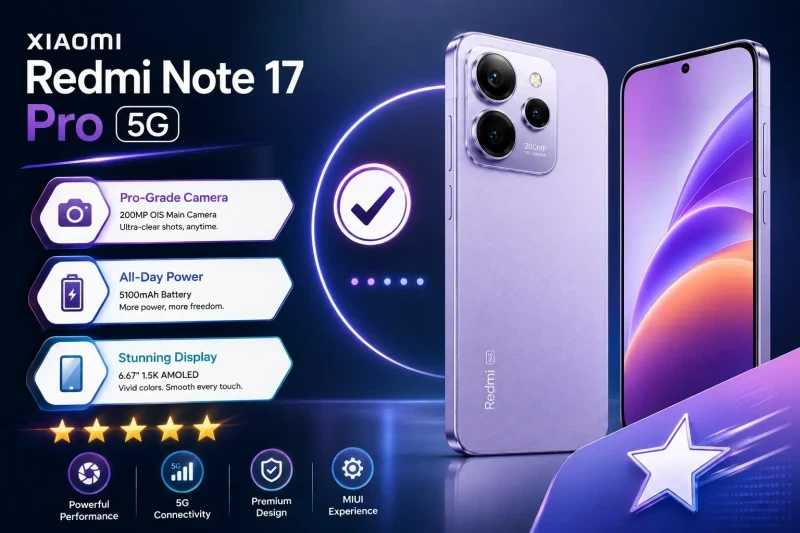
The Redmi Note 17 Pro 5G isn't for everyone, but if long battery life and a tough build matter more to you than raw power, it's a solid pick under 40,000 Tk. The standout is a massive 9000mAh battery that easily gets you through two full days.
It also comes with an IP68/IP69K rating, so dust and splashes won't scare it, plus a bright AMOLED screen that's easy on the eyes. The catch? Gaming isn't its strong side. The Snapdragon 6s Gen 4 handles daily use fine but struggles with heavy titles.
Overall, this phone earns a solid 7.5 out of 10. In this blog, we'll break down everything about the Redmi Note 17 Pro 5G from price to camera to battery. So you can decide if it's worth your money.
Xiaomi Redmi Note 17 Pro 5G Price in Bangladesh
Xiaomi hasn't launched this phone officially in Bangladesh yet. What you'll find right now is the China variant, brought in through unofficial import channels. Prices vary by storage, and none of them are cheap.
Price vs Competitors (This is where you can win)
At its real price of 36,299 Tk to 45,999 Tk, the Redmi Note 17 Pro sits above most rivals in the 22,000 Tk - 32,000 Tk bracket. But the gap isn't wasted. You get a bigger battery, faster charging, and a sharper display than nearly everyone in that range.
So who wins here? If you want a telephoto lens and official warranty at a lower cost, Realme or Infinix make more sense. If you trust Samsung's name and long update support, the M35 is the safe pick. But if battery life is your main worry, the Note 17 Pro beats every phone on this list. You're just paying extra for that endurance.
Design & Build Quality
This phone doesn't cut corners on build quality. Between the sturdy glass-and-aluminum body and rare IP69K protection, it's built to take a beating most rivals can't survive.
In-Hand Feel & Dimensions
This phone is big. It measures 163.5 x 78.3 x 8.5 mm and weighs around 222-226 g. That's heavier than most mid-range phones.
Why is it so heavy? The massive battery adds bulk. One-hand use gets tricky, especially for smaller hands. But the flat screen helps balance the weight, so it still feels solid, not clumsy.
Build Material & Durability
The front uses Gorilla Glass Victus 2, tough, flagship-level protection. The frame is aluminum, and the back is glass too, which looks premium but attracts fingerprints easily.
Now the real win is IP68 and IP69K ratings. What does that mean for you? You can drop it in a puddle, get caught in heavy rain, or even rinse it under a strong tap, and it'll survive. Most phones in this price range can't handle that kind of abuse.
Colors & Variants Available in BD
In Bangladesh, Black and white are easiest to find. Purple and blue exist too, but stock is limited, and prices run higher.
Display
This phone brings a large, bright AMOLED screen built for both watching videos and using outdoors. On paper, it beats most rivals in this price range.
Panel Type & Specs
This phone packs a 6.83-inch AMOLED screen with sharp resolution and a smooth 120Hz refresh rate. Peak brightness hits 3,500 nits, with 2,000 nits in high-brightness mode and 800 nits for normal use. It also supports HDR10+ for streaming.
Real-World Viewing Experience
Here's what those numbers actually mean for you. Most mid-range phones sit around 500-600 nits, so text gets hard to read in bright sun. This one starts at 800 nits already ahead of the pack. Push it further, and brightness jumps past 2,000 nits for short bursts.
What does that mean walking outside at noon in Dhaka? You should be able to read messages, check maps, and scroll through your feed without shading the screen with your hand. That's rare in this price range.
Colors look rich too, thanks to AMOLED's natural contrast. And with HDR10+ support, shows on Netflix or YouTube get better highlights and deeper blacks. Closer to what you'd expect from a flagship, not a mid-ranger.
Performance
This phone runs on the Snapdragon 6s Gen 4, built on a 4nm process. It's not a flagship chip, but it handles daily life well and even manages light-to-mid gaming without much trouble.
Chipset — Snapdragon 6s Gen 4 (4nm)
So what does that mean in practice? App opening feels fast, scrolling stays smooth, and multitasking between social media and browsers won't slow you down. Compared to the older Snapdragon 6s Gen 3. You get 25-40% quicker everyday speed and roughly 50-60% better graphics performance.
That's a real jump if you're upgrading from a 2023 or 2024 phone. For gaming, it's tuned for popular eSports titles and mid-range 3D games at steady frame rates, not the heaviest AAA titles, but enough for most players.
RAM & Storage Management
The Note 17 Pro comes in 8GB and 12GB RAM options, paired with fast UFS storage. That storage type loads apps and games quicker than older eMMC storage.
A nice bonus is that HyperOS 3 adds a memory extension feature. It borrows some storage space and turns it into virtual RAM, so your phone shows something like "8+8GB" in settings.
This helps keep more apps running in the background, so switching between apps feels less like starting from scratch.
Gaming Test
We couldn't test this unit directly, so here's what chipset benchmarks and other reviews suggest. In PUBG and BGMI, expect around 60fps at HDR graphics with high frame rate settings.
Free Fire runs smoothly at max graphics with barely any heating. Heavier games like Genshin Impact work best at medium settings, since high settings may cause frame drops during action-packed scenes.
The chip also runs 8-12°C cooler than its predecessor, so your phone stays comfortable and your frame rate stays steady during long sessions.
Software — HyperOS 3 on Android 16
This phone runs HyperOS 3 on top of Android 16. It's Xiaomi's cleanest, smartest software yet, though it still carries some baggage.
UI & Features
The design feels fresh, with new icons, a redesigned lock screen, and smoother animations. Xiaomi says it's up to 30% smoother. One standout feature is HyperIsland, a floating panel that shows live activity like calls, timers, or delivery tracking without opening an app.
AI plays a bigger role here too. DeepThink mode helps draft messages and emails. Voice recordings get real-time transcripts through AI Speed Recognition, and noisy calls sound clearer thanks to AI noise reduction.
There's even an AI Describe tool that explains what's in a photo, plus smart search that finds pictures by content type "beach" and it'll find your beach photos.
Security gets an AI boost too. The phone can detect scam calls and deepfake video calls in real time, which is a genuinely useful safety net.
Bloatware & Update Policy
Now, the less exciting part. Like most Xiaomi phones, this one ships with extra apps. Mi Browser, Mi Video, Mi Notes, and a few others. Some show ads or recommendations unless you turn those off in settings. Expect to spend a few minutes cleaning things up if you want a simpler home screen.
Here's what actually matters long-term
Xiaomi promises 3 major OS updates and 4 years of security patches. That's a real commitment, and most competitors in this price range don't offer nearly as much. If you plan to keep this phone for 2-3 years, that update promise puts your money to good use.
Camera

This phone keeps its camera setup simple. One solid 50MP shooter instead of a crowded lens array. No ultra-wide, no OIS, but the main sensor pulls its weight where it counts. Daylight shots and everyday photography.
Camera Hardware Overview
This phone keeps things simple: one strong 50MP main camera, f/1.8 aperture, paired with a 2MP depth sensor just for portrait blur. There's no ultra-wide, no macro lens. And there's no OIS either. It relies on electronic stabilization instead. The front camera sits at 8MP, good enough for calls and casual selfies.
Daylight Photo Quality
In good light, this sensor performs well. Photos come out sharp, with solid detail on textures like brick walls or fabric. Colors look natural, not overly punchy like older Redmi phones tended to be. Dynamic range holds up too. Bright skies and shady spots both stay balanced, especially with HDR turned on.
The real drawback? No ultra-wide lens. You can't fit a full building or a big group shot into frame without stepping way back.
Low-Light Performance
Night shots have improved compared to older Redmi models, but limits remain. Night mode brightens things up and reduces noise decently in streetlights or indoor settings. Push it into near-total darkness, though, and you'll notice softness and grain creeping in.
Since there's no OIS, keep your hand steady during night shots. Resting the phone on a table or ledge helps avoid blur.
Video Recording Capabilities
You can record up to 4K at 30fps, or 1080p at 30/60fps. Stabilization comes from EIS, which smooths out small shakes but isn't as steady as OIS during fast movement walking shots may show slight wobble.
Camera App & Modes
The camera app covers the basics well: portrait mode with background blur, night mode for dark scenes, and a manual Pro mode for full control over ISO and shutter speed. AI scene detection adjusts settings automatically for food, sky, or documents, and AI beautification is there for selfies too.
Battery & Charging
This phone's biggest strength is right here. A massive 9,000mAh battery powers it, and it easily beats every rival in this price range.
Battery Capacity & Real-World Backup
Most phones under 35,000 Tk pack 5,000-6,000mAh batteries, lasting a day and a half at best. This one goes further. Real user data shows 7-9 hours of screen-on time daily, stretching easily to two full days on one charge. Light users, mostly texting and calling, can push past two days without breaking a sweat. Even heavy gaming barely dents it, using just 13% per hour.
Charging Speed
Charging runs at 67W. A full charge takes about 84-85 minutes, so a bit over an hour and a half from empty. Want a quick boost? You'll hit 50% in roughly 30 minutes.
Wireless charging isn't available here. You'll need the cable. But reverse charging works, letting you charge your earbuds or smartwatch straight from the phone, up to 22.5W. Handy in a pinch.
Connectivity & Extra Features
This phone covers the basics well. Solid 5G, decent audio, and quick unlocking. But it skips one thing a lot of users still want.
5G Bands, Network Support
It supports full 2G to 5G networks, including bands common across Asia. For Bangladesh specifically, it covers n78 and n41, the same bands local carriers are rolling out for 5G.
So once Grameenphone, Robi, or Banglalink expand their 5G coverage, this phone should connect fine. Right now, it'll run smoothly on 4G with all major operators.
Audio (Speakers, Headphone Jack)
Stereo speakers come with Dolby Atmos, giving decent depth for videos and games. There's no 3.5mm headphone jack. You'll need USB-C headphones or an adapter if you use wired earphones.
Biometrics (Fingerprint/Face Unlock)
The fingerprint sensor sits on the side power button. Fast, reliable, and works even with gloves on. Face unlock is also available using the front camera, which is convenient in good lighting but not as secure as fingerprint unlock. Skip it for banking apps. Stick with fingerprints for anything sensitive.
Who Should Buy the Redmi Note 17 Pro 5G?
Not sure if this phone is right for you? Let's break it down by who actually gets the most out of it.
Battery-focused users: Do you commute for hours or deal with power cuts often? This phone can run 1.5 to 2 full days on a single charge, so you won't be hunting for outlets all day
Students and content consumers: If your day involves long video lectures, endless YouTube, or hours of scrolling, the big bright display makes all that screen time genuinely comfortable
Durability-first buyers: Field workers, delivery riders, and anyone who's tough on their phone will appreciate the IP68/IP69K rating. Dust, rain, even accidental splashes won't slow it down
Budget-conscious upgraders: Coming from an old 4G phone and wanting to jump to 5G without paying flagship money? This is a smart, future-ready step up
Who Should Skip It
But this phone isn't for everyone. Here's where it falls short.
Gamers wanting flagship performance: Daily games run smoothly, but if you're chasing high settings on Genshin Impact or similar heavy titles, this chipset just won't keep up
Camera-first buyers: No ultra-wide, no telephoto, no OIS. If photography is your main priority, other phones in this range serve you better
Fans of compact phones: At nearly 226g, this is a big, heavy device. If you want something light and pocket-friendly, look elsewhere.
Redmi Note 17 Pro 5G vs Alternatives Under 30,000 BDT
At 37,000 Tk, the Redmi Note 17 Pro price in Bangladesh sits above true ৳30K options. So is the extra cost worth it? Let's see how it stacks up.
Realme Narzo 70 Pro 5G: Against the Realme Narzo 70 Pro 5G (around 26,000 Tk), you can save money but lose battery. It only has 5,000mAh versus 9,000mAh. What you gain instead is a Sony IMX890 sensor with OIS, better for night shots and steady video.
Samsung Galaxy M35 5G: The Samsung Galaxy M35 5G (25,000 Tk - 28,000 Tk) trades battery size for software trust. Samsung promises 4 major updates and 5 years of security patches, longer than Xiaomi's offer. But its 6,000mAh battery and 25W charging feel slow next to the Note 17 Pro.
Infinix Note 40 5G: Then there's the Infinix Note 40 5G (around 26,400 Tk), built for tight budgets. It packs a 108MP camera and AMOLED display, but battery life drops sharply at 5,000mAh.
So the real question is, do you want camera quality and savings, or battery life and toughness? If endurance and durability matter most, the Redmi Note 17 Pro justifies itself. If not, these three rivals give you more for less.
Final Verdict
So, should you buy the Redmi Note 17 Pro 5G? It depends on what matters most to you. If battery life and toughness top your list, then this phone delivers a 9,000mAh cell, IP68/IP69K protection, and a bright display that handles the Bangladeshi sun with ease.
But if camera quality or top-tier gaming is your priority, look elsewhere. The missing OIS and ultra-wide lens hold it back. At ৳36,299 and up, it's not the cheapest option, but for endurance and durability, few phones in this range come close. Overall rating: 8.5 out of 10.
Frequently Asked Questions
No. The main camera relies on electronic stabilization (EIS) instead of OIS. Night shots need a steady hand, or rest the phone on a surface for best results.
This detail isn't confirmed in available specs for the China variant. Check with your local seller before buying if storage expansion matters to you.
Yes, it supports 5G on bands n78 and n41, the same ones Bangladeshi carriers use for their rollout. Right now, it runs smoothly on 4G with Grameenphone, Robi, and Banglalink.
Real-world data shows 7-9 hours of screen-on time daily, easily stretching to two full days on one charge. Light users can push even further.
For popular titles like PUBG and Free Fire, yes. Expect smooth performance around 60fps. But heavier games like Genshin Impact work best on medium settings, since this isn't a flagship gaming chip.