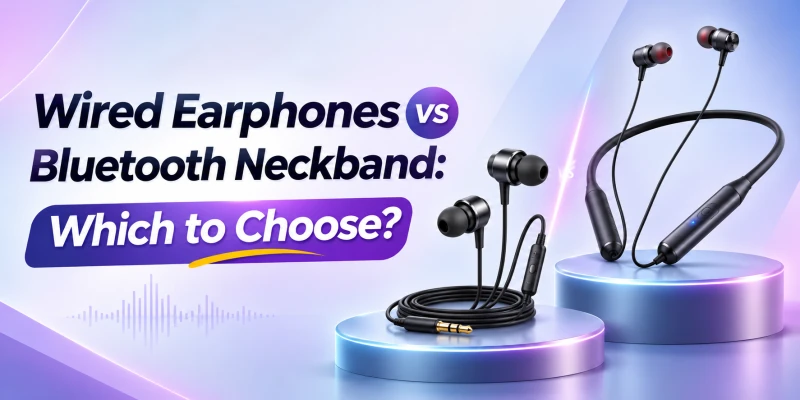
Wired earphones are better if you play competitive games, hate charging, want the most value for your money, or work mostly at a desk. Bluetooth neckband, on the other hand, is suited for you if you move a lot, take calls on the go, or your phone has no headphone jack. Wired has almost no delay. A neckband in gaming mode is fine for casual games and videos, but not for fast shooters. The sound quality difference is smaller than most people expect. Drivers, tuning and ear-tip fit count for more than the connection. Your phone's port and codec must support the neckbands.
Wired Earphones vs Bluetooth Neckband: Which Should You Choose?
With all the technological advances in the past couple of decades, wireless Bluetooth has been quite a blessing for humanity in all sorts of ways. But does that mean wired gadgets don’t belong in this modern era anymore? Not quite. Wired has its own advantages. In the consumer market, the wired earphones vs. Bluetooth neckband debate is still on. In this article, we try to explain the differences between these two technologies and provide you with the knowledge to make an informed buying decision.
What Is the Difference Between Wired Earphones and a Bluetooth Neckband?
The main difference is that wired earphones send sound through a copper cable, and the Bluetooth neckband sends it through the air and carries a battery around your neck.
How Wired Earphones Work
Your phone or laptop turns the digital file into an analog signal in its DAC (Digital-to-Analog Converter), amplifies it, and pushes it down the cable to the drivers in each earpiece. Nothing gets compressed on the way. There's no battery either, because the earphones run on the signal itself.
How a Bluetooth Neckband Works
The process starts with the neckband receiving a compressed digital stream over Bluetooth. It then decodes it and converts it to analog with its own DAC and amplifier. A short cable then feeds the converted audio to the earpieces. The band contains the battery, chip, antenna, microphones and controls. This is why it weighs more compared to TWS (True Wireless Stereo) earbuds.
Wired Connection vs Bluetooth Connection
A cable provides a fixed, dependable path that requires no pairing and is not as susceptible to connection drops. Bluetooth, on the other hand, gives you freedom to move around, but it adds compression, a little delay and requires a dedicated battery.
Feature
Wired Earphones
Bluetooth Neckband
Connection
3.5mm jack or USB-C
Bluetooth
Power
None needed
Built-in battery, needs charging
Sound path
No wireless compression
Compressed by SBC, AAC or similar codec
Latency
Almost none
Noticeable, lower in gaming mode
Microphone
Inline mic near the mouth
Mics in the band, helped by ENC
ANC
Rare
Common on mid-range models
Compatibility
Needs a jack or adapter
Works with any Bluetooth device that support compatible Bluetooth audio profiles
Price
Cheaper for the same sound
Costs more
Weak point
Cable and connector
Battery and charging port
Which Has Better Sound Quality?
The difference in sound quality between the two has decreased over the years. In theory, the wired earphones should provide better sound quality. However, modern Bluetooth neckbands do provide sound quality on par with wired. It depends quite a lot on the hardware. A good neckband will definitely outdo a bad wired earphone, though.
Wired Audio Signal
A cable passes the analog signal along with nothing between your device's DAC and the drivers. Your music files and streaming apps are already compressed, and they don’t have to go through a second round of compression through wired earphones.
Bluetooth Audio Compression
Bluetooth compresses audio with a codec such as SBC or AAC before sending it, which causes some data loss. In everyday listening, many people struggle to tell them from wired. Trained experts are able to hear some loss in fine detail, mostly on well-recorded acoustic tracks.
Driver Quality and Tuning
Drivers and tuning set the sound. A cheap wired pair with a tight 10 mm driver can beat a neckband with muddy bass. The connection type doesn't change that.
Codec, DAC and DSP
A wired pair depends on the DAC inside your phone or laptop, which is fine in most devices. A neckband carries its own DAC, amplifier and often a DSP for EQ and ANC. Its codec has to match your phone, so AAC suits an iPhone, while an Android phone may support something else. Our Audio Codecs Guide covers the codec basics.
Ear-Tip Fit and Seal
A good seal is really important. Bass falls apart the moment a tip leaks. Before you blame the earphones, try the other tip sizes in the box.
Which Has Lower Latency?
Wired, clearly. Simply because of data transmission physics. Wired earphones don’t need to compress data, whereas Bluetooth neckbands do. And doing so requires time that is quite noticeable.
Wired Earphones and Latency
An analog connection adds no noticeable delay. USB-C wired earphones add a digital step, but they stay low enough that you won't feel it.
Bluetooth Audio Delay
A Bluetooth link adds delay at every stage: encoding, transmission, buffering and decoding. With SBC or AAC, it often runs well past 100 milliseconds, which is long enough to notice when a sound should follow an action.
Gaming Mode and Low-Latency Bluetooth
Gaming mode reduces the buffer. The delay does decrease a bit but doesn't vanish. Also, a smaller buffer leaves less room to absorb a signal drop. Developers quote numbers that are far below the normal mode, so it’s best to treat those numbers as the best-case scenario.
Video vs Gaming Latency
Video apps measure the Bluetooth delay and try to synchronize the picture to the audio. But games can't do that, because your button press has to meet its sound in real time.
Which Is Better for Gaming?
Wired for anyone who plays to win. A neckband works for everyone else.
Competitive Gaming
In a shooter, footsteps are information. Hear them a tenth of a second late and the enemy is already in view. Wired earphones, including USB-C ones, deliver sound on time.
Casual Gaming
Puzzle, racing and story games forgive delay. A neckband with gaming mode handles them well, and being free of the phone is nice during a long Ludo session.
Microphone Quality
A wired inline mic sits near your mouth, so your voice comes through clearly. A neckband's mics sit around the collarbone and rely on ENC to clean things up. Both are fine for squad chat in a quiet room.
Comfort During Long Gaming Sessions
Wired earpieces are usually much lighter. A neckband adds weight on your neck, and you can feel it after a few hours of gaming. Wired has its own annoyance, though. The cable tugs on your ears when you move the phone around.
Which Is Better for Calls and Meetings?
Both are actually quite close in this case. The neckband might have the edge as it is more convenient.
Inline Microphone
The mic sits on the cable, about a hand's length from your mouth, so your voice stays loud against the background. Cheap ones pick up cable rubbing and button clicks, though.
Neckband Microphone Systems
Neckbands put the mics in the band or the pods. They are positioned farther from your mouth, unlike a wired earphone. As such, manufacturers lean on noise reduction to compensate for this. Quality differs widely from model to model.
ENC and Background Noise Reduction
ENC filters the noise your mic picks up, so the other person hears you and not the traffic. A neckband with ENC copes well on a busy road. One without it won't.
Multipoint Connectivity
Some neckbands can hold two connections at once. Wired earphones plug into one device at a time, and you need to swap by hand. Not every neckband has multipoint connectivity, so check the spec sheet before buying.
Work Calls and Meetings
For a day of meetings, I'd lean toward a neckband, since you can walk around while talking. I'd keep a cheap wired pair in the bag as the backup that never needs charging.
Which Is More Convenient for Everyday Use?
The neckband is definitely more convenient. You don’t have to fuss over tangled wires and whatnot.
Plug-and-Play Convenience
Wired is plug-and-play. It requires no pairing or updates. That reliability is hard to beat.
Wireless Freedom
A neckband lets you leave the phone on a table or in a bag and walk around. For housework or a quick stroll, this is the biggest daily difference.
Cable Management
Wired cables tangle and snag on pockets, bags and door handles. A neckband has a cable too, but it's short and hangs from the band, so it tangles far less.
Pairing and Reconnection
Pairing is a one-time chore, but reconnect glitches do happen. If a neckband refuses to reconnect, the reset steps in our TWS pairing issues guide are a good place to start.
Which Is Better for Gym, Running and Exercise?
Neckband for most people, with a few conditions.
Cable Movement
A long wired cable swings and tugs during squats and runs, and the rubbing travels up into your ears as noise. A neckband's cable is short and held in place by the band.
Secure Fit
The band shares the load, so a neckband stays put. It is so darn annoying when a wired earphone pops out when the cable catches on a bar or a sleeve. A shirt clip is quite handy in this case.
Sweat Resistance and IP Rating
IP rating is a rating system for water and dust resistance. A neckband with an IPX4 rating can handle splashes and sweat. IPX5 can survive water jets, and IPX7 may last even after a short immersion. Many wired earphones carry no rating at all. So they don’t have a standardized sweat- or water-resistance value. Sweat can seep into the connector and the mic on a wired earphone.
Freedom of Movement
No cable running to a phone on your arm, no pocket tug on the treadmill. For running, this is the neckband's biggest win.
Which Is Better for Travel and Commuting?
It depends on how long the trip is and whether you can charge.
Portability
Wired earphones fold into a tiny pouch. A neckband is bulkier, and the band doesn't collapse, so it takes up more space in your bag.
Battery Dependence
Wearing a dead neckband is just like wearing a necklace. It can’t do anything without a charged battery. A wired pair works as long as the phone does. On a long journey, a spare pair of wired earphones or a fully charged power bank can save the day if you wear neckbands.
ANC and Ambient Features
A neckband with ANC removes engine and traffic rumbles. Some have ambient mode, which lets you hear announcements. Most wired earphones have no ANC and rely on the seal of the ear tip.
Calls on the Move
Wind noise hurts both a wired earphone and a Bluetooth neckband. A neckband with ENC is better than a basic inline mic. Cupping a hand over the mic helps to reduce the noise for both.
Battery and Long-Term Reliability
No-Charge Advantage of Wired Earphones
Wired earphones don't have a battery to worry about. Pull them out of a drawer after a month, and they should still work fine.
Neckband Battery Life
Many neckbands last a day or more on a single charge. If you use ANC, then that also shortens the playtime. Manufacturers often quote hours with ANC on and off.
Fast Charging
Many neckbands give a few hours of playback from a 10-minute charge. It rescues the dead-battery morning.
Battery Degradation
Lithium battery capacity decreases over time. After a good number of charging cycles over the years, a neckband battery holds noticeably less charge. Our charging and storage guide explains how to slow that loss.
Cable and Charging Port Durability
The cable on a wired earphone usually degrades near the jack or the Y-split. In the case of a neckband, its weak spots are the charging port and the thin cable at each earpiece. A dead wired pair is cheaper to replace, though.
Which Is Better for Music, Movies and Videos?
Music Listening
For everyday playlists on a streaming app, a neckband is more than good enough, and the freedom outweighs the small quality gap.
High-Quality Music
Wired earbuds with a decent DAC are the better choice if you care about the subtle details in your music. Standard Bluetooth codecs compress the audio, and some details get lost in the process.
Movies and Dialogue
Both are fine for watching a movie. The ANC on a neckband helps you hear dialogue properly in a noisy environment, while wired earphones give clear dialogue with no battery worry on a long film.
Lip-Sync Delay
Most video apps compensate for Bluetooth delay by slowing down the picture and synchronizing it with the audio. If you see speech lagging behind lips in some app, try another app or switch on the neckband's low-latency mode. Some apps also have the option to manually delay or hasten the audio to sync with the video.
Long Listening Comfort
Comfort comes down to weight and tip fit. Wired is lighter than neckbands. Whichever you pick, keeping the volume moderate is better for your ears when listening for longer periods. Our hearing safety article explains all the safety concerns related to earwear.
Which Is Better for Office Work and Online Classes?
Calls and Meetings
When you’re working at your office desk or paying attention to an online class, a pair of wired earbuds with an inline mic is a cheap and dependable choice. But with a neckband, you get the freedom to walk and talk without having to move your device.
Laptop Compatibility
Most modern laptops have a single 3.5mm combo jack, a USB-C or a USB-A that connects to earphones with a mic. A few older ones have separate mic and headphone jacks, which requires a wire splitter. Neckbands can pair with any laptop that has Bluetooth connectivity. Though call audio over Bluetooth can sound worse than music on some laptops.
Multipoint Connectivity
Multipoint lets your neckband stay connected to a laptop and a phone simultaneously. It is quite useful when you have to juggle between two devices.
Long-Wearing Comfort
Light wired earpieces are easier to wear throughout a long day. A neckband's weight starts to wear you down after a few hours, especially in warm weather.
Affordability
Generally, a decent wired pair of earphones costs far less than a decent neckband. This is why students might opt to go for wired earphones.
Device Compatibility: Android, iPhone and Laptop
3.5mm Headphone Jack
Wired earphones plug straight into laptops and many budget phones. A lot of mid-range and flagship phones have dropped the jack.
USB-C Wired Earphones
Most USB-C earphones carry a digital signal, with the DAC in the earphone or the phone. Many work on Android and on iPhones with USB-C, but not every pair works with every phone. Some USB-C earphones carry analog signals which require the phone to have a DAC. So check before you buy.
Bluetooth Compatibility
A neckband works with anything that supports the Bluetooth audio profiles, which is true for almost every modern phone and laptop.
Connector and Adapter Requirements
A 3.5mm pair on a phone with no jack needs a USB-C to 3.5mm adapter. It's one more small thing to lose, and some cheap adapters pass sound but not the microphone.
Codec Support
Wired earphones don’t need codecs, but a neckband does. You need to use the right codec that your phone supports. AAC for iPhone, and check the supported list on Android. If the phone and neckband share no better codec, they fall back to the default SBC.
Does Bluetooth Version Matter?
A little, and less than the box implies. Our guide to which Bluetooth version is best for a neckband covers it in depth.
Bluetooth Version
5.3 or 5.4 is the sweet spot, and 5.0 is fine at a low price. Newer numbers like 6.x add little for a neckband today.
Codec Support
The codec is mostly responsible for the sound quality. The Bluetooth version doesn’t matter in this case. A 5.4 neckband stuck on SBC can sound worse than a 5.0 one with AAC on an iPhone.
Connection Stability
Connection strength and stability are dependent on the antenna design and chip quality. The Bluetooth version number has a small effect in such cases.
Latency
The Bluetooth version has very little to no effect in terms of latency. A good gaming mode and codec combo is what is required for optimal latency.
Advantages and Disadvantages of Wired Earphones and Bluetooth Neckbands
Form Factor
Advantages
Disadvantages
Wired Earphones
No battery, no charging
Almost no latency
Lower price for the same sound
Simple and reliable, with no pairing
Light on the ear and neck
Many phones have no headphone jack
Cables tangle, snag and wear out
Cable noise during movement
No ANC on most models
You're tied to the device
Bluetooth Neckband
Wireless freedom without losing a cable
Stay put during exercise
ANC, ENC, multipoint and an app on many models
Works with any Bluetooth device
Fast charging on many models
Needs charging, and the battery ages
Noticeable delay for fast games
Heavier at the neck and warmer in humid weather
Costs more than a wired pair with the same sound
Codec must match your phone for the best quality
Wired Earphones vs Bluetooth Neckband for Different Users
Gamers
Wired earphones are best for shooters or ranked matches. A neckband in gaming mode is enough for casual play.
Office Workers
A neckband will be convenient if you walk during calls. But if you sit at a laptop all day, wired earphones would be better.
Students
If you have budget restrictions, wired is a no-brainer. If not, then a neckband would be better just for the convenience.
Gym Users
A neckband with an IPX4 or higher rating. The short cable and secure fit beat any wired pair for movement.
Travelers
A neckband with ANC for the journey, plus a wired pair as a spare for when the battery dies.
Music Lovers
Wired earphones with a good DAC if sound detail is your priority. Otherwise a well-tuned neckband is close enough.
Heavy Callers
A neckband with ENC and multipoint, or a wired pair with a quality inline mic. Avoid either with a poor mic.
People Who Hate Charging
Wired, without any contest. It's the only option here that never asks for power.
Common Mistakes When Choosing
Assuming Wired Always Sounds Better
A bad wired pair loses to a good neckband. Drivers, tuning and fit decide the sound.
Assuming Bluetooth Always Has Noticeable Delay
For videos and music, you won't notice it. Delay only hurts in fast games.
Ignoring Device Compatibility
Buying wired earphones for a phone that has no jack, or a neckband with a codec that your phone doesn’t support, is a waste of your money.
Ignoring Battery Life
A neckband with a weak battery turns into a daily chore. Read the figure with ANC on.
Ignoring Cable Durability
Thin cables fray at the jack. Look for a reinforced connector and a tangle-resistant cable.
Ignoring Codec Support
The codec list is more useful than the Bluetooth version. Match it to your phone.
Choosing Features You Do Not Need
ANC, multipoint and a companion app are nice, but you pay for each. Skip the ones you won't use.
Ignoring Your Main Use Case
Pick for what you do most. A rare gaming night shouldn't decide a purchase you'll use daily for commuting.
Wired Earphones vs Bluetooth Neckband Buying Checklist
Check
What to look for
Phone port
A 3.5mm jack for wired, or a USB-C adapter if there's none
Main use
Gaming points to wired. Gym and commuting point to a neckband
Codec
AAC for iPhone. Match your phone's list on Android
Microphone
Inline mic quality for wired, ENC for a neckband
IP rating
IPX4 or higher for gym and running
Battery
Hours quoted with ANC on, plus fast charging
Cable
Reinforced connector, tangle-resistant design
Extras
Multipoint, gaming mode and an app only if you will use them
Warranty
Official warranty, with the box kept
Final Decision: Wired Earphones or Bluetooth Neckband?
Both wired earphones and Bluetooth neckbands are great in their own ways.
Our suggestion would be to buy wired earphones if you are a competitive gamer, or if you sit at a desk most of the time, or just hate charging stuff in general. They cost less, and they never run out of battery. You also don’t have to worry about delays.
If you walk, exercise, commute or take lots of calls every day, a Bluetooth neckband will suit you better. The freedom to move around is the whole point, and the sound quality is close enough that you won't miss the cable.
However, if budget isn’t an issue for you, then we’d suggest buying both. You can use the neckband for daily life and a cheap wired pair in the bag for gaming and the days the battery dies.
Shop neckbands at SMS Gadget
Are you looking to buy your first neckband or replace the older one? Then we got you covered. SMS Gadget features all the best and most popular neckbands available in Bangladesh. Examples include the OnePlus Bullets Z3, OnePlus Bullets Z2 ANC, Nothing Neckband Pro, Realme Buds Wireless 5 ANC, QCY BassBloom ANC N2, and Oraimo Necklace Lite. Visit the neckband category on our website and find whichever suits your budget and use case. SMS Gadget provides nationwide delivery and proper warranty documents for all the gadgets you require.
Frequently Asked Questions
Only in some ways. Wired wins on delay, price, and never needing a charge. A neckband wins on freedom, ANC and convenience.
Wired has a small edge in raw signal. Drivers, tuning and fit matter more, so a good neckband can beat a poor wired pair.
Wired earphones. A neckband in gaming mode narrows the gap but doesn't close it.
Wired for competitive games, and either for casual ones.
It's close. A neckband with ENC and multipoint is the more convenient pick, while a good inline mic gives clear voice in a quiet room.
A neckband with an IPX4 or higher rating. The short cable and stable fit make a real difference.
Slightly, in raw signal terms, since there's no wireless compression. Plenty of listeners can't tell in everyday use.
For music and video, no. In fast games, yes, though gaming mode helps.
A wired pair has no battery to age, but its cable wears out. A neckband's battery fades over a couple of years, though a careful owner can slow that.
Wired earphones give the most sound per taka. A neckband costs more but earns it with convenience.