
iPhone 17 Pro Max vs Samsung Galaxy S26 Ultra: Which One Is Worth Buying?
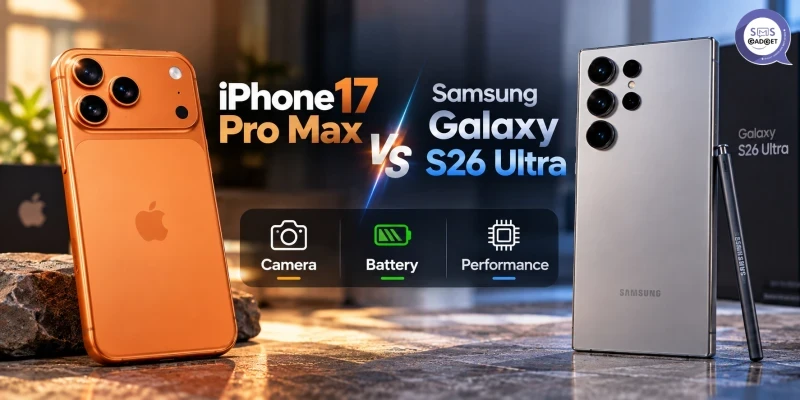
Both flagships are already sitting on store shelves. iPhone 17 Pro Max costs ৳154,999. Samsung Galaxy S26 Ultra costs ৳115,999. That's a big price gap. So which phone is really worth your money?
This isn't just another spec-sheet comparison. Both phones have been tested in real conditions, not just judged by spec sheets. And one thing stood out fast: Samsung's camera has way more megapixels, and its chip scores higher on benchmarks too. But here's the twist — real battery life turns out almost the same on both phones. Let's find out why.
Release Timeline and Price
Both phones landed in stores months apart, yet they're fighting for the same buyer's wallet today. Price and timing tell only half the story here.
Six Months Apart, But Still Direct Rivals
iPhone 17 Pro Max came out in September 2025. It costs ৳154,999. The Galaxy S26 Ultra launched later, in March 2026. It costs ৳115,999.
That's a big price difference. Almost ৳39,000 separates them. But wait. Samsung gives you something extra. The S Pen comes free with the Galaxy S26 Ultra. No need to buy a stylus separately.
Think about it this way. If you wanted a stylus anyway, that price gap shrinks fast. You're not just paying less. You're getting more for less.
Apple doesn't offer anything like this. No stylus. No bundle. Just the phone. So the real question isn't "which phone costs more." It's "which extra features actually matter to you." Six months apart in launch date, these two phones still compete for the same buyer today.
Full Spec Comparison Table
Here's a quick look at how these two phones stack up, side by side.
Design and Build
Weight and In-Hand Feel
Pick up the Galaxy S26 Ultra, and you'll feel it right away. It weighs just 214g. It's 7.9mm thick.
Now pick up the iPhone 17 Pro Max. It weighs 233g. It's 8.75mm thick. That's almost 20 grams heavier. Almost a full millimeter thicker too.
Doesn't sound like much, right? But hold either phone for an hour with one hand. Scroll through photos. Reply to messages. You'll notice the difference fast. Samsung wins here. Plain and simple. It's lighter. It's thinner. Your hand gets tired slower.
Materials and Durability
Both phones use aluminum frames. Both have glass backs. Both carry IP68 rating, so water and dust won't easily damage them. On paper, they're neck and neck.
But look closer at the glass itself. Apple uses something called Ceramic Shield. Samsung uses Gorilla Glass Armor 2. Both companies claim their glass resists drops well.
Here's the catch. These are marketing claims. Real drop tests, done by independent labs, tell a more honest story. Until we see solid third-party testing, treat both claims with a little caution.
The S Pen — Samsung's Clear Structural Advantage
Samsung packs in something Apple simply doesn't offer: a built-in stylus.
Want to jot down quick notes? Sketch an idea? Sign a document? Edit a screenshot? The S Pen handles all of it. The iPhone 17 Pro Max has no answer for this. None at all.
But don't call this a total win for Samsung. It's not that simple. Some people never touch a stylus. Others use it every single day. This isn't about which phone is "better". It's about which tool actually fits your life.
Display
Both screens look sharp, but they win in different ways. One packs in more detail. The other shines brighter under the sun.
Same Size, Different Resolution and Brightness Philosophy
Both phones use a 6.9-inch screen. Both run at 120Hz, so scrolling feels smooth.
Samsung's screen packs in more pixels 3120×1440, or 498 PPI. It's Dynamic AMOLED 2X, with 2,600 nits peak brightness. Apple's screen has fewer pixels 2868×1320, or 458 PPI. It's Super Retina XDR OLED, but it hits 3,000 nits at peak.
So who wins? Samsung packs in sharper detail. Apple shines brighter. Here's the honest truth. In daily use, you won't notice the pixel gap much. But step outside on a sunny day, and Apple's extra brightness actually helps you see the screen better.
Performance
Numbers on paper tell one story. Real-life speed tells another. Let's see how these two chips actually compare.
Benchmark Numbers
Samsung's Snapdragon 8 Elite Gen 5 scores around 11,407 on Geekbench multi-core test. Apple's A19 Pro scores lower, around 9,921. That's a real gap. Samsung looks faster on paper.
But hold on. Higher benchmark scores don't always mean a smoother phone in your hand. Why? Apple builds its own chip and its own software together. That tight fit often closes the gap you see in test numbers. So a big benchmark lead doesn't always feel like a big lead in daily use.
Sustained Performance and Gaming
Short tests don't tell the whole truth. A phone can score high for ten seconds, then slow down after ten minutes. This matters most during long gaming sessions. Heat builds up. Chips slow down to cool off. This is called thermal throttling.
Right now, solid third-party data on how each chip handles heat over time is still limited. Until more testing comes out, treat any big gaming performance claims with a little caution.
Camera Comparison
Cameras look simple on paper, but real photos tell a different story. Let's break down what actually matters here.
Megapixels vs Real-World Output — Set Expectations First
Samsung's main camera has 200MP. Apple's main camera has just 48MP. Sounds like Samsung wins by a mile, right?
Not so fast. More megapixels doesn't mean 4 times better photos. Sensor size matters. Processing matters. How the phone handles light and shadow matters even more. Raw pixel count alone won't tell you which phone takes better pictures.
Zoom and Telephoto
Both phones handle zoom well, just in different ways. Apple uses a tetraprism lens for 4x optical zoom. It can also crop the sensor to fake an 8x optical-quality shot. Samsung takes a different path. It uses a quad-camera system, with separate telephoto lenses built in.
This gives Samsung more flexibility. You get more focal length options to choose from. Apple, on the other hand, leans on smart software to stretch fewer physical lenses further.
Video Recording — Apple's Traditional Strength
Want to shoot serious video? Apple still holds the edge here. The iPhone supports ProRes RAW, a format professionals trust. Apple also has years of experience refining color science and stabilization. For video creators, the iPhone 17 Pro Max remains the safer pick, even against Samsung's newer hardware.
Battery Life — Where Real Testing Beats Spec Sheets
Spec sheets show one number. Real life shows another. Here's what actually happens when you use these phones all day.
The mAh Numbers Suggest a Bigger Gap Than Reality
Samsung packs a 5,000mAh battery. Apple's number is trickier. Some sources say 5,088mAh, others say 4,832mAh. Either way, the two phones sit close together on paper.
But paper numbers don't tell the full story. PhoneArena ran real battery tests on both phones. Browsing lasted about 7 hours 46 minutes on Apple, 7 hours 53 minutes on Samsung. Video playback ran about 20 hours 9 minutes versus 20 hours 10 minutes. Gaming lasted 9 hours 37 minutes versus 9 hours 54 minutes.
Look at those numbers again. They're almost identical. Most spec-sheet comparisons make it sound like Samsung wins battery life easily. Real testing says otherwise. This generation, it's basically a tie.
Charging Speed — A Clearer Samsung Advantage
Here's where Samsung actually pulls ahead. Its 60W charging gets you to 75% in about 30 minutes. Apple charges slower, maxing out at 40W. Reaching the same charge level takes noticeably longer.
Unlike battery life, this gap is real. And it favors Samsung, plain and simple.
Software and Ecosystem
Hardware isn't everything. How a phone runs day to day matters just as much. Here's how these two operating systems stack up.
iOS vs One UI — AI Features and Customization
Samsung pushes hard on built-in AI features. It also offers something called Privacy Display, which limits who can see your screen from an angle.
Apple takes a different route. It focuses on tight ecosystem connections. Think MagSafe, AirDrop, and Handoff working smoothly together. Apple also tends to offer longer, more consistent software updates over time.
Neither side wins outright here. It really comes down to what you value more: Samsung's flexibility and features, or Apple's simplicity and consistency.
Price and Value
Price alone doesn't tell you which phone is worth it. Let's look at what you're really getting for your money.
Storage Tier Comparison
At the same storage level, Samsung costs more. The iPhone 17 Pro Max sits at ৳154,999, while the Galaxy S26 Ultra runs close behind at ৳115,999. But Samsung isn't just charging more for nothing. It throws in the S Pen for free.
Think about it this way. If you were going to buy a stylus anyway, that price difference basically disappears. You're getting the S Pen built right in.
But if a stylus isn't something you'd ever use, Apple becomes the smarter buy. You get solid value without paying for a feature you'll never touch.
Which Should You Buy? — A Practical Decision Guide
Still not sure which one fits you? Let's break it down by what actually matters to you.
Choose the iPhone 17 Pro Max If —
You're already deep into Apple's world. Think MacBook, AirPods, iPad. Switching feels natural for you.
Video recording matters a lot to you. Apple's ProRes RAW and color science still lead the pack. If you want software that just works, without much fuss. Simpler day-to-day use appeals to you.
Or also like the way Apple's build materials feel in your hand. That premium touch counts for something. If any of this sounds like you, the iPhone 17 Pro Max, priced at ৳154,999, fits your needs well.
Choose the Galaxy S26 Ultra If —
You want the S Pen. Note-taking, sketching, signing documents — it all matters to you.
Charging speed matters too. You hate waiting around for your phone to fill up. A lighter, thinner phone feels better in your pocket and your hand. If you like customizing your phone deeply. Then Android gives you that freedom.
Sharper display detail catches your eye. Pixel density actually matters to you. If this sounds like you, the Galaxy S26 Ultra, priced at ৳115,999, makes more sense.
If Battery Life Is Your Main Concern
Here's something important. Don't let battery life decide this for you.
Real-world testing shows both phones perform almost the same. Browsing, video, gaming — the numbers stay close across the board.
The mAh figures on paper might suggest otherwise. But real testing tells a different story. Battery life simply isn't the deciding factor here anymore.
Final Verdict
No clear winner here, just two great phones with different strengths. Here's the honest final take.
Neither phone wins outright. Samsung leads on display sharpness, the S Pen, and faster charging. Apple leads on video quality, simpler software, and battery life that ties Samsung despite a smaller number on paper.
Don't let spec numbers alone decide this for you. Megapixels and mAh figures don't tell the whole truth. Real testing paints a fairer picture.
Priced at ৳154,999, the iPhone 17 Pro Max suits some buyers. At ৳115,999, the Galaxy S26 Ultra suits others. Check the buying guide above and pick based on what you actually need.
Frequently Asked Questions
Honestly, it's almost a tie. Real testing shows browsing, video, and gaming battery life staying close on both phones. Samsung's Galaxy S26 Ultra and Apple's iPhone 17 Pro Max both hold up well through a full day of normal use.
Not really, and not by 4 times better either. More megapixels doesn't automatically mean better photos. Sensor size and processing power matter more. Both phones take great photos, just with different strengths.
The Galaxy S26 Ultra wins here, no question. It charges at 60W, reaching about 75% in just 30 minutes. The iPhone 17 Pro Max charges slower at 40W, taking noticeably longer to hit the same level.
No, it doesn't. Apple has no built-in stylus option to match Samsung's S Pen. If stylus support matters to you, the Galaxy S26 Ultra, at ৳115,999, is your only choice between these two.
The iPhone 17 Pro Max still holds the edge. It supports ProRes RAW, a format serious video creators trust. Apple's years of experience with color science and stabilization keep it ahead of Samsung in this area.